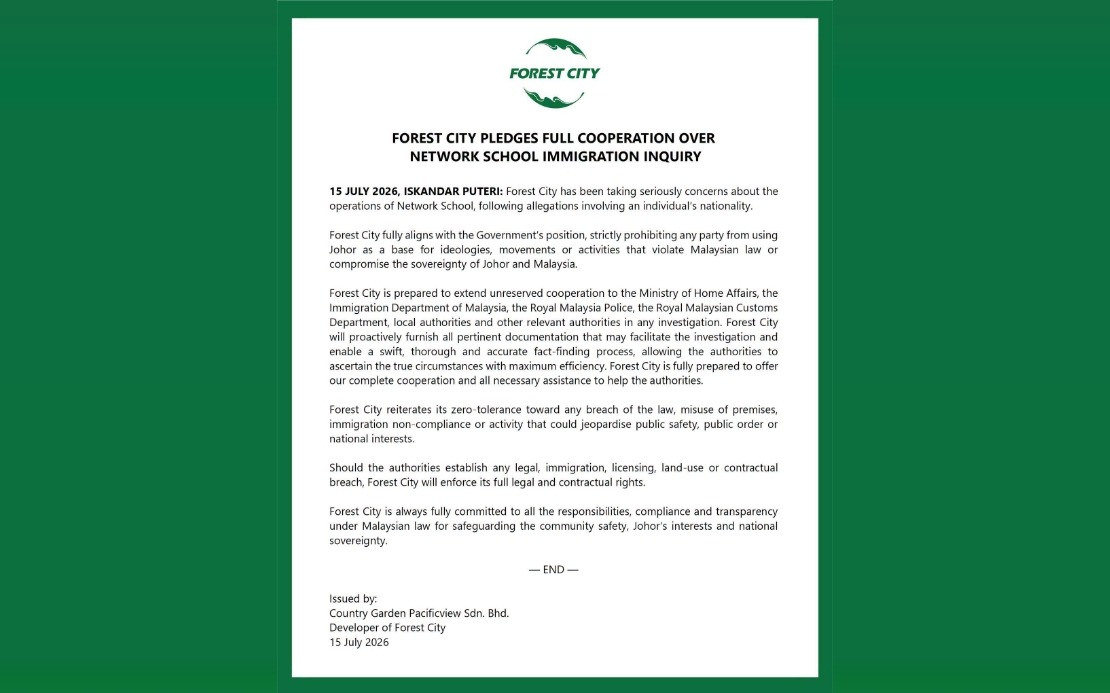
Country Garden Pacificview Sdn Bhd, the developer behind the sprawling Forest City development in Johor Bahru, has committed to providing unrestricted assistance to government agencies investigating allegations surrounding the Network School and its connection to Israeli citizens. The statement represents an immediate and comprehensive response to mounting scrutiny of activities within the mixed-use township, signalling the company's intent to distance itself from any controversial operations that may have occurred on its premises.
The developer's pledge encompasses cooperation with a broad coalition of enforcement agencies, including the Home Ministry (KDN), Immigration Department (JIM), Royal Malaysia Police, Royal Malaysian Customs Department, and municipal authorities. This multi-agency approach reflects the seriousness with which the government views the matter, treating it not merely as an administrative irregularity but as a potential breach of national security and sovereignty concerns. The comprehensive list of potential collaborators indicates the interconnected nature of modern regulatory oversight, where immigration, customs, public safety, and local governance all converge on a single incident.
Country Garden Pacificview emphasised its commitment to submitting all documentation and records deemed necessary by investigating authorities, aiming to accelerate the fact-finding process and ensure that conclusions rest on accurate, thorough evidence. This proactive disclosure stance differs sharply from defensive corporate posturing and suggests confidence in the legitimacy of the developer's position, or at minimum, a determination to avoid further reputational damage. For a major real estate enterprise with significant ongoing investments in Malaysia, regulatory goodwill carries substantial economic weight.
The developer has articulated an explicit zero-tolerance philosophy toward premises abuse, immigration law violations, and activities endangering public order or safety. This principled stance addresses wider concerns about how commercial developments in Malaysia are managed and monitored, particularly mixed-use townships that blend residential, commercial, and educational facilities. The statement effectively positions Forest City as a victim of potential tenant misconduct rather than a willing participant, though the investigation will ultimately determine whether such claims are substantiated.
Johor Menteri Besar Datuk Onn Hafiz Ghazi initiated the escalation by requesting formal investigation, citing allegations that individuals had attended Network School using fraudulently obtained second-country passports to circumvent immigration screening. This technique—utilising alternative documentation to mask national origin—represents precisely the kind of sophisticated circumvention that immigration authorities find most concerning, as it suggests deliberate deception rather than administrative oversight. The political pressure from state leadership elevated what might otherwise have remained a compliance matter into a full law enforcement inquiry.
The Immigration Department's subsequent inspection of 266 foreign nationals across 40 countries resident in Forest City revealed that all individuals possessed valid immigration documentation upon initial examination. This broad sweep, conducted with apparent urgency, found no immediate violations, yet officials cautiously noted that deeper investigations remain ongoing. The distinction between preliminary clearance and comprehensive investigation is critical—initial document validation represents only the first checkpoint in uncovering potential fraud involving forged credentials or identity misrepresentation.
The Network School allegations touch on broader sensitivities surrounding Israel's position in Malaysian politics and society. Malaysia maintains no diplomatic relations with Israel and constitutionally backs Palestinian causes, creating a domestic environment where any Israeli presence attracts intense scrutiny. Public perception of Forest City potentially serving as a hub for Israeli educational activities would provoke significant backlash, regardless of technical legality, explaining the swift political and administrative response to initial allegations.
For Malaysian real estate developers generally, the Forest City incident underscores mounting expectations for tenant vetting and premises monitoring. Large-scale developments, particularly those hosting international residents and programmes, now face implicit pressure to conduct due diligence comparable to that of government agencies. The reputational risks of unwitting complicity in unauthorised activities have risen substantially, making proactive cooperation and transparency essential business strategies rather than merely courteous gestures.
The involvement of multiple government agencies reflects institutional complexity in Malaysian law enforcement. Immigration violations fall under JIM's purview, but border security implications engage the Home Ministry, while public order concerns involve police, and commercial premises compliance involves local municipal governments. Coordinating investigations across these bodies demands clear communication and shared intelligence, yet agencies sometimes operate with overlapping mandates and distinct priorities, potentially fragmenting investigative efforts.
For Southeast Asian observers, the Forest City case illustrates how global mobility, educational entrepreneurship, and geopolitical sensitivities intersect in rapidly developing commercial zones. Mixed-use townships attracting international clientele inevitably encounter tensions between openness to global investment and commitment to national security principles. As Malaysia continues developing integrated communities with international dimensions, balancing these competing imperatives will remain an ongoing governance challenge.

