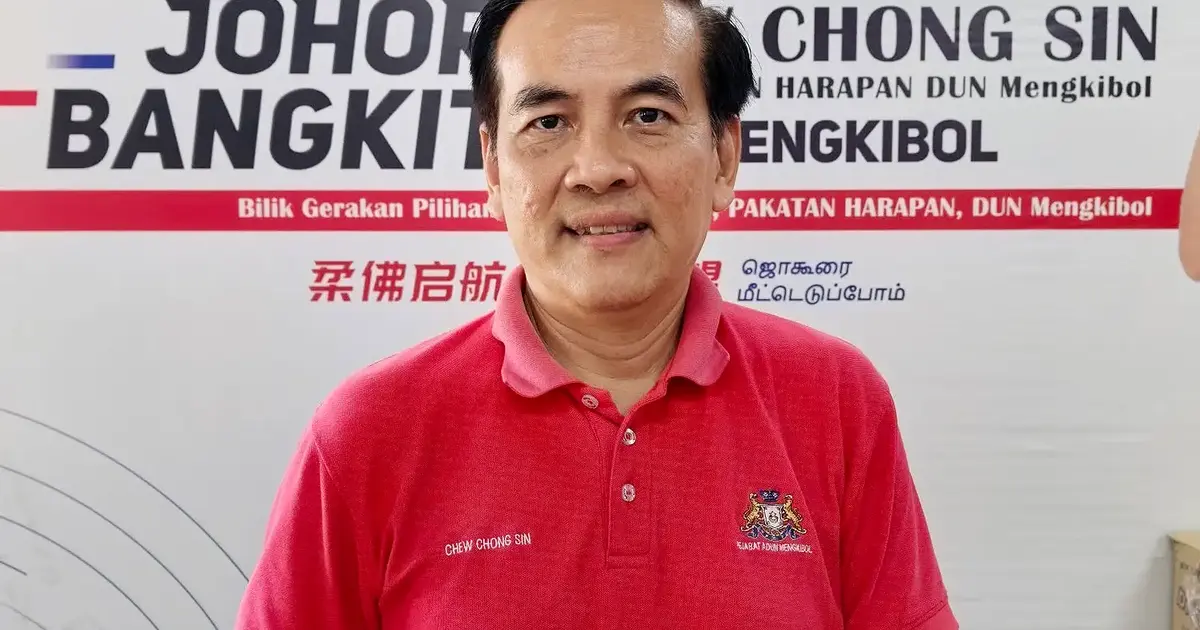
Former DAP representative Chew Chong Sin has opened a new front in Malaysian political debate by publicly alleging that Barisan Nasional and Perikatan Nasional have orchestrated an unspoken arrangement to jointly administer Johor state. The assertion carries significant weight given Chew's insider position within the opposition camp and his familiarity with the tactical calculations that drive coalition politics at state level across the country.
Chew's contention rests on the premise that such a unity administration would fundamentally reshape the ideological character of Johor's governance. By combining the traditional establishment coalition represented by BN with the Islamist-oriented politics of PN, the resultant configuration would presumably tilt towards more conservative policy frameworks across multiple domains. This characterisation reflects growing anxiety within DAP circles about the trajectory of Malaysian politics and the potential exclusion of the reform-oriented opposition from meaningful power-sharing arrangements.
The allegation gains contextual relevance when viewed against the broader pattern of coalition realignments that have defined Malaysian electoral politics since 2018. The strategic flexibility demonstrated by both BN and PN—formerly implacable rivals before their tactical cooperation in the 2023 general election—suggests that post-election negotiations focused on state-level administration could indeed involve undisclosed understandings. Such arrangements, while technically legal, operate in a grey zone where implicit agreements avoid the transparency expected of formal coalition documents.
For Johor specifically, the implications of BN-PN collaboration would extend beyond symbolic political geometry. The state has historically served as a testing ground for policy innovations and conservative governance models that later diffuse across Malaysia's federal landscape. If a combined BN-PN administration were to consolidate control, the policy environment could shift noticeably on social issues, religious affairs, and the relationship between secular and Islamic governance frameworks.
Chew's intervention reflects DAP's defensive posture following the 2023 general election outcome, which substantially diminished the party's parliamentary presence and raised existential questions about its electoral viability. The party's inability to secure stronger representation in key states, particularly in the east coast and among Muslim-majority constituencies, has forced a strategic recalibration. By publicly articulating concerns about BN-PN coordination, DAP seeks to reframe the political narrative and position itself as the primary guardian against conservative governance consolidation.
The allegations also illuminate the persistent fragmentation within Malaysia's opposition ecosystem. Despite occupying the same anti-government space, PKR, DAP, and other opposition parties often operate as competing power centres rather than cohesive units. This fragmentation creates strategic vulnerabilities, allowing the governing coalitions to exploit divisions and secure advantageous positions in state-level bargaining. Johor, as the second-largest state economy and a politically significant entity, naturally becomes a focal point for such maneuvering.
From the perspective of ordinary Johorean voters, the substantive question involves what concrete policy differences a BN-PN joint administration would produce compared to alternatives. Chew's warning about conservative policies requires specification—whether this encompasses Islamic governance expansion, gender-related policy restrictions, media freedom considerations, or economic policy orientations. The vagueness inherent in such allegations limits their persuasive impact on swing voters who prioritise economic management and service delivery over coalition composition.
The timing of Chew's claims also merits attention. Whether articulated immediately following power-sharing negotiations or months into an existing administration, the strategic intent differs substantially. Early disclosure suggests an attempt to mobilise opposition constituencies against the arrangement before it becomes entrenched, while delayed revelation might indicate a rearguard action by a marginalised political actor seeking relevance.
Historically, Malaysian politics has featured numerous instances of tacit understandings between ostensible rivals. The convention of not aggressively campaigning against coalition partners even when they contest the same seat, mutual recognition of territorial constituencies, and coordinated positioning on federal issues all constitute implicit agreements that operate outside formal documents. That similar patterns would emerge at state level represents neither novelty nor surprising deviation from established practice.
For DAP specifically, the challenge involves translating coalition anxiety into constructive political positioning. Merely highlighting alleged BN-PN coordination risks appearing obstructionist unless accompanied by compelling alternative governance visions. The party must articulate its own state-level agenda with sufficient clarity that Johorean voters perceive meaningful differences rather than simply different competing elite groups.
The broader implication extends to Malaysian democratic health and governance transparency. If significant political arrangements routinely operate through tacit understanding rather than public disclosure, citizens lose the opportunity to evaluate governing coalitions on explicit policy platforms. This information asymmetry advantages those already positioned within power structures while disadvantaging would-be challengers dependent on voter support.
Moving forward, Chew's allegations will likely persist as a rhetorical device within opposition campaigns, though their concrete electoral impact remains uncertain. Whether they catalyse genuine anti-BN-PN sentiment or fade as background noise in the political cycle depends substantially on how effectively opposition forces translate such concerns into compelling alternative platforms that resonate with Johorean voters' material interests and aspirations.

