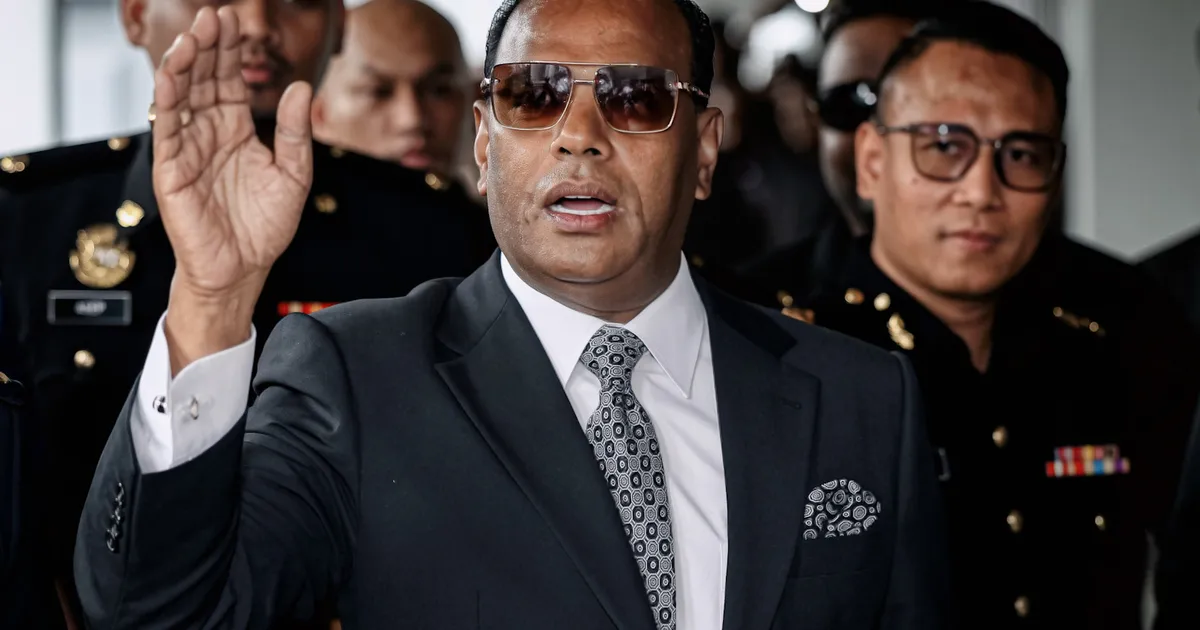
In a statement addressing mounting speculation over his communications with the Prime Minister, former Human Resources Minister Saravanan has moved to clarify the nature and intent of his correspondence with Anwar Ibrahim, emphasizing that he sought nothing more than a fair and complete examination of his legal predicament rather than any form of political intervention or concealment. The clarification comes as questions swirl around the ex-minister's bribery charges, which he continues to contest as fundamentally without merit.
Saravanan's letter to Anwar Ibrahim, according to the former minister's own account, was directed toward securing a thorough investigative review of the allegations levelled against him. He maintains that the charges he faces carry no legitimate basis and that a rigorous examination of the evidence would demonstrate his innocence. This positioning represents his attempt to distinguish between seeking institutional fairness—which he characterizes as his rightful entitlement—and pursuing clandestine attempts to evade accountability, the latter being a charge of considerable political sensitivity in Malaysia's current anti-corruption climate.
The distinction Saravanan draws is significant within Malaysia's broader governance landscape. Under Anwar Ibrahim's administration, commitments to combating corruption have been positioned as central to the government's legitimacy and reform agenda. Any perception that senior officials might leverage their proximity to the Prime Minister to circumvent proper legal procedures would represent a substantial contradiction of these publicly articulated values and could undermine public confidence in institutional impartiality.
Saravanan's insistence that his approach was procedurally proper rather than preferentially motivated reflects a common defensive posture adopted by politicians facing graft allegations in Southeast Asia. The argument essentially contends that requesting high-level attention to one's case constitutes an appeal for correctness rather than an appeal for favoritism. However, the line between seeking thorough review and seeking intervention often blurs in practice, particularly when such requests flow from individuals with established political relationships to decision-makers.
The former minister's charges relate to allegations of soliciting bribes during his tenure in the Human Resources portfolio, a ministry that oversees civil service management and has significant leverage over numerous government contracts and appointments. Such positions typically attract scrutiny from anti-corruption authorities precisely because of the scope for potential malfeasance and the scale of public resources that fall within their purview. Saravanan's rejection of these charges therefore carries implications beyond his individual circumstances.
For Malaysian observers, Saravanan's case has arrived at a moment when the country's anti-corruption institutions face questions about their independence and consistency. The Malay Mail previously reported on Saravanan's letter to Anwar Ibrahim, generating public discourse about whether such appeals represent appropriate channels for addressing legal grievances or whether they exemplify the persistence of informal power dynamics in Malaysian politics. Saravanan's current statement represents an attempt to reframe that narrative.
The timing of Saravanan's clarification also matters. Political fortunes in Malaysia often turn partly on perceptions of vulnerability and strength. A former minister appearing to reach toward the Prime Minister for assistance might signal desperation or impropriety to segments of the public, whereas framing the same action as a legitimate request for institutional fairness projects a different impression. Saravanan's statement thus functions as an exercise in political communication as much as legal defense.
Saravanan's assertion that the corruption allegations lack credibility places him in a category of numerous Malaysian political figures who have contested graft charges during recent years. The outcomes of such cases have been mixed, with some resulting in acquittals, others in convictions, and still others languishing in the courts for extended periods. Public perception of these cases often hinges on factors extending beyond evidence: political alignment, media coverage, and the apparent independence of the judiciary all influence how Malaysians evaluate such proceedings.
The role of the Prime Minister's office in such matters remains constitutionally circumscribed. While Anwar Ibrahim possesses certain powers relating to the exercise of judicial functions, his ability to intervene directly in ongoing cases is limited by law and constitutional convention. Saravanan's framing of his request as seeking a review rather than seeking dismissal may represent an attempt to position his letter within legally defensible boundaries, distinguishing it from requests that would clearly transgress institutional norms.
For Malaysian civil service politics specifically, the situation carries additional dimensions. The Human Resources Ministry oversees career progression, disciplinary matters, and administrative processes affecting hundreds of thousands of government employees. Questions about whether ministries of this significance become repositories of corrupt practices carry implications for broader governance quality. Saravanan's case, therefore, functions partly as a referendum on whether Malaysia's institutions can credibly address high-level misconduct allegations.
The international dimension should not be overlooked. Malaysia's standing in global governance indices has improved under Anwar Ibrahim's administration, partly reflecting perceptions of heightened institutional accountability compared to his predecessor's tenure. Cases involving prominent figures and questions about potential political intervention attract attention from international observers monitoring Malaysia's governance trajectory. Saravanan's case thus resonates beyond domestic political circles.
Moving forward, the legal proceedings against Saravanan will likely continue their conventional course through Malaysia's judicial system. His clarification statement, however, has served to establish a public record of his position: that he sought fair examination rather than favorable treatment. Whether this distinction ultimately proves decisive either legally or politically remains to be seen as investigations and court proceedings advance.

