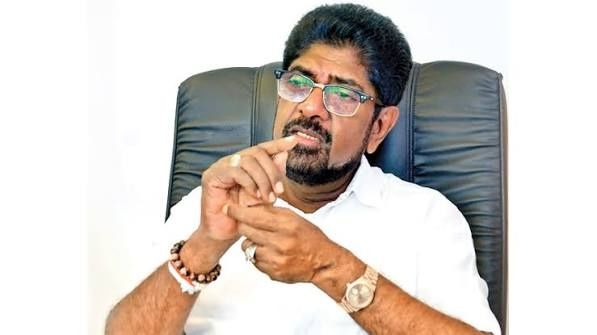
A former Sri Lankan government minister was taken into custody on Tuesday over accusations that he facilitated the removal of a historically significant carved stone from a royal palace, according to the country's anti-corruption watchdog. Keheliya Rambukwella, who held ministerial rank at the time of the alleged offence, stands accused of conspiring in the December 2022 theft of the moonstone, an elaborate granite artefact that once formed part of the ornamental entrance to the palace of Veera Parakrama Narendrasinghe, Sri Lanka's last Sinhala king who ruled until 1739.
The Commission to Investigate Allegations of Bribery or Corruption identified the moonstone as a valuable cultural object of considerable weight and symbolic importance. The stepping stone arrangement of which it was a component represented a significant feature of the royal residence's architectural heritage. Beyond the theft itself, the anti-corruption body determined that Rambukwella had actively worked to hinder the police investigation that followed the artefact's disappearance, compounding his culpability in the matter.
Rambukwella's detention represents a broadening pattern of accountability measures being applied to political figures in Sri Lanka. The charges against him extend beyond the moonstone case, reflecting a wider examination of conduct within government circles. Investigators have separately charged him with misappropriating public funds to finance private employment arrangements, allegedly deploying state resources to hire six individuals for personal business ventures unrelated to his official duties.
The former minister's legal difficulties have accumulated significantly over recent months. Parallel proceedings against him in court centre on his role as health minister in purchasing pharmaceutical products that proved to be counterfeit. Most notably, police submitted evidence to the judiciary that Rambukwella authorised the acquisition of a critical cancer therapeutic agent that laboratory testing revealed to be merely water—a substitution of particularly grave consequence given the life-or-death implications for patients depending on legitimate medication.
This pharmaceutical scandal occurred within a specific and damaging context for Sri Lanka's healthcare infrastructure. When Rambukwella served as health minister, the nation faced severe shortages of essential medicines following a catastrophic debt crisis that forced the government to default on approximately $46 billion in foreign obligations in April 2022. The country had formally declared bankruptcy, creating an acute shortage of foreign currency needed to import pharmaceuticals and medical supplies. Against this backdrop of systemic scarcity, the substitution of water for cancer medication represented a particularly severe betrayal of public trust.
The drug procurement scandal has ensnared multiple officials beyond Rambukwella. Several additional senior-ranking bureaucrats within the health ministry have been formally charged in connection with the counterfeit pharmaceutical scheme, suggesting an institutional problem rather than isolated misconduct. The breadth of the indictments indicates that the fraudulent transaction involved multiple levels of the ministry's operations, from authorisation through acquisition and distribution.
For Malaysian observers, the Rambukwella case offers instructive parallels regarding corruption in post-crisis environments. Sri Lanka's financial collapse and subsequent restructuring created conditions where procurement integrity eroded significantly, mirroring dynamics that emerge when institutions face extreme resource constraints. The case demonstrates how economic emergencies can create vulnerabilities that officials exploit, particularly when accountability mechanisms weaken during periods of governmental crisis management.
The moonstone theft itself carries cultural and symbolic dimensions that extend beyond mere property crime. Archaeological and heritage preservation professionals across South Asia have expressed concern about the fate of historical artefacts during periods of political instability and financial distress. Sri Lanka's heritage tourism sector, which depends substantially on preserved monuments and historical sites, faces reputational damage when government officials are implicated in cultural theft. The recovery and proper restoration of such objects becomes more challenging once they enter black markets or private collections, rendering them inaccessible to scholars and public education.
The anti-corruption commission's aggressive pursuit of these cases signals a shift in enforcement priorities within Sri Lanka's political system. Whether this represents sustained institutional commitment or cyclical attention to high-profile figures remains uncertain. The accumulation of charges—ranging from cultural property theft through pharmaceutical fraud to financial misappropriation—suggests either a particularly corrupt individual or a systematic examination of one politician's conduct across multiple government portfolios. Either interpretation raises questions about oversight mechanisms across different departments during periods when Rambukwella held office.
For the broader Southeast Asian region, these developments underscore ongoing tensions between institutional accountability and political patronage networks. Sri Lanka's trajectory since 2022 has involved substantial governance reforms, yet implementation remains uneven. The Rambukwella prosecutions will provide a test case for whether anti-corruption bodies can sustain independence and prosecute figures from different political factions with consistency. Success or failure in these high-visibility cases will shape public confidence in institutional capacity to address elite misconduct across the island nation and potentially influence governance expectations throughout the region.

