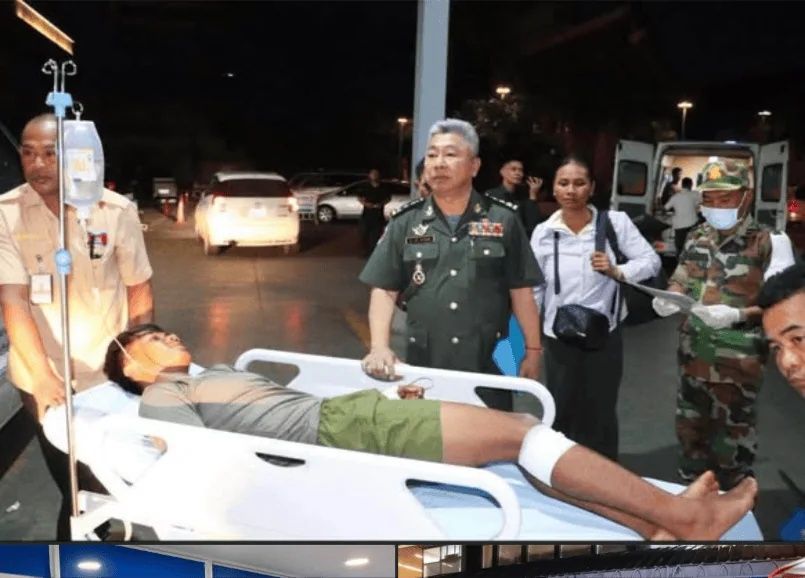
Four Cambodian military personnel sustained injuries after an explosive device detonated along the kingdom's shared frontier with Thailand, officials announced Monday. The incident unfolded during a routine border patrol operation on Sunday afternoon in the cashew plantation districts of Chouk Kruos and Thma Don villages within Oddar Meanchey province, one of Cambodia's most strategically sensitive zones adjacent to Thailand's eastern flank.
Lieutenant General Maly Socheata, an undersecretary of state and official spokesperson for Cambodia's Ministry of National Defence, confirmed the incident occurred at 12:35 p.m. local time. The blast struck the Cambodian soldiers as they conducted their designated patrol duties in the plantation area, a terrain historically prone to unexploded ordnance and illicit weapons caches from previous regional conflicts. Socheata indicated that medical personnel have been providing continuous care to the wounded servicemen, though specific details regarding the severity of their injuries were not disclosed.
The Cambodia-Thailand border, stretching across some 800 kilometres, has remained a flashpoint for occasional military incidents and territorial disputes despite decades of diplomatic efforts to stabilize the relationship between the two neighbours. Oddar Meanchey province, where Sunday's explosion occurred, lies in Cambodia's northwestern region and has experienced periodic tensions along its demarcation line with Thailand. The exact circumstances surrounding how the explosive device came to be positioned in the area remain unclear, though such incidents often stem from accumulated ordnance deposited during the region's turbulent past.
Thailand's military response came swiftly, with Royal Thai Army spokesperson Winthai Suvaree issuing a formal statement on Sunday evening. According to the Thai account, troops conducting routine patrols on the Thai side of the border detected the explosion emanating from the Cambodian territory. The statement represented a standard defensive posture by Bangkok, emphasizing that Thai forces made no offensive moves at the time of the incident.
The Royal Thai Army explicitly stated that its personnel did not discharge any weapons or deploy explosives in connection with the blast. A subsequent investigation by responsible Thai units examined the incident's origins and concluded that the explosion occurred definitively on Cambodian soil and could not be attributed to Thai military action. This clarification sought to preempt potential accusations and maintain diplomatic equilibrium between the two nations, which have experienced friction over border demarcation and military movements in previous years.
The incident arrives amid ongoing sensitivities between Cambodia and Thailand regarding their disputed frontier. While formal relations between Phnom Penh and Bangkok have generally remained stable in recent years, occasional military skirmishes and accusations of border violations continue to punctuate their relationship. The two countries have worked through various bilateral mechanisms and ASEAN frameworks to manage tensions, though fundamental disputes over certain territorial areas persist.
For Malaysia and other Southeast Asian nations, such border incidents underscore the regional challenges surrounding demarcation and military coordination in areas with complex historical legacies. The Cambodia-Thailand situation reflects broader Southeast Asian patterns where Cold War-era conflicts left behind physical remnants that continue threatening civilian and military personnel. Unexploded ordnance from previous wars remains buried across Cambodia, Laos, and Vietnam, creating persistent hazards for those operating in rural and frontier zones.
The treatment of this incident by both Cambodian and Thai authorities demonstrated diplomatic restraint, with neither party escalating rhetoric or accusations. Cambodia's Ministry of National Defence focused messaging on soldier welfare rather than attributing blame, while Thailand's military preemptively clarified its non-involvement. This measured response reflects the mature security dialogue that ASEAN countries have cultivated, contrasting with historical patterns of rapid militarization following border incidents.
For military planners across Southeast Asia, the Oddar Meanchey incident serves as a reminder that border operations require meticulous coordination, mine-clearing capacity, and robust communication channels between neighbouring forces. Cambodia's security establishment must balance patrol operations with the reality that certain areas remain contaminated by historical ordnance. Regional armies continue investing in demining capabilities and explosive ordnance disposal expertise to address these persistent threats.
The incident also highlights why ASEAN nations maintain interest in maintaining stable relationships with military neighbours despite occasional friction. Both Cambodia and Thailand have economic and security interests in border stability, making diplomatic restraint preferable to confrontation. As regional military modernization accelerates across Southeast Asia, established protocols for incident reporting and investigation—exemplified by the Thai and Cambodian responses—help prevent minor incidents from escalating into larger crises that could destabilize the broader region.
Looking forward, the wounded soldiers' recovery will likely proceed without significant diplomatic fallout, assuming no further developments emerge. However, the explosion underscores Cambodia's ongoing struggle with unexploded ordnance management and the resource demands of frontier security in zones where remnants of conflict continue posing dangers. Regional cooperation on demining efforts and ordnance disposal could emerge as a valuable avenue for expanding ASEAN military-to-military engagement beyond traditional training and exercise partnerships.

