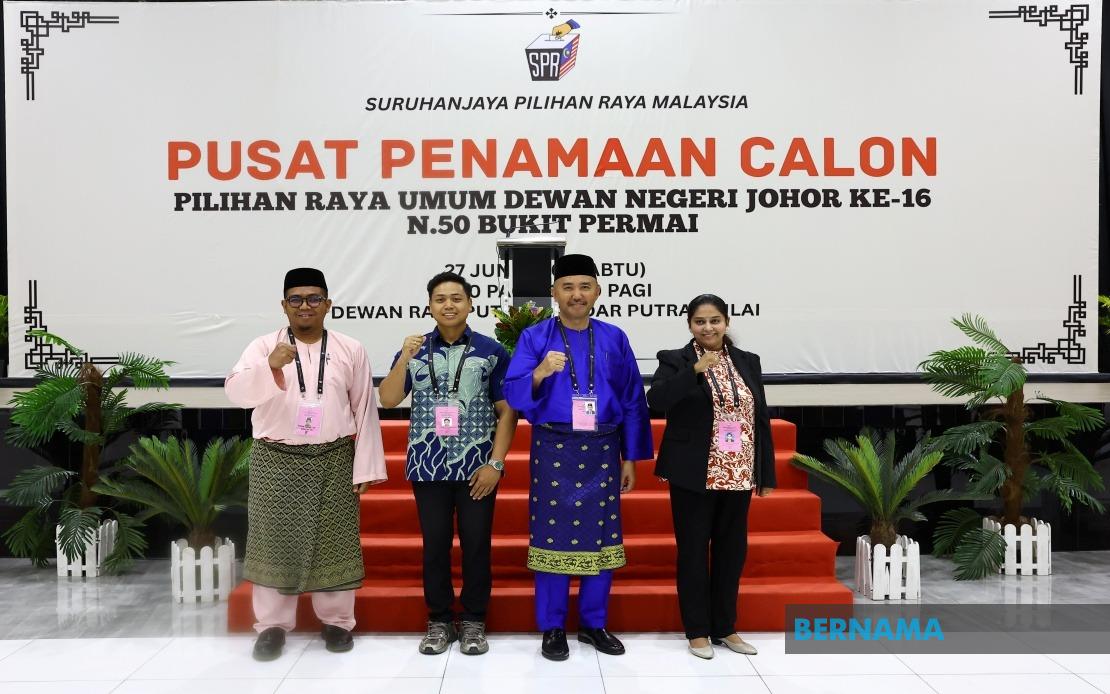
The political contest in Bukit Permai is shaping up as a closely-watched battle in the 16th Johor state election, with incumbent assemblyman Datuk Mohd Jafni Md Shukor of Barisan Nasional now facing opposition from three separate challengers. Nomination papers were officially closed on June 27 at the Dewan Raya Putra nomination centre in Bandar Putra, with returning officer Afzan Azhari confirming the final slate of candidates contesting the Batu Pahat-based seat.
Mohd Jafni's primary challenger comes from Pakatan Harapan in the form of Mohamad Shafwan Ani, who arrived at the nomination centre accompanied by Johor DAP chairman Teo Nie Ching. The presence of a senior DAP figure underscores the coalition's commitment to competing strongly in this particular constituency, suggesting that PH views Bukit Permai as a winnable seat despite the incumbent's previous victory. Perikatan Nasional has fielded M. Lina Manoh as its representative, whilst Parti Bersama Malaysia—a newer entrant in Malaysia's electoral landscape—is contesting through Muhammad Aidil Riduan Mohd Yusof.
The four-way contest marks continuity with the 2022 state election dynamics in this constituency. When Johor voters last went to the polls two years ago, Mohd Jafni secured victory with a comfortable majority of 4,755 votes, also in a four-cornered fight. However, the intervening period has seen significant political realignments across Malaysia's political landscape, and the personal vote that carried him to victory previously may now face sharper scrutiny from better-organised opposition campaigns.
The decision by PH to mount a visible campaign in Bukit Permai reflects broader strategic calculations about which seats offer realistic opportunities for gaining ground in Johor. The state has historically been a BN stronghold, but the coalition has made targeted efforts to improve its performance in selected constituencies where demographic trends or local grievances might favour the opposition. The participation of Teo Nie Ching, a prominent national DAP figure and former Member of Parliament, signals that the coalition is investing resources and political capital into the contest.
Perikatan Nasional's presence in the race introduces another dimension to the electoral dynamics. The coalition, which has consolidated support among certain voter segments in Malaysia, continues to test its appeal across various state-level contests. Whether PN can consolidate alternative-vote support or whether its candidacy primarily fragments opposition votes remains an open question that could influence the final outcome.
The emergence of Parti Bersama Malaysia as a contesting force is worth noting within the broader context of Malaysia's political evolution. The party's decision to field candidates in state elections represents an effort to establish grassroots presence and demonstrate electoral viability at the state level, even if national-level recognition remains limited. For voters in Bukit Permai, the presence of a fourth candidate offers a genuine choice beyond the traditional BN and established opposition blocs.
The timeline for the election process has been formally established by the Election Commission. Early voting is scheduled for July 7, providing opportunities for voters such as government employees, security personnel, and others with legitimate reasons to cast ballots before the main polling day. The principal election day is set for July 11, giving campaigners roughly two weeks from the close of nominations to make their appeals to constituents.
For Mohd Jafni, defending the seat will require mobilising the vote base that supported him in 2022 whilst demonstrating responsiveness to any emerging local concerns that might have developed since the previous election. A majority of 4,755 votes provides a cushion, but in a four-cornered contest, vote distribution across multiple candidates rather than concentration of opposition support can significantly influence outcomes. The incumbent's position as a sitting assemblyman carrying the BN machinery typically confers organisational advantages, yet these can be offset by voter appetite for change or dissatisfaction with specific policies.
The Bukit Permai contest will serve as one of numerous bellwethers for understanding voter sentiment in Johor ahead of the 16th state election. The diverse range of candidates and political affiliations contesting the seat reflects broader patterns of political competition visible across Malaysia, where the traditional two-sided contest has been complicated by the emergence of newer coalitions and parties. The results in this particular constituency will contribute to the overall picture of whether BN can consolidate control in Johor or whether opposition groups can make meaningful gains in what has long been considered a government stronghold.
The coming fortnight of campaigning will see candidates attempting to articulate their positions on local issues ranging from infrastructure development and service delivery to broader state and national policy questions. Voters in Bukit Permai will ultimately decide whether to return the incumbent or entrust representation to one of his challengers. The outcome will not merely determine who occupies the state assembly seat but will also provide insight into the broader political currents flowing through Johor as the state navigates questions of governance and representation in an evolving political environment.

