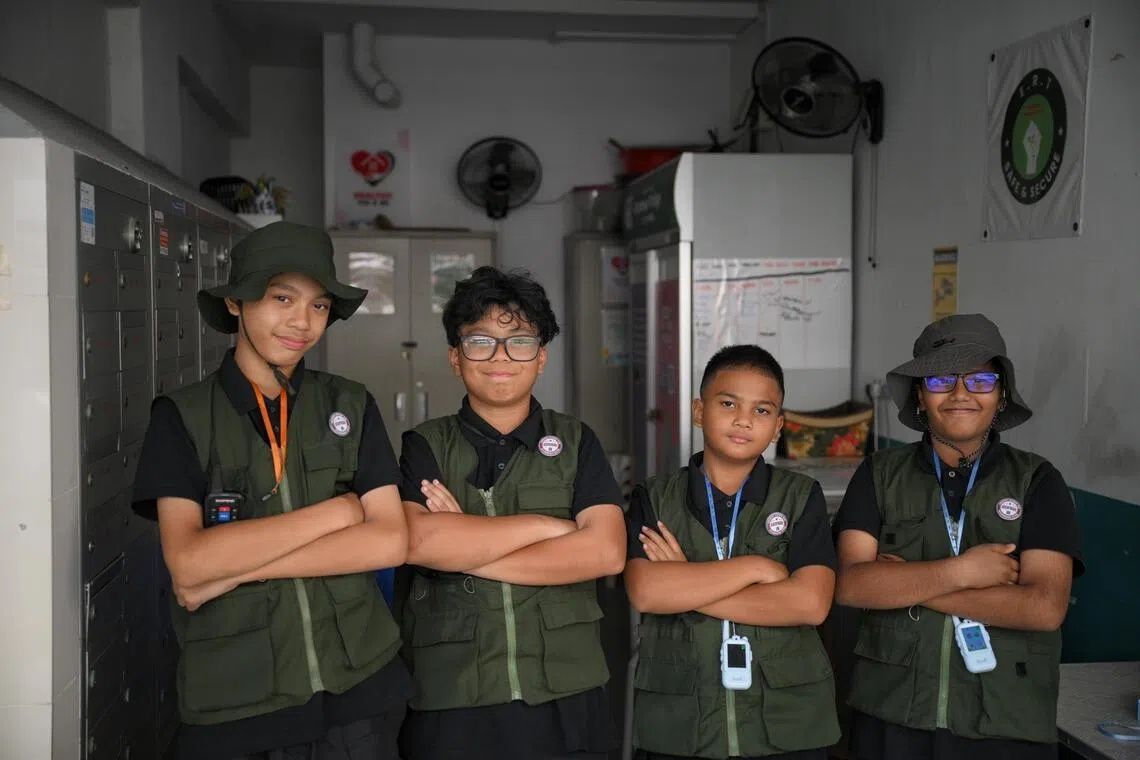
In Singapore's Lengkok Bahru housing estate, an unusual volunteer movement has taken root—one led not by seasoned civic leaders or government officials, but by four primary school students determined to improve their immediate surroundings. The initiative emerged from a simple frustration: twelve-year-old Rafieq Sahin Rafizal watched helplessly as people repeatedly raided a community fridge intended to provide free milk and refreshments for children from economically disadvantaged families. Rather than accept this as inevitable, he channelled his concern into action, eventually forming what would become the Emergency Response Team LB, a neighbourhood watch operation staffed entirely by youngsters aged between eleven and fourteen.
The group's genesis reveals the pragmatism of Rafieq's mother, Marlina Yased. Rather than position her son as a passive guardian of the charity fridge, she redirected his protective instincts outward, encouraging Rafieq and three companions from Gan Eng Seng Primary School to conduct systematic patrols throughout their neighbourhood. Since commencing their daily rounds in August 2025, the four have evolved into informal custodians of their community's physical and social wellbeing, identifying problems that might otherwise escape official attention. Their work extends beyond the visible landscape of litter and vandalism to encompass the safety hazards that plague densely populated residential areas—improperly charged personal mobility devices in common spaces pose genuine fire risks, while bulky waste dumped in public areas both diminishes living conditions and signals broader neglect.
The operational structure is deceptively sophisticated for a youth initiative. Each afternoon, following school, the boys don matching vests emblazoned with their names and team logo, then deploy in pairs to systematically cover up to six blocks of their estate. They maintain constant communication with Marlina and fellow volunteer Fahmidah Farihullah, a twenty-one-year-old coordinator, via walkie-talkies—a detail that underscores how their work integrates seamlessly into the estate's existing support infrastructure. When problems emerge, the team documents them photographically and escalates findings to Marlina, who then liaisons with estate management to ensure appropriate remedial action. This chain of accountability transforms observation into intervention, converting youthful vigilance into measurable community improvement.
Beyond the mechanicals of patrol, the team has demonstrated genuine capacity for human-centred problem-solving. Members have assisted elderly residents with mobility constraints in transporting groceries, served as mediators during children's disputes, and most dramatically, identified a decomposed body in a flat after detecting an unusual odour—an incident that resulted in police involvement and underscored how informal neighbourhood networks can detect welfare emergencies that formal systems might miss. These experiences situate the patrol not merely as a response to property damage and maintenance, but as a genuine expression of collective care within a community where residents often lack resources to independently address their own vulnerabilities.
The initiative's recognition within Singapore's civic calendar attests to its broader significance. In August, the four will participate in the National Day Parade as representatives of ordinary Singaporeans actively contributing to their nation's wellbeing—a placement that elevates youth civic participation from the margins of public consciousness to its symbolic centre. For these primary school students, many of whom had never considered themselves capable of meaningful social contribution, the invitation represents profound validation. As Rafieq articulated, with the unvarnished pragmatism of youth, they sacrifice an hour of their daily leisure to serve their community because they recognise the value of structured purpose over unstructured recreation.
Motivations for participation vary meaningfully among team members. Didie Andiqa Muhaimin, the eldest at fourteen, initially sought simply to occupy time constructively—a motivation that resonates with developmental psychology regarding adolescent needs for structured activity and social belonging. Aaron Sarandev, at eleven the youngest, has internalised the discipline and perseverance that daily commitment demands, learning viscerally that responsibility sometimes requires effort despite low motivation. These aren't abstract lessons delivered through curriculum, but embodied knowledge acquired through sustained engagement with their actual neighbourhood.
Marevidentlyi Yased's role extends beyond administrative coordination into something resembling mentorship and informal social work. She maintains standards of conduct, provides guidance during challenging moments, and actively cultivates the boys' sense of purpose. The feedback she receives from their families suggests measurable outcomes: improved school attendance, enhanced concentration spans, and shifting behavioural patterns. These impacts hint at how structured civic engagement may benefit not only neighbourhoods but the young people themselves, offering alternative models to the passive consumption that often characterises adolescent urban life across Southeast Asia.
Community reception has evolved from scepticism to qualified support. Initial wariness about children conducting unsupervised patrols has transformed as residents observed their genuine commitment and low-key professionalism. Nasha Asrin, a local mother of five, explicitly expressed relief that these boys channel their energy toward constructive neighbourhood engagement rather than gravitating toward the aimless clustering that can presage more troubling behaviours. This observation carries particular weight in discussions about youth development in densely populated public housing environments, where supervised, meaningful activity occupies significant preventive potential.
The Lengkok Bahru initiative also illuminates broader questions about how communities organise themselves when formal state provision proves insufficient. Marlina's community fridge, which first prompted this patrol movement, emerged from recognition that official safety nets contain gaps—some families lack consistent access to basic nutrition for their children. The fridge represents one form of mutual aid; the patrol represents another, a mechanism through which residents collectively monitor and maintain the commons that all inhabit. Neither requires extensive resources, and both rely on the willingness of individuals to accept modest responsibility for collective outcomes.
What remains particularly noteworthy is the explicit framing adopted by these young people themselves. Rafieq deliberately named the group after Singapore's police Emergency Response Team, which handles high-risk incidents, suggesting that even children in public housing developments conceptualise civic participation as analogous to professional service. This aspiration—to function with the discipline and purpose of official institutions despite lacking formal authority—reflects either impressive maturity or poignant recognition that their contributions, however essential locally, operate at the margins of official recognition. Their forthcoming National Day Parade participation suggests some institutional acknowledgment of this boundary-crossing, validating their self-conception while maintaining the distinction between citizen volunteers and formal state apparatus.
As these four young people prepare for their August parade appearance, their neighbourhood patrol will continue its daily rounds, addressing the accumulated griefs of a densely populated estate where residents often cannot afford individual solutions to collective problems. Their initiative demonstrates that meaningful civic participation need not await adulthood, formal authority, or substantial resources. The project's durability and scalability remain open questions—the team originally numbered seven members before contracting to four, suggesting retention challenges. Yet the existence of the Emergency Response Team LB at all, and its expanding recognition, suggests that communities possess untapped capacity for self-governance when circumstances activate young people's sense of purpose and elder residents invest in structuring that energy productively. For Malaysian observers watching similar housing challenges unfold in Klang Valley neighbourhoods and other urban concentrations, the Lengkok Bahru model offers instructive lessons about catalysing community resilience through surprisingly modest interventions.

