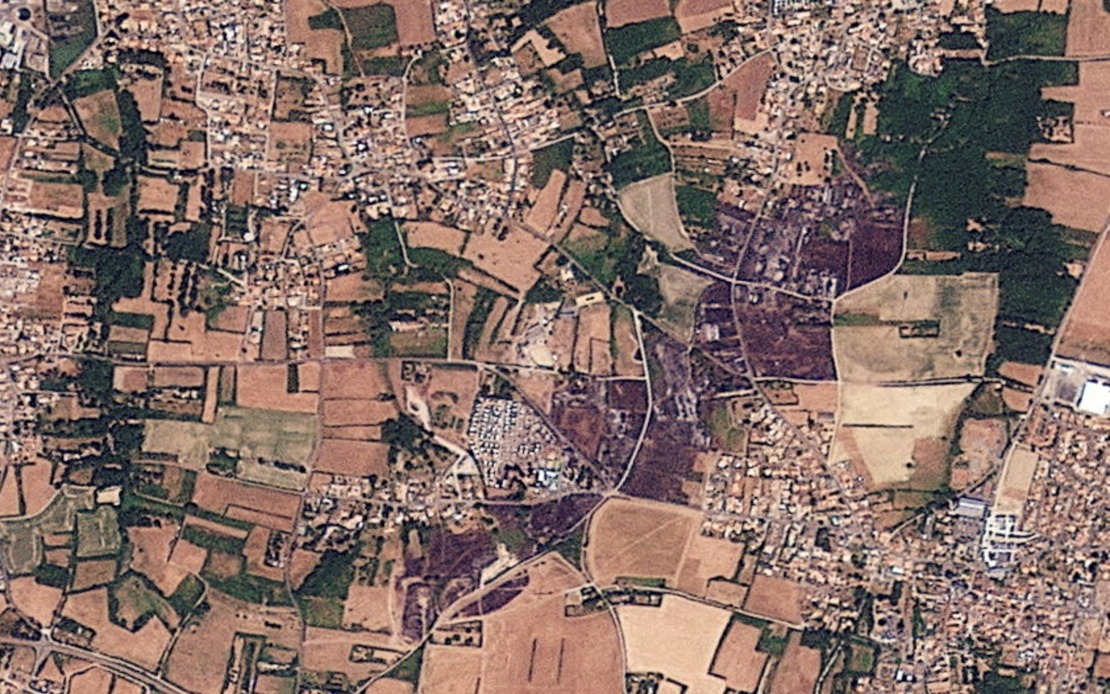
France is confronting an escalating wildfire crisis as multiple blazes continue to ravage forests and coastal regions across the country, with the Fontainebleau forest serving as the epicentre of destruction. Two active fires in this historic woodland southeast of Paris have consumed 1,920 hectares of land, forcing authorities to maintain intensive firefighting operations even as the flames continue their relentless spread. The dual disaster underscores the mounting vulnerability of French ecosystems to uncontrolled fire, particularly as summer temperatures soar and drought conditions persist across continental Europe.
The first fire, which ignited on Sunday, has proven especially destructive, consuming approximately 1,500 hectares of the Fontainebleau forest's dense woodlands. A second blaze that emerged subsequently has claimed an additional 300 to 400 hectares, creating parallel challenges for emergency responders attempting to contain multiple fire fronts simultaneously. The scale of destruction reflects the exponential difficulty faced by firefighting teams when managing simultaneous incidents across geographically challenging terrain, where dense forest cover and uneven topography complicate both access and containment strategies.
In a significant development, French authorities have arrested two individuals suspected of deliberately igniting the initial Fontainebleau fire, a revelation that has intensified political pressure for tougher judicial responses to arson. Transport Minister Philippe Tabarot has vocally demanded stringent sentencing for those found guilty of intentionally starting wildfires, distinguishing between criminal arsonists who warrant severe penalties and individuals afflicted by pyromania who require psychiatric intervention and treatment. This differentiation reflects an emerging understanding within French policymaking circles that wildfire causation encompasses both criminal intent and psychological pathology, requiring calibrated legal responses that address both dimensions.
The broader scope of deliberate fire-setting has become increasingly evident across France. Since the commencement of the current fire season, authorities have apprehended 59 individuals nationwide on suspicion of intentionally sparking wildfires, a statistic that underscores the pervasive human element in France's recent fire epidemic. This pattern of suspected arson raises troubling questions about whether socioeconomic factors, mental health crises, or deliberate malice drive such behaviour, with implications for how communities approach wildfire prevention and public safety messaging moving forward.
Current firefighting efforts remain intensive, with approximately 600 firefighters positioned throughout the affected areas maintaining round-the-clock operations. The deployment represents a substantial commitment of resources, reflecting the gravity of the situation and the authorities' determination to prevent further territorial expansion by active flames. However, the persistence of the fires despite such numerical commitment highlights the formidable challenge posed by weather conditions, terrain difficulties, and the unpredictable behaviour of fire in forestland environments.
Beyond Fontainebleau, France's infrastructure and civilian populations face disruption from wildfire impacts across geographically dispersed regions. The Trevillach wildfire, which erupted earlier in July within the Pyrenees-Orientales region, damaged critical railway infrastructure along the Perpignan-Villefranche-Vernet-les-Bains corridor, creating significant logistical complications for regional transport. National railway operator SNCF has suspended train services between Ille-sur-Tet and Villefranche-Vernet-les-Bains until at least July 20, disrupting commuter patterns and freight operations that depend upon this vital transport artery linking the Mediterranean coast to inland communities.
The wildfire phenomenon has extended its reach into Atlantic coastal areas and central highlands, further fragmenting the nation's capacity to respond cohesively. In Côtes-d'Armor, a department within the Brittany region, a heath fire erupted near Cap Fréhel, forcing the evacuation of more than 100 residents on Monday while consuming approximately 38 hectares of terrain. Simultaneously, the Lozère department in the central Massif Central has experienced its own fires, with authorities documenting 107 hectares of burned landscape, demonstrating the nationwide distribution of wildfire threat during this particularly volatile period.
For Southeast Asian observers, France's wildfire crisis offers instructive lessons regarding climate vulnerability and disaster response scaling. Malaysia and its regional neighbours increasingly confront similar challenges during drought periods, when agricultural burning, land clearing operations, and occasionally deliberate fire-setting create transboundary haze and ecological damage. The French experience demonstrates how even wealthy, developed nations with sophisticated emergency services struggle to contain multiple simultaneous fire events when environmental conditions prove unfavourable, a sobering reminder that resource availability alone cannot guarantee rapid crisis resolution.
The distinction France is drawing between prosecuting arsonists and treating those with pyromania reflects evolving jurisprudential approaches to environmental crime that may resonate with Malaysian legal frameworks. As Malaysia addresses its own wildfire and haze challenges through the ASEAN Transboundary Haze Pollution Agreement framework, incorporating nuanced understandings of perpetrator motivation could enhance enforcement effectiveness and rehabilitation outcomes. France's 59 arrests during the current fire season suggest that intentional fire-setting, whether criminal or pathological in origin, represents a measurable proportion of wildfire incidents, a proportion that targeted prevention and enforcement strategies might meaningfully reduce.
The scale of destruction in Fontainebleau and across France underscores climate change's intensifying impact on fire regimes throughout temperate zones. Extended drought periods, elevated temperatures, and altered vegetation conditions are creating environments where fire propagation becomes increasingly rapid and difficult to control, even for technologically advanced nations. This reality poses particular challenges for developing economies in Southeast Asia, where institutional capacity for firefighting may be more limited and where transboundary dimensions mean that fires ignited in one nation threaten air quality and health across multiple neighbouring states, as Malaysia has experienced repeatedly from Indonesian peatland fires.
Looking forward, France's aggressive stance toward arson prosecution may influence regional approaches to environmental crime enforcement. If severe penalties prove effective as deterrents within the French context, similar strategies might merit consideration within ASEAN frameworks, particularly given the recurring nature of wildfire and haze crises that devastate regional air quality and public health. The French model of combining criminal justice responses with medical intervention for those displaying pathological fire-setting behaviour offers a potentially more sophisticated approach than simple criminalization alone, suggesting that multidisciplinary strategies addressing root causes might prove more effective than punitive approaches in isolation.

