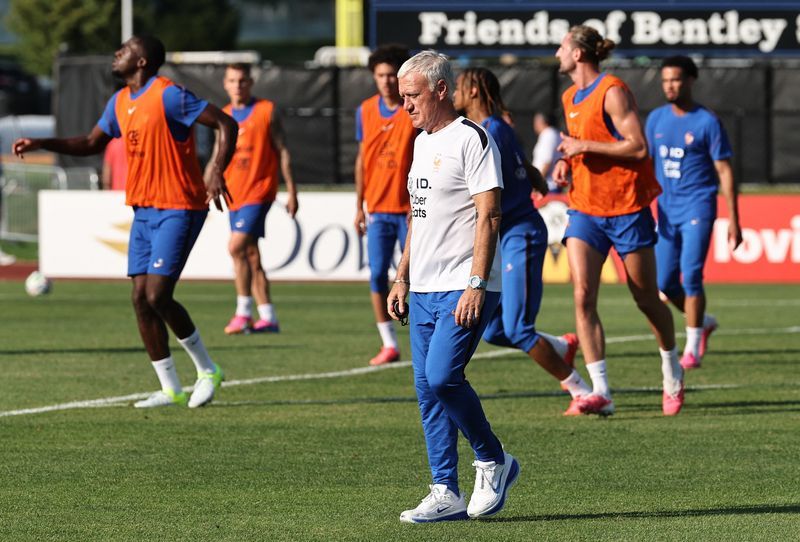
France enters the World Cup knockout stages as one of the tournament's most feared attacking forces, having swept through their group phase with a flawless record and an impressive goal-scoring tally. The European champions topped Group I ahead of matches against Senegal, Iraq and Norway, demonstrating an offensive capability that most observers regard as among the finest on display in the competition. Yet despite this dominance, France coach Didier Deschamps faces a crucial decision ahead of Tuesday's Round of 32 encounter with Sweden: how to balance the team's devastating attacking prowess with defensive solidity on the left side of his formation, an area that has occasionally exposed vulnerabilities.
The French attacking axis centred on Kylian Mbappe, Ousmane Dembele and Michael Olise has provided the backbone to France's group stage dominance. Mbappe has remained the focal point of their attacking play, whilst Dembele announced himself with a hat-trick performance in the comfortable victory over Norway. Olise has contributed creativity and movement that regularly stretches opposing defences. Together, these three players represent a level of individual quality and collective understanding that has rarely been seen in recent World Cup tournaments. The combination of pace, technical ability and clinical finishing has overwhelmed every opponent France has faced so far, creating a template of attacking football that is difficult to contain.
Yet the coach's concern centres on the left flank, where tactical adjustments are anticipated before the Swedish match. Theo Hernandez, the Milan left-back, has not convincingly stamped his authority on the position, prompting speculation that Lucas Digne may be recalled to provide both greater defensive reassurance and improved delivery from wide areas. This represents a choice between attacking ambition and defensive pragmatism—a trade-off that becomes increasingly significant as matches progress beyond the group stage. Further up the left wing, Bradley Barcola is expected to replace Desire Doue, with Deschamps seeking the kind of penetrative running and pace that can better utilise the width of the pitch and create numerical advantages in transition situations.
The anticipated personnel changes reflect a broader strategic calculation. Rather than fundamentally altering France's approach, these substitutions aim to create greater tactical coherence along the left side whilst preserving the overwhelming attacking potential down the right. Sweden will likely adopt a defensive setup, positioning themselves deep and looking to exploit set pieces or the spaces that sometimes open behind the French defence during transitions. The return of William Saliba to central defence should provide additional stability in areas where France has occasionally appeared vulnerable to direct play and quick counter-attacking opportunities.
For all the adjustments Deschamps may implement, the fundamental reality remains stark: France possesses an embarrassment of attacking riches that few opponents can match. Beyond the established trio of Mbappe, Dembele and Olise, the French bench includes Bradley Barcola, Desire Doue, Rayan Cherki, Jean-Philippe Mateta and Marcus Thuram—a collection of talent that demonstrates the depth of their offensive options. This abundance allows Deschamps to rotate personnel, maintain intensity and introduce fresh legs without sacrificing quality. In knockout football, where fatigue and intensity often determine outcomes, such versatility becomes a considerable advantage.
Sweden presents themselves as difficult rather than glamorous opponents. The Nordic side finished second in Group F behind the Netherlands, recording a commanding 5-1 victory against Tunisia but suffering an identical defeat to the Dutch. A goalless stalemate with Japan illustrated their capacity for organisation and discipline, if not attacking flair. Alexander Isak, Viktor Gyokeres and Anthony Elanga provide physical presence and occasional moments of genuine threat, but these forwards lack the consistent brilliance that defines France's attacking personnel. Sweden will need to execute their defensive shape with precision, maintain organisation under pressure and hope that France suffer an uncharacteristic loss of focus.
The knockout stage presents a fundamentally different examination than group phase football. Teams cannot simply overwhelm opponents through sustained attacking pressure and superior individual quality; instead, discipline, organisation and the ability to defend as a unit become paramount. Opponents willing to sit deep and transition quickly can exploit the spaces that France sometimes leaves behind their attacking players. Against a second-string Norwegian side, France did indeed appear vulnerable to such tactics, conceding opportunities that could have been costly against more clinical finishing. Yet this represents an isolated concern rather than a systemic weakness, particularly given France's strong defensive record at international tournaments.
France's recent World Cup history provides considerable confidence. Excluding the 2022 final against Argentina—a match decided by extraordinary circumstances—France have not suffered a knockout defeat at the World Cup since 2014. This record suggests that the team possesses both the mentality and the tactical intelligence to navigate the most demanding stages of the tournament. The progression from knockout rounds would pitch France against either Germany or Paraguay, depending on the outcome of their respective matches, in a Round of 16 contest that offers little respite to emerging challengers.
Former England forward Gary Lineker, speaking to French sports daily L'Equipe, articulated the conventional wisdom that now dominates analysis of France's prospects. Despite acknowledging Sweden's respectable attacking options, Lineker emphasised the gap in overall firepower and quality between the teams. The fundamental proposition remains unchanged: France's capacity to generate goals through multiple channels exceeds Sweden's ability to either score sufficiently or defend cohesively. Counter-attacking opportunities may occasionally materialise, but France's scoring threat promises to supersede whatever danger Sweden can manufacture, making the French advance a probable outcome unless Deschamps' men suffer an extraordinary lapse in concentration or efficiency.

