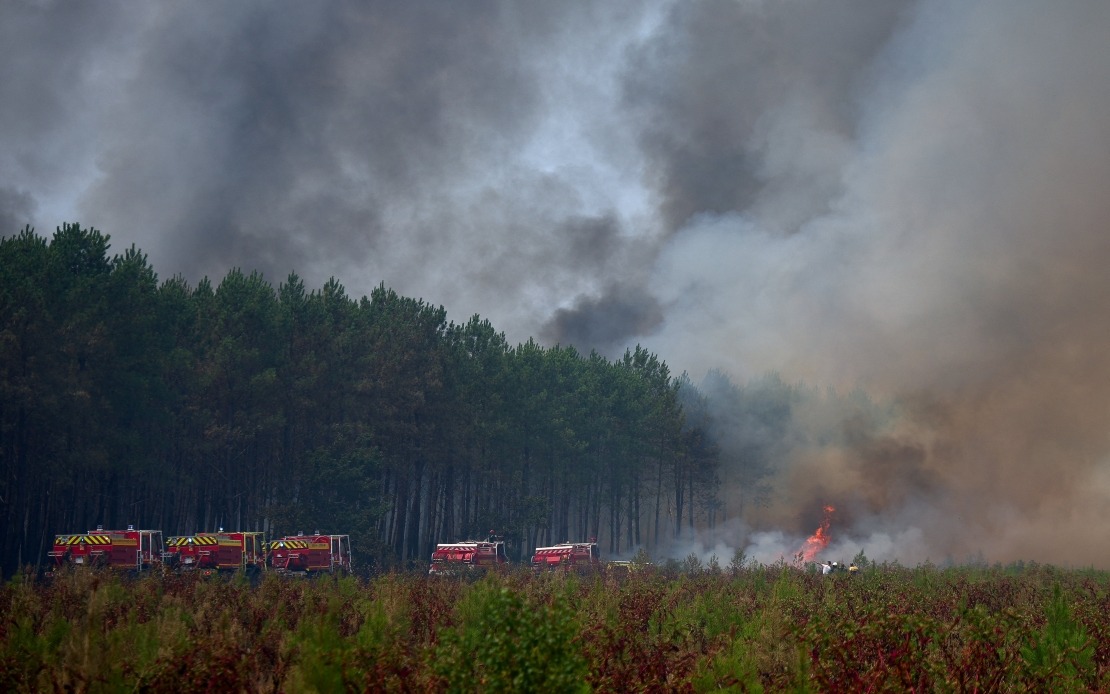
France is grappling with an escalating wildfire emergency of historic proportions, with more than 85 firefighters sustaining injuries while combating sprawling forest fires across multiple departments. The figure represents a significant jump from the previous week, when 84 firefighters had been reported injured, with an additional five sustaining wounds while fighting blazes in the Hautes-Alpes department in more recent days. The rising toll underscores the extreme physical and operational demands facing France's emergency services as they confront what President Emmanuel Macron has characterized as a record-breaking summer for wildfires in the nation since the conclusion of World War II.
The Gironde department in southwestern France has emerged as the epicenter of this environmental catastrophe, with fires consuming an estimated 42,000 hectares of forestland. The scale of the evacuation effort reflects the unprecedented threat posed by these blazes: French Finance Minister Roland Lescure confirmed that over 13,000 businesses have been forced to cease operations and evacuate from the affected zone, while preliminary reports indicate that approximately 220,000 residents have been displaced from their homes and communities. This represents one of the largest mass evacuations undertaken in France in recent years and underscores the severity of the threat to infrastructure and civilian safety.
The catastrophe has prompted France's military to mobilize resources typically reserved for strategic operations. The French air and space force deployed an Airbus A400M military transport aircraft to assist firefighting operations in Gironde for the first time, demonstrating both the scale of the emergency and the exhaustion of conventional civilian firefighting capabilities. This deployment, confirmed by France's Armed Forces Ministry through reports carried by European policy media outlet Euractiv, represents an extraordinary measure that highlights how comprehensively the crisis has overwhelmed standard emergency response mechanisms.
Experts warn that the immediate threat extends far beyond the current moment. Lieutenant Colonel David Annotel, a spokesman for the National Firefighters Federation, cautioned that the fires consuming the Gironde region will likely persist for weeks and potentially months to come. Speaking to Franceinfo broadcaster, Annotel emphasized that authorities should prepare for a sustained emergency requiring continuous resource allocation and firefighting operations throughout an extended period. This assessment suggests that the injuries already sustained by firefighting personnel may represent only the beginning of a longer toll on emergency services personnel.
The connection between these unprecedented blazes and climatic conditions is explicit. The wildfires have erupted amid abnormal and prolonged heat waves sweeping across France, creating optimal conditions for rapid fire spread and intensity. The combination of elevated temperatures, dry conditions, and vegetation stress has transformed forests across multiple departments into tinderboxes, with blazes spreading with remarkable velocity once ignited. This pattern aligns with broader European climate trends and represents the type of extreme weather event that climate scientists have long predicted would become increasingly common in Mediterranean and temperate regions.
The economic consequences extend beyond the immediate disruption to civilians and businesses. The Lectra technology company, a significant employer in the region, announced the temporary closure of its manufacturing facility in Bordeaux-Cestas due to proximity to the active fire zone. Such closures multiply across the affected area, disrupting supply chains, employment, and economic activity across southwestern France. For Malaysian readers and regional business interests, the disruption to European industrial operations serves as a reminder of how climate-related disasters increasingly disrupt global economic networks and production capabilities.
The scale of this crisis carries implications that extend beyond France's borders. Southeast Asian nations, including Malaysia, face similar vulnerabilities to climate-driven environmental emergencies, particularly during dry seasons when forest fire risks escalate dramatically. The French experience demonstrates how rapidly evacuations can escalate to affect hundreds of thousands of people, how emergency services can become overwhelmed despite advanced capabilities, and how military resources may be required to supplement civilian responses. The lesson resonates across the region, where transboundary haze and fire events have historically caused significant public health and economic damage.
The designation of this summer as France's worst for wildfires since 1945 carries historical weight. The measurement against the postwar period suggests that despite technological advances, firefighting expertise, and modern emergency management systems, the underlying environmental conditions have shifted in ways that current infrastructure cannot reliably contain. This observation challenges assumptions about humanity's capacity to manage natural disasters through technological means alone, pointing instead toward the necessity of addressing root causes through climate mitigation and adaptation strategies.
As France mobilizes every available resource to combat these fires—from specialized military aircraft to thousands of frontline firefighters—the human cost continues mounting. The injuries sustained by firefighters represent not merely statistics but the physical toll extracted from those undertaking extraordinarily dangerous work under increasingly extreme conditions. The pattern of escalating injury counts week after week suggests that this toll will likely continue accumulating throughout the coming months, particularly if Lieutenant Colonel Annotel's forecast of sustained fires proves accurate. For policymakers and emergency managers across Southeast Asia and globally, France's current struggle offers both a warning and a call to action regarding climate preparedness and disaster response capabilities.

