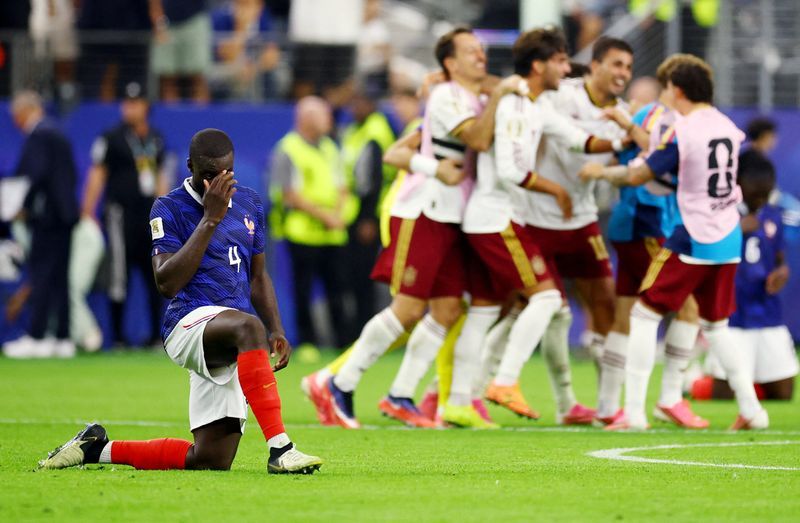
France's World Cup campaign came to an abrupt and humiliating end on Tuesday night in Arlington, Texas, when Spain dismantled them 2-0 in the semi-final with a performance that exposed fundamental weaknesses in both tactics and execution. The French, who had been installed as tournament favourites, crumbled at the first serious test of their credentials, delivering a collapse that bore painful echoes of their opening hour against Argentina in the 2022 final—except this time there would be no dramatic recovery or penalty-shootout redemption. Instead, the squad endured a masterclass in dominance from their Spanish opponents, reduced to helpless witnesses as their European rivals controlled the match with surgical precision.
The gap between expectation and reality proved devastating. Those who had placed France at the top of the tournament's pecking order appeared to have fundamentally miscalculated the balance of power in world football, a misreading that France's players themselves shared. Coach Didier Deschamps, addressing the aftermath with characteristic candour, laid bare the harsh truth: "The players are devastated, but we have to be clear-headed: technically, we were second best. That is on us." The acknowledgement reflected not merely tactical failure but a more troubling acknowledgement that France had simply been outplayed by a superior team on the night.
At the heart of France's collapse was the inexplicable disappearance of Michael Olise, the player whose creative brilliance had generated enormous anticipation before the tournament. Thrust into conversations about elite playmakers and even whispered alongside Ballon d'Or contenders, Olise was rendered utterly anonymous in Arlington, struggling visibly against the pressing demands of Spain's midfield. Starved of space and bereft of meaningful opportunities to dictate play, the young Frenchman surrendered possession an alarming 20 times while failing to complete a single successful dribble—a statistical indictment for a player France had relied upon to unlock Spanish defensive patterns. His comprehensive outclassing by Rodri, who glided through the centre of the pitch with ruthless authority and dictated terms with almost contemptuous ease, symbolised France's broader midfield collapse.
Yet Olise's struggles merely epitomised a far wider malaise afflicting the French attack. Ousmane Dembéle, expected to provide threatening width, posed virtually no menace to Spain's defence. Bradley Barcola, brought into the starting lineup, and his replacement Désire Doué both proved equally ineffectual, leaving France's supposedly formidable offensive arsenal looking strangely impotent when confronted with resolute Spanish resistance. Even Kylian Mbappé, the tournament's most electrifying talent, failed to produce the moment of individual brilliance that might have shifted momentum. The afternoon's most resonant cheer from Arlington's crowd came not for French attacking flair but for the appearance of David and Victoria Beckham on the stadium's giant screen—a telling commentary on where entertainment value lay as the match progressed.
France's structural vulnerabilities were evident from the opening exchanges. Spain, led by the precocious Lamine Yamal—who had declared with adolescent swagger that France should be the ones harbouring fear—understood perfectly how to exploit those weaknesses. The Spanish teenagers and their experienced companions had grasped the crucial tactical insight that eluded Deschamps: controlling tempo, slowing the game's rhythm, and suffocating France's creative spaces. Rayan Cherki, introduced as a second-half substitute, later acknowledged this fundamental gap: "We knew their main strength was their ability to play at a false tempo. At times, we should have done the same. It was more difficult than we expected." The admission revealed how badly France had misjudged not merely the opposition but their own capacity to impose their preferred patterns of play.
The midfield pivot that Deschamps had constructed crumbled under sustained pressure. Adrien Rabiot, picking up an early yellow card that forced him to temper his aggressive instincts, became a diminished force in proceedings. Aurélien Tchouaméni, struggling to regain full sharpness after missing the previous two matches with a hamstring injury, proved insufficient to contain Spain's midfield thrust, frequently finding himself exposed and unable to maintain the pace demanded by the encounter. With the double pivot overwhelmed, France's defensive line was left dangerously open, vulnerable to the incisive movements and precise finishing that Spain repeatedly demonstrated. Mikel Oyarzabal converted a 22nd-minute penalty with clinical composure, before Pedro Porro added a second goal just before the hour mark to render the contest effectively concluded.
Spain's tactical dominance represented a watershed moment in the tournament. The Spanish demonstrated they possessed not merely technical sophistication but the willingness and ability to match France directly, challenging the narrative that had positioned Deschamps' squad as inevitable finalists. Where other opponents had attempted to absorb pressure and counter-attack, Spain chose confrontation—and won that confrontation decisively. Their team, constructed around the movement and intelligence of midfield controllers like Rodri and the attacking geometry of players like Yamal, simply outthought and outexecuted their opposition across ninety minutes.
The psychological aftermath was rendered visible in the final whistle's aftermath. Mbappé stood isolated on the pitch, a solitary figure embodying France's broader disconnection and isolation. Teammates dropped to their knees or buried their faces in their hands—reactions befitting an unexpected and devastating reversal rather than the measured disappointment of a tournament favourite. The carefully cultivated narrative of cohesion and unity, repeated endlessly in press conferences and team meetings through the days preceding the match, suddenly felt impossibly distant. The squad that had spoken of collective purpose and harmonious function stood exposed as a collection of individuals overwhelmed by superior opposition.
For Malaysian and Southeast Asian football followers, France's collapse offers instructive lessons about the fragility of tournament favouritism and the critical importance of tactical flexibility. The French demonstrated that neither individual brilliance nor pre-tournament expectations guarantee success when confronted with opponents who possess both technical quality and tactical discipline. Spain's victory represented not merely victory over a strong opponent but validation of a particular football philosophy—one emphasizing control, pressing, and the suffocation of space. As the region's football communities continue developing their own competitive structures and aspirations, the lesson from Arlington resonates clearly: superiority in one tournament cycle offers no guarantee against comprehensive reversal when facing truly elite opposition prepared to enforce their tactical vision.

