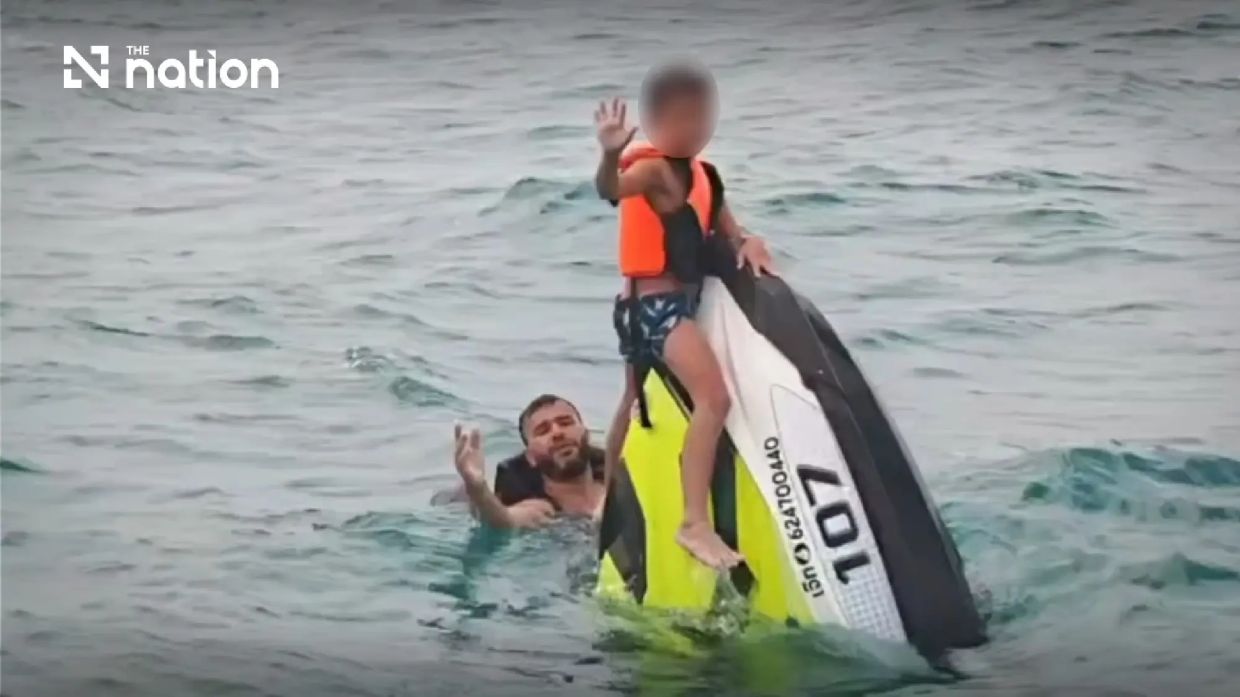
A French family endured a harrowing overnight experience in the waters off Koh Samui after their jet ski overturned, leaving them adrift for more than 16 hours before rescue workers pulled them to safety. The 50-year-old father and his two young sons, aged five and seven, were discovered exhausted and suffering from seawater ingestion on Friday morning, according to local government official Amorn Chomchoey. Following their recovery, all three family members were transported to hospital for medical evaluation but were discharged shortly after, having escaped without serious injury from what could have proven a tragic incident.
The misadventure began when the father rented a jet ski from a local operator on Koh Samui at approximately 5pm on Thursday evening, setting out into the Gulf of Thailand with his two young sons. The rental agreement stipulated specific operating boundaries and an expected return time, but when the family failed to materialise as scheduled, alarm bells rang at the rental company. The operator's concern prompted immediate action, with authorities and local rescue teams being notified of the missing recreational watercraft and its passengers.
Searching the waters through the night and into the following morning, rescue personnel finally located the capsized jet ski and its occupants around 10am on Friday. Video footage captured by the Koh Samui district office revealed a striking image: the jet ski lay almost entirely submerged, with only its triangular nose section visible above the water's surface. One of the young boys perched on the overturned hull while his father floated nearby, both thankfully secured by life jackets that proved instrumental in keeping them afloat throughout their ordeal.
The rescue operation itself demonstrated the professionalism of Thai responders, with audio recordings capturing rescuers calling out reassurances to the frightened family. Operators could be heard urging calm and shouting confirmation that the family had survived, as one rescuer assisted the young boy from the jet ski onto a rescue vessel and provided the exhausted family with drinking water. The immediate provision of medical supplies and psychological reassurance highlighted the coordinated nature of the rescue effort, which had evidently been searching methodically through the night.
Investigations into the incident have focused on why the jet ski capsized after operating for just over 15 minutes, particularly given that the father claimed to possess experience with such watercraft. According to Amorn's secretary, who serves also as translator, the father asserted he was an accomplished jet ski operator, suggesting mechanical failure or environmental factors rather than pilot error as possible causes. However, complicating the narrative somewhat, the jet ski rental operator has alleged that the family ventured beyond the designated operational zone outlined in their rental agreement, raising questions about whether the family deliberately exceeded their permitted boundaries.
The distinction between these competing accounts—mechanical malfunction versus unauthorised travel—carries important implications for safety oversight on Thailand's popular resort islands. If the family strayed outside approved operational areas, this would point to inadequate supervision of rental activities and the potential for greater risks when operators move beyond patrolled or monitored waters. Conversely, should mechanical defect be confirmed as the cause, it would raise concerns about the maintenance standards and safety protocols of rental operators serving tourists on busy islands like Koh Samui.
Koh Samui's appeal to international travellers, particularly families, lies partly in its reputation for relatively calm waters compared to other Thai islands, backed by abundant resort infrastructure and established safety records. The island welcomes millions of visitors annually seeking beach relaxation and water-based activities, with jet skiing representing one of the most accessible and popular recreational options. However, incidents such as this underscore the potential hazards that can arise when tourism infrastructure and personal responsibility fail to align, even in apparently low-risk environments.
The family's decision to continue their holiday in Thailand following the incident speaks to both their resilience and the relatively rapid recovery they achieved after their ordeal. Rather than cutting short their trip, the father and his two sons opted to remain on the island, suggesting the incident did not fundamentally alter their confidence in the destination, though their experience may well influence how they approach water-based recreation in future travels. This choice also reflects the broader reality that traumatic experiences, even when resolved safely, often become defining memories of otherwise positive travel experiences.
For Malaysia and Southeast Asia's growing tourism industry, the incident carries broader significance regarding liability, safety regulation, and the protection of young visitors engaging in adventure activities. As regional destinations compete for international families and seek to expand water sports tourism, maintaining rigorous standards for equipment maintenance, operator licensing, and adherence to designated operational zones becomes increasingly critical. The incident on Koh Samui serves as a timely reminder that tourism safety extends beyond mere infrastructure to encompass the responsible management of potentially hazardous recreational pursuits.

