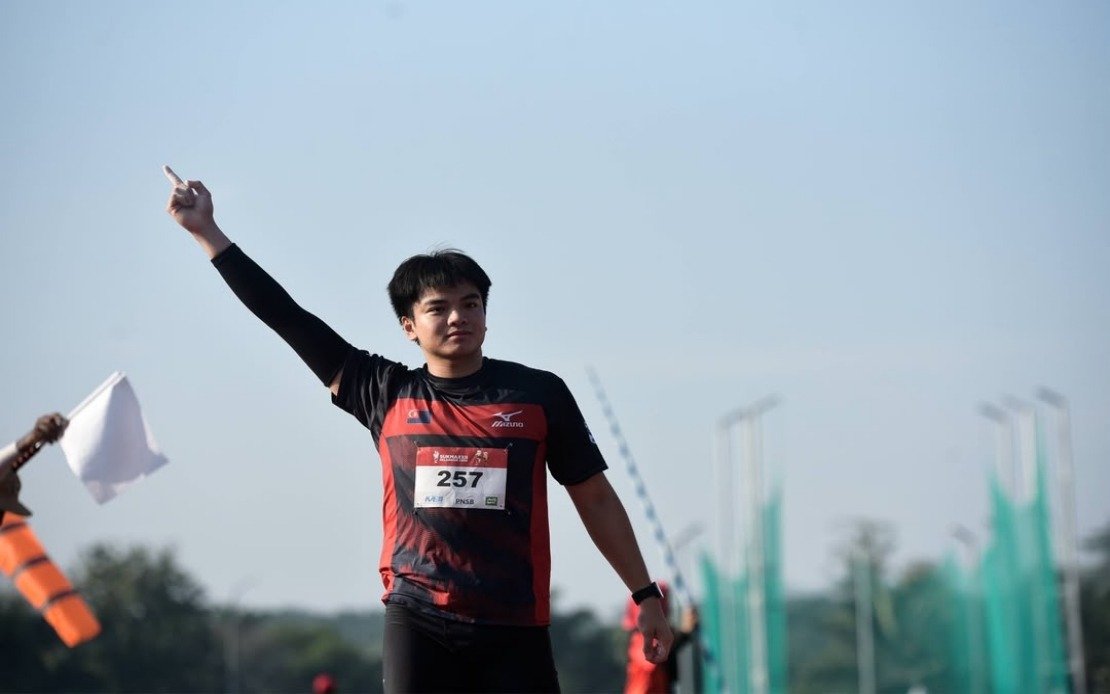
Johor's Chai Kai Le has rewritten the history books at the Selangor 2026 Malaysia Games, becoming the holder of the coveted javelin record after launching the implement 64.44 metres during competition at the Universiti Putra Malaysia Sports Centre. The 18-year-old's throw erased a benchmark that had stood unchallenged for over a quarter-century, surpassing Sarawak's Kho Mei Kuan's mark of 62.33 metres set at the Penang edition in 2000. The achievement represents not merely a statistical triumph but the culmination of a pathway shaped by chance observation, mentorship, and familial dedication.
Kai Le's trajectory into javelin sport reads as an unlikely crossing of circumstance and opportunity. His early years were spent wielding a badminton racket rather than a spear, developing the reflexes and hand-eye coordination that define the shuttlecock game. A perceptive teacher, however, recognised something distinctive in the teenager's arm mechanics during badminton sessions—a particular quickness and snap in his shuttle release that suggested untapped potential in a different athletic discipline. This observation during Standard Six proved pivotal, steering the young athlete from the indoor court towards the open field and introducing him to the technical demands of javelin throwing.
The transition from badminton to javelin could have ended as a fleeting experiment, but Kai Le persisted through the learning curve. His early years in the sport were spent absorbing knowledge through attendance at open competitions and careful observation of senior athletes competing at higher levels. Watching experienced throwers achieve distances that seemed almost impossible to a novice created an aspiration that crystallised into resolve. "I started taking part in open competitions and watching the senior athletes throw," he explained to reporters. "Seeing how far they could throw made me think that one day, I wanted to be like them." This kind of aspirational learning, where younger athletes internalise the standards set by their predecessors, has long been recognised as integral to talent development within Malaysian sports.
Behind the technical development and competitive achievements stands an equally significant narrative concerning family support and sacrifice. Chai Kai Le's father, Chai Yin Huan, has provided consistent financial and emotional backing that has proven indispensable to the javelin thrower's continued progress. The investment encompasses not merely the obvious—equipment and entry fees—but the less visible expenditures that sustain an athletic career: physiotherapy sessions, recovery treatments, replacement footwear, and the countless hidden costs of elite training. For a family managing a pre-university athlete's needs, these outlays represent genuine commitment rather than casual expenditure.
The father's philosophy has been notably pragmatic rather than trophy-obsessed. Rather than pressuring his son to achieve specific rankings or podium finishes, Chai Yin Huan emphasised doing one's utmost whilst maintaining physical wellbeing. "He never expected me to become a top athlete," Kai Le reflected. "He just wanted me to do my best and, most importantly, to stay healthy." This parental orientation—prioritising sustainable development over immediate results—represents a healthier framework for nurturing young talent than the increasingly common pursuit of premature specialisation and burnout.
Yet the path to the SUKMA podium has not been smooth or injury-free. Throughout the past twelve months, Kai Le has grappled with persistent physical challenges, including recurring back problems and injuries to his right shoulder and elbow. These ailments, which remain incompletely healed, would have provided convenient justification for reduced training or withdrawal from competition. Instead, the pre-university student attending Bukit Jalil Sports School maintained his preparation schedule and continued competing despite discomfort. This resilience was evident at the Indonesia Open earlier this year, where he established both a personal best and the national under-20 record with a 65.65-metre throw.
The significance of Kai Le's record-breaking performance extends beyond individual achievement and touches upon broader considerations for Malaysian athletics development. Selangor 2026 represents a rare opportunity for the country to showcase its emerging talent pool at the regional level. The javelin record—particularly one that demolishes a 26-year standing mark by over two metres—demonstrates that systematic coaching and talent identification mechanisms, when combined with family support and athlete dedication, can produce internationally competitive performers. The fact that this breakthrough occurred in a non-revenue sport like javelin, which receives less media attention and sponsorship compared to football or badminton, highlights the importance of equitable resource distribution across all Olympic disciplines.
Kai Le's next target reveals the trajectory he envisions for himself. Having already breached the SUKMA threshold, he has established a 70-metre benchmark as his immediate objective, contingent upon achieving this distance by next year. Successfully reaching this mark would position him competitively for the 2027 SEA Games, a significant carrot dangling before Malaysian track and field athletes. To facilitate this ambitious goal, he has arranged a one-month specialised training programme in Japan early next year, reflecting the contemporary reality that world-class coaching expertise often necessitates international mobility.
The decision to pursue international coaching exposure underscores a growing pattern within Malaysian sports: the recognition that medals and records increasingly require exposure to coaching methodologies and training environments beyond what domestic facilities alone can provide. Japan's reputation as a centre for athletics excellence makes it a logical choice, though such arrangements carry substantial financial implications that again fall upon family resources or institutional support systems. For Kai Le, this next chapter will test whether the foundation constructed through years of consistent training, parental backing, and competitive experience can translate into the elite performances demanded by Southeast Asian competition.
The broader Malaysian sports ecosystem should take careful note of Kai Le's journey. Here is a case study demonstrating that excellence in non-mainstream sports remains achievable when three critical elements align: competent coaching identification and guidance, unwavering family support that prioritises long-term athlete welfare, and the athlete's own determination to persist through setbacks. The teacher who recognised potential in a badminton player's arm mechanics, the father who consistently funded recovery and equipment, and the young athlete who trained through pain—together they have produced a national record holder at eighteen. Replicating this success across other disciplines and regions requires systematic investment in talent scouting, sustainable family engagement models, and coaching infrastructure that extends beyond Malaysia's urban centres and established sporting powerhouses.

