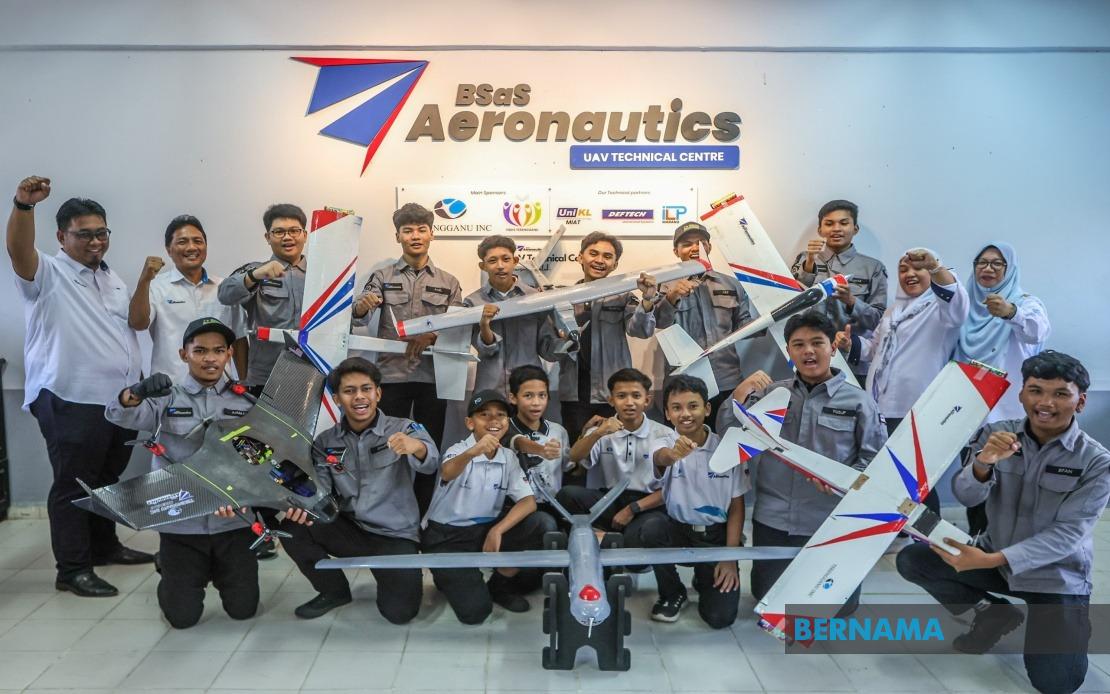
In the classrooms and workshops of SMK Bukit Sawa in Marang, Terengganu, a quiet revolution in technical education is unfolding. What began as one English teacher's passion for remote-controlled aircraft has blossomed into a comprehensive programme where 35 secondary students have designed and built fully functional unmanned aerial vehicles, each representing an investment of between RM6,000 and RM10,000. This transformation from theoretical learning to hands-on engineering demonstrates how schools across Malaysia can bridge the gap between classroom instruction and industry-relevant skills in emerging technological fields.
Badrul Hisyam Zakaria, who leads the TI-BSAS UAV In School programme alongside two colleagues, explains that the initiative reflects a broader pedagogical shift toward experiential learning in Malaysian secondary education. Since its inception in 2023, the scheme has attracted substantial backing from corporate partners, most notably Terengganu Incorporated, which recognised the potential of cultivating aerospace talent within the state. The students operate under professional standards, employing the same construction methodologies and materials used in actual aviation manufacturing, albeit adapted to smaller scales suitable for educational purposes. Each vehicle incorporates GPS technology enabling precise target tracking, with development now advancing toward artificial intelligence integration that will allow visual recognition capabilities beyond simple programmed navigation.
The programme's credibility within Malaysia's aerospace community became evident when SMK Bukit Sawa captured the championship title at the UAV Avionics Integration Challenge (Secondary Schools) category during the MyAERO Challenge 2026, held at MAEPS in Serdang, Selangor, last June. This victory signifies far more than local school pride; it validates the pedagogical approach and demonstrates that secondary students, when provided proper mentorship and resources, can compete at national standards in sophisticated technical domains. The recognition positions the school as a serious contributor to aerospace talent development, elevating its status within educational circles across Southeast Asia where drone technology and UAV research increasingly dominate innovation agendas.
The tangible career outcomes already emerging from the programme underscore its transformative potential. Two former SMK Bukit Sawa participants have transitioned directly into aircraft engineering studies at Universiti Kuala Lumpur, while three additional alumni are pursuing scientific qualifications through matriculation pathways. Badrul Hisyam projects that within three to four years, the first generation of aerospace engineers trained through this school programme will enter the professional workforce, representing both personal achievement and a measurable contribution to Malaysia's indigenous aerospace capabilities. This pipeline approach—nurturing students from secondary through tertiary education and into employment—offers a strategic framework that other Malaysian schools might adapt across different technical disciplines.
Terengganu Incorporated has committed RM75,000 in corporate social responsibility funding since 2023, with RM45,000 deployed during the programme's initial establishment phase and an additional RM30,000 allocated in 2026 for continued expansion and technological advancement. This sustained corporate investment reflects confidence in the initiative's sustainability and impact potential. The funding mechanism specifically targets students from the B40 economic classification, ensuring that technological education in aviation is not confined to affluent families but accessible to lower-income communities within Terengganu. Such equity-focused investment addresses a critical disparity in Malaysia's educational landscape, where advanced technical training has historically concentrated in urban centres and better-resourced schools.
The programme's emphasis on developing indigenous UAV technology capacity responds to legitimate national security and economic considerations. By cultivating local expertise in unmanned aerial vehicle design and manufacturing, Malaysia reduces dependency on foreign technology imports and builds intellectual property foundations for homegrown aerospace industries. This aligns with broader government objectives to develop Malaysia as a regional technology hub and reduce reliance on imported defence and commercial aviation systems. For a nation increasingly concerned with technological sovereignty, investing in secondary-level aerospace education represents strategic foresight that extends beyond immediate commercial benefit.
The collaboration between SMK Bukit Sawa, the Terengganu State Education Department, and multiple corporate sponsors illustrates how decentralised education initiatives can flourish when stakeholders align around shared objectives. Rather than waiting for centralised curriculum redesign, the school took initiative to address the skills gap in aviation technology through collaborative partnership. This model has become increasingly relevant across Southeast Asia, where rapid technological change often outpaces formal curriculum development cycles. Other Malaysian schools facing similar pressures to modernise technical education might examine this framework as a replicable template for sectoral innovation.
The programme extends beyond occupational preparation; it cultivates scientific thinking, problem-solving methodologies, and engineering ethics among participating students. Building a fully functional aerial vehicle demands understanding of aerodynamics, electrical systems, GPS technology, software programming, and structural mechanics. Students simultaneously develop project management capabilities, collaborative skills, and persistence in troubleshooting complex technical problems. These transferable competencies benefit graduates whether they pursue aviation careers or transition into other technology-intensive fields, providing educational value that transcends any single industry application.
The technological sophistication represents a substantial pedagogical escalation from traditional classroom instruction. By progressively advancing from GPS-dependent target detection toward artificial intelligence-enabled visual recognition systems, the programme pushes students toward frontier technologies that major commercial and military aerospace programmes are actively developing. This exposure provides participants with contextual understanding of current innovation trajectories, positioning them advantageously should they pursue advanced study or professional roles in competitive aerospace markets. The deliberate movement toward AI integration signals that the programme adapts continuously to emerging industry demands rather than remaining static around initially established standards.
For Malaysian parents and students considering technical education pathways, SMK Bukit Sawa's success offers compelling evidence that exceptional opportunities exist beyond conventional academic hierarchies. The school has demonstrated that secondary institutions in state capitals outside Kuala Lumpur can achieve excellence in sophisticated technical domains through strategic vision and partnership cultivation. This potentially influences educational decision-making across Terengganu and neighbouring states, encouraging families to consider local technical programmes as genuine alternatives to pursuit of credentials in distant urban centres. The psychological impact of visible success—students building actual aircraft and winning national competitions—proves motivational for younger cohorts considering whether advanced technical training aligns with their aspirations and capabilities.
Looking forward, the programme faces the fundamental challenge of scaling its impact while maintaining educational quality and corporate support sustainability. Current capacity serves 35 students; expanding to accommodate significantly larger cohorts would require proportional resource increases and additional corporate partnerships. The question of whether the model can replicate across multiple Terengganu schools, or indeed nationally, remains open. However, the existence of a proven template, measurable outcomes, and demonstrated corporate commitment to funding suggests replication pathways that other state education authorities might pursue. The programme thus represents not merely a localised success story but a potential catalyst for broader systematic change in how Malaysian secondary education addresses the technological skills deficit that increasingly constrains the nation's competitiveness.

