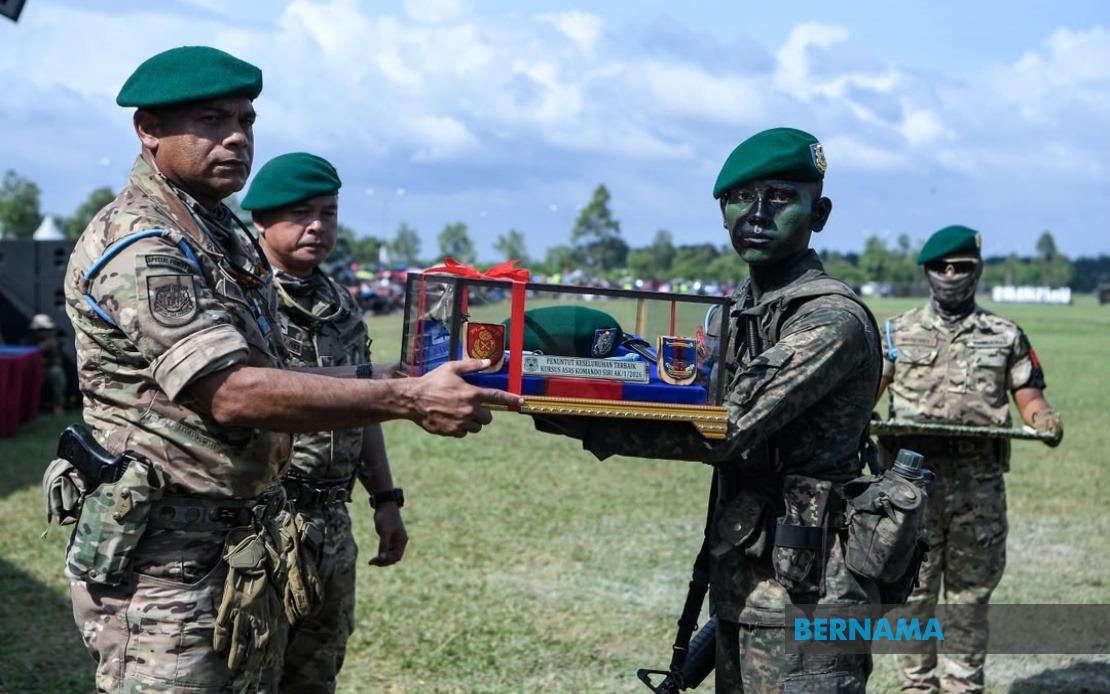
Second Lieutenant Muhammad Fadli Jamalluddin's path to becoming an elite commando was anything but straightforward. The 24-year-old from Ampang, Kuala Lumpur, has been recognised as Best Overall Trainee in the Basic Commando Course Series AK/1/26 at Universiti Sultan Abdul Halim Mu'adzam Shah in Kuala Ketil, but the honour came only after he overcame a significant initial failure and nearly abandoned the pursuit midway through this year's intensive programme.
Failing his first attempt at the Basic Commando Course Series 3/2024 might have deterred many candidates, but Muhammad Fadli regarded the setback as motivation rather than a barrier. Having graduated from the National Defence University of Malaysia (UPNM) and commissioned into the Royal Malay Regiment in 2024, he possessed the foundational training to understand what lay ahead. Nevertheless, attempting the notoriously demanding commando course a second time required exceptional mental fortitude, particularly given the punishing physical and psychological demands that weed out candidates throughout the programme.
Military ambitions took root in Muhammad Fadli during his secondary school years, though the specific catalyst for his commitment to military service remains personal. What stands out is his deliberate choice to pursue not simply a military career but specifically the most challenging pathway available. This decision reflects an emerging trend among younger officers in the Malaysian Armed Forces who see elite specialist training as essential to both personal development and meaningful contribution to national defence. The 21st Special Service Group (21 GGK), into which Muhammad Fadli ultimately gained admission, represents the institution's most demanding posting, reserved for personnel who demonstrate exceptional capabilities.
The motivations driving Muhammad Fadli's perseverance extend beyond professional ambition. As the third of five siblings, he cited a desire to make his father proud as a sustaining force throughout the gruelling training. This personal dimension took on heightened significance when his father suffered a stroke more than a year ago, adding emotional weight to an already demanding endeavour. For Muhammad Fadli, completing the course and achieving top trainee status transcended military accomplishment; it represented a gift of sorts to his family, particularly his father, whose absence from the closing ceremony due to his health condition underscores the personal sacrifice embedded within military achievement.
The third training attempt proved nearly catastrophic when Muhammad Fadli failed one of the training exercises during the eighth week of the current course. At that critical juncture, he faced genuine possibility of repeating the entire three-month programme from the beginning, a prospect that triggered an emotional breakdown. Having already invested enormous physical and psychological resources, completing over 100 kilometres of endurance marching before the setback made the near-failure particularly devastating. Yet he refused counsel from those suggesting he abandon the attempt, instead reframing failure as a platform for renewed effort rather than a terminal outcome.
The Basic Commando Course Series AK/1/26 spanning three months subjected Muhammad Fadli to training across both terrestrial and maritime environments designed to test the limits of human endurance and mental resilience simultaneously. The curriculum extends far beyond physical conditioning to encompass the sophisticated cognitive demands inherent in special operations planning and execution. As Muhammad Fadli himself observed, becoming a commando officer demands not merely muscular strength but intellectual sharpness, since operational success depends upon meticulous preparation and sound tactical decision-making rather than brute force alone.
Muhammad Fadli's academic background in Global Policing and Intelligence with Honours from UPNM provided intellectual preparation complementing his physical conditioning. This combination of theoretical knowledge and practical military training positions officers like him to understand the strategic context within which special operations occur. Such theoretical grounding has become increasingly important as regional security challenges evolve, requiring personnel capable of adapting to complex scenarios rather than executing rote procedures.
The cohort completing the course numbered 38 personnel in total, comprising five officers and 33 other ranks, suggesting that officer candidates face comparable attrition rates to enlisted personnel despite their elevated baseline training. This egalitarian selection process, wherein officer rank confers no advantage in commando qualification, maintains rigorous standards across the special forces structure. Muhammad Fadli's recognition as Best Overall Trainee therefore reflects genuine superiority across all measured dimensions rather than any professional rank consideration.
Colonel Nordin Abu, Commandant of the Special Warfare Training Centre (PULPAK), presented the award at the closing ceremony, lending institutional validation to Muhammad Fadli's achievement. PULPAK's role in maintaining training standards and developing personnel capable of executing Malaysia's most sensitive military operations carries significance extending beyond ceremonial function. The centre's approach to identifying emerging talent like Muhammad Fadli contributes to building institutional strength within the special operations community.
Muhammad Fadli's trajectory illuminates the resilience characteristics valued within Malaysian military circles, where initial setbacks need not determine final outcomes. His willingness to attempt the course again after initial failure, persevere through near-failure midway through the programme, and ultimately emerge as the most accomplished trainee in the cohort demonstrates the determination increasingly central to military identity. For a generation of Malaysian officers, such examples establish standards of commitment extending beyond comfortable performance to embrace deliberate engagement with maximum difficulty.
The significance of Muhammad Fadli's achievement extends beyond individual distinction to reflect broader patterns within the armed forces. As Malaysia confronts evolving regional security dynamics and asymmetric threats requiring sophisticated responses, the availability of highly motivated specialist personnel becomes strategically valuable. Officers like Muhammad Fadli, having deliberately chosen and persevered through elite training pathways, bring not merely technical competence but demonstrated commitment to institutional missions, potentially affecting organisational culture across the broader force structure.

