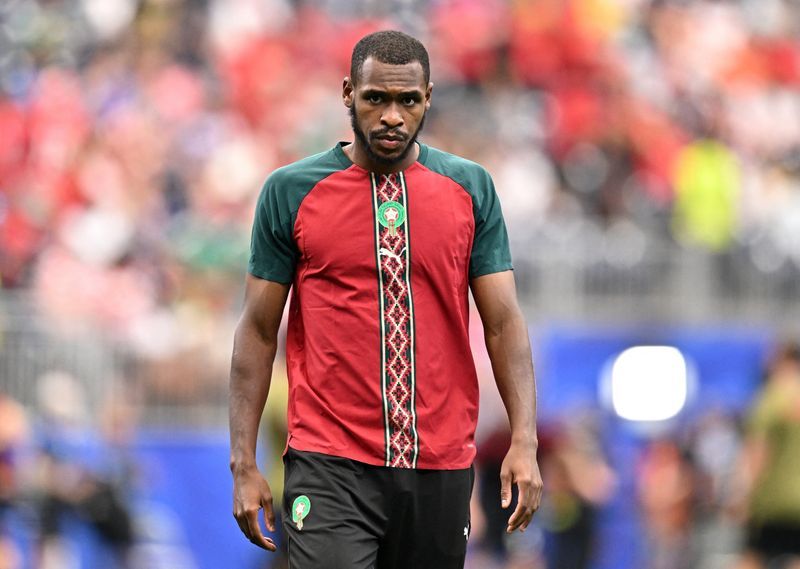
The narrative surrounding Morocco's defence has taken an ironic turn as Issa Diop prepares to confront one of France's most formidable attacking weapons. The 29-year-old centre-back, who publicly professed his unwavering commitment to the French national team just years earlier, now finds himself in the uncomfortable position of attempting to neutralise Kylian Mbappé's blistering pace and finishing prowess in a World Cup quarter-final that carries far more weight than a simple sporting encounter.
Diop's journey to this moment reveals the complex nature of international football allegiances, particularly for players with multicultural backgrounds. Born in Toulouse to a Senegalese father and Moroccan mother, he might reasonably have represented any number of nations. Yet his declarations of loyalty to France were unambiguous and forcefully articulated. Seven years ago, while representing France's Under-21 programme, he told Canal Plus with striking certainty: "I am French. I was born in France. France has given me everything. Joining another national team simply because I didn't make the French squad would be a bit hypocritical of me. It would be something of a default choice." Those words proved prophetic in ways he surely did not anticipate, setting the stage for considerable social media backlash when he reversed course.
The shift materialised in March when Diop committed to Morocco, a decision that appeared to some as precisely the opportunism he had previously condemned. His timing aligned conveniently with Morocco's preparations for the World Cup and the departure of defensive stalwarts including captain Romain Saiss, who stepped away following the Africa Cup of Nations in January, and Nayef Aguerd, sidelined by injury the same month. Coach Mohamed Ouahbi clearly viewed Diop as essential reinforcement to plug gaps in the defensive line. The recruitment of a Premier League-tested defender from West Ham United and Fulham represented a calculated gambit to strengthen Morocco's back line before the tournament's commencement.
The early criticism dissipated remarkably quickly following Diop's dramatic contribution against the Netherlands in the round of 32 knockout stage. With his team teetering on the brink of elimination in stoppage time, Diop powered home a header from Chemsdine Talbi's cross precisely one minute into added time, dragging Morocco from the precipice of defeat and forcing the match into extra time before Morocco prevailed on penalties. The moment dramatically altered the narrative surrounding his international switch, transforming him from controversial turncoat into clutch performer. "I went forward, I don't know what I was doing there, it was the end of the match. I tried to find some space and scored," he reflected with characteristic understatement.
Coach Ouahbi's perspective on Diop's integration suggests the pragmatism required in modern international football management. Rather than dwelling on historical statements or perceived contradictions, Ouahbi focused on observable commitment. "I sensed someone who is committed, who lives a somewhat Moroccan lifestyle and visits the country frequently," he explained. This assessment shifted the conversation from identity politics to performance metrics. Ouahbi's insistence that "what matters most is his attitude on the pitch" proved a masterclass in diplomatic messaging, allowing Morocco's football community to embrace Diop without extensive reckonings with his earlier protestations. "We shouldn't dwell too much on the past but rather focus on what lies ahead," Ouahbi declared, effectively closing that chapter.
Diop's defensive partnership with Crystal Palace's Chadi Riad has provided Morocco with a reassuring stability at the heart of defence, particularly given the absences created by Saiss's departure and Aguerd's injury. His Premier League experience across eight seasons gave him familiarity with the tactical intensity and physical demands that Morocco would encounter. Making his debut in a March friendly against Ecuador, he transitioned seamlessly into the starting role that would define his tournament, suggesting Ouahbi's confidence was warranted.
Thursday's encounter transforms Diop's World Cup participation into something altogether different from defensive competence in knockout football. Containing Mbappé demands extraordinary concentration and positional awareness. The Paris Saint-Germain forward represents the cutting edge of international attacking football, combining explosive acceleration with clinical finishing and game intelligence. Mbappé's capacity to influence matches extends beyond his goal-scoring; his movement creates space for teammates and draws defensive attention that disrupts structure. For Diop, the assignment requires leaving aside any residual emotional complexity surrounding his French connection and focusing entirely on the technical challenge.
Morocco's ambition to reach a second consecutive World Cup semi-final hinges substantially on defensive solidity. The team's surprising progression through the tournament has relied upon organisation and discipline rather than overwhelming offensive power. Maintaining that defensive foundation against France's attacking prowess depends significantly on Diop's performance. His physical attributes—strength, aerial dominance, and reading of the game—align well with the demands of this particular matchup. Yet football rarely permits individual brilliance to overcome systematic shortcomings, and Morocco's success depends upon collective cohesion across the back line.
The broader context of Franco-Moroccan relations in football adds subtle resonance to the encounter. Both nations share historical ties and significant diaspora populations, creating cultural complexity that extends beyond eleven players on a pitch. For Diop personally, Thursday represents an opportunity to define his international narrative through performance rather than past declarations or motivations. His heroics against the Netherlands demonstrated his capacity to deliver in high-pressure moments, suggesting he possesses the temperament required for this challenge.
What remains uncertain is whether Diop can channel the defensive focus required to frustrate Mbappé while avoiding the psychological complications that might arise from facing his birth nation. The technical aspects of the assignment are straightforward: positioning, timing, and physicality deployed judiciously to prevent the French forward from dominating play. Yet international football's human dimensions rarely remain entirely separate from its tactical components. Diop's transformation from France's reluctant midfielder into Morocco's pivotal defender has unfolded with remarkable speed, and Thursday will determine whether that conversion holds true when circumstances become genuinely demanding.
Morocco's coaching staff will likely employ additional defensive support to ensure Mbappé does not single-handedly dismantle their tournament hopes. Double-marking, tactical shape adjustments, and disciplined pressing protocols all represent available tools. Still, Diop as the primary central defender carries responsibility for orchestrating defensive responses to the French attack's movement and positioning. His eight seasons in English football provided extensive experience against elite attacking talent, yet the World Cup quarter-final stage presents pressures that domestic football rarely replicates.
The match itself transcends sporting competition for both nations, carrying symbolic weight that extends into national pride and international standing. For Diop specifically, it represents validation of his controversial decision or confirmation of critics' concerns. The defender has stated his commitment to Morocco unambiguously since switching allegiances, and his performance against France will constitute the definitive test of that commitment. Whether he succeeds or fails in containing Mbappé will largely determine how his international career transition becomes remembered and whether it appears prescient or opportunistic in retrospect.

