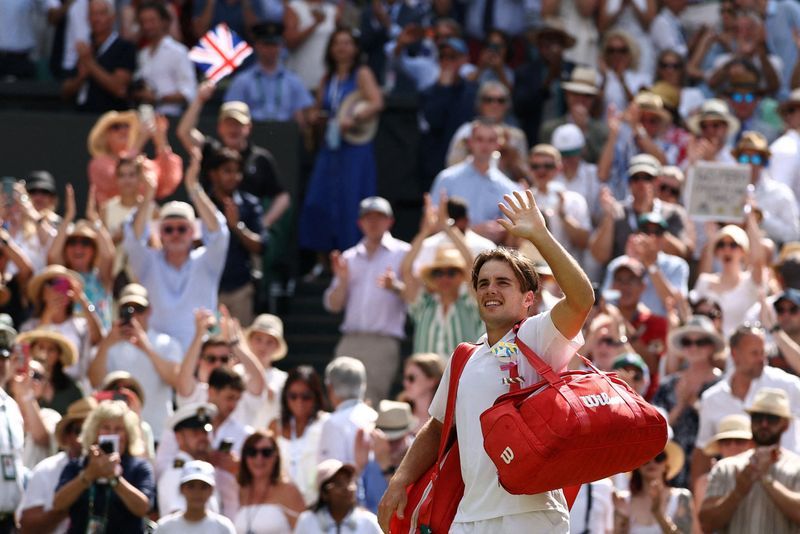
Arthur Fery had made peace with his fate. The 23-year-old British player, ranked 114th in the world, had resigned himself to a summer escape when he accepted his invitation to compete at Wimbledon this year. A Greek holiday with friends beckoned as the more likely scenario for mid-July, a chance to decompress after another season grinding through the lower reaches of professional tennis. But an improbable sequence of victories transformed that casual expectation into an impossible dream, and Fery found himself instead contending with London's oppressive heat and the mounting pressure of playing in the sport's most prestigious event.
When Fery dispatched his fifth consecutive opponent to advance beyond the quarter-finals, he etched his name into the tournament's history books. No wildcard entry had reached the men's semi-finals at Wimbledon in a quarter-century, a drought spanning more than 9,000 days of elite grass-court competition. The achievement arrived with theatrical timing: just as his friend, who had departed for Greece in advance, grudgingly returned to London mid-tournament to watch the player he had assumed would disappoint him. That friend's premature exit and subsequent return embodied the implausibility of Fery's entire journey.
The magnitude of support that coalesced around Fery's unexpected run proved extraordinary by any measure. England's World Cup football squad recorded a video message endorsing the emerging tennis star, while members of the Royal Family—Queen Camilla and Princess Kate—attended matches to witness his progress firsthand. This cascade of public endorsement, rarely extended to journeymen professionals ranked outside the top 100, reflected something deeper than mere patriotism. Fery's story tapped into the collective appetite for genuinely surprising sporting narratives, a reminder that elite competition occasionally produces narratives that transcend conventional tournament scripts.
His run ultimately concluded when Alexander Zverev proved too accomplished and too experienced for the occasion, dismantling Fery's challenge in straight sets on Friday. The defeat, while disappointing, could not diminish the seismic shift in trajectory that the past fortnight had already accomplished. Prior to Wimbledon, the French-born player competing for Britain had accumulated only two match victories across the Grand Slam circuit in his entire career. That meagre record now belonged to a distant past version of himself.
The financial windfall accompanying his semi-final appearance—£900,000 in prize money—provided immediate tangible benefits. The sum represented more earnings than Fery had accumulated in several previous seasons combined, offering genuine security for the first time in his professional life. The monetary injection would indeed upgrade that postponed Greek holiday considerably, transforming it from a modest escape to something more luxurious. Yet money represented merely one dimension of the transformation occurring.
Fery's ranking is expected to soar into the mid-30s by the conclusion of this week, a leap that carries profound implications for his career trajectory. That numerical improvement opens doors that remain closed to players operating outside the top 50. Tournament invitations become more readily available, qualifying rounds can be bypassed, scheduling becomes more favourable. The entry-level privileges that had seemed impossibly distant just ten days earlier suddenly appear within reach. For a professional athlete previously accustomed to grinding through preliminary rounds and fighting for acceptance, the administrative relief alone constitutes a genuine transformation.
The psychological dimension of Fery's breakthrough may ultimately prove more consequential than the ranking points or prize money. He arrived at Wimbledon as an afterthought, a name that appeared on draws almost apologetically. Opponents regarded him as a walk-over, a convenient early-round victim who would allow the tournament's genuine contenders to progress without meaningful resistance. Instead, he demonstrated something fundamental about his capacity to compete at the sport's highest level. That knowledge—that he possesses sufficient skill and composure to defeat accomplished professionals across five consecutive matches—will inform every future competition in ways that rankings and statistics cannot capture.
Looking ahead, Fery acknowledged the substantial challenge awaiting him. Expectations have transformed overnight from non-existent to substantial. Sponsors, broadcasters, the public, and his own support team will now scrutinise his performances with an intensity entirely absent during his earlier career. The transition from anonymity to prominence arrives with psychological territory that few athletes navigate successfully. His candid recognition of this challenge—his acknowledgement that managing external expectations while maintaining internal focus constitutes the actual test ahead—suggests he possesses the maturity to navigate these treacherous waters.
The American hardcourt swing represents the immediate next chapter in this unfolding narrative. The United States Open in Flushing Meadows will mark his Grand Slam debut at a major tournament as a ranked player arriving with legitimate expectations. Merely months earlier, that scenario would have seemed fantastical. The arc from anonymity to the threshold of genuine Grand Slam contention has compressed into a single explosive fortnight, challenging conventional wisdom about how professional tennis careers typically develop.
Fery's insistence on taking time to process the whirlwind of recent events demonstrates self-awareness that extends beyond the tennis court. He recognises that sustainable success requires more than capitalising on momentum. Rest, reflection, and the gradual integration of his new status into his identity as a competitor constitute essential components of the journey ahead. The Greek holiday, indefinitely postponed, will presumably resume at some point—but the player who eventually arrives at that beach will bear no resemblance to the one who had booked it weeks earlier. The transformation that began with a Wimbledon wildcard invitation has rewritten the script for whatever comes next, establishing a new baseline from which his career will proceed.
For Malaysian and Southeast Asian tennis enthusiasts observing from afar, Fery's breakthrough carries particular resonance. The Asia-Pacific region produces numerous talented young players competing against similar odds, operating in professional circuits where breakthrough moments remain elusive. Fery's demonstration that a sustained run at a single tournament can fundamentally alter career trajectory offers an inspirational template, suggesting that the path to prominence need not follow conventional patterns. His story validates the persistence required to maintain professional commitment despite limited recognition or immediate reward—a narrative that resonates across sporting cultures where pathways to elite success remain less established than in the world's major tennis economies.

