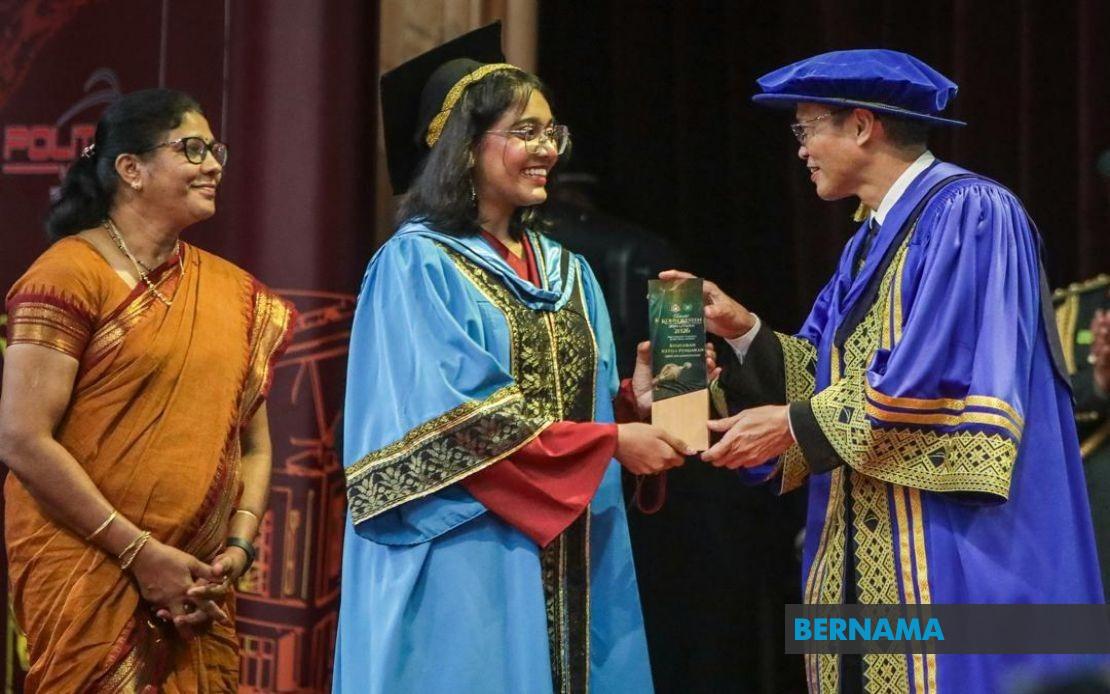
Teerti Ganapathi Rao's journey through Politeknik Tuanku Syed Sirajuddin (PTSS) demonstrates the power of resilience in the face of tragedy. The 22-year-old Diploma in Digital Technology student from the Department of Information and Communication Technology received dual honors at the first session of the 2026 Northern Zone Polytechnic and Community College Convocation Ceremony held in Arau today, earning both the Director-General's Award and the Academic and Co-Curricular Excellence Award. What makes her achievement particularly remarkable is that she accomplished this while carrying the weight of her father's death, which occurred during her Semester Two examinations in 2023—a period when most students are navigating the most demanding phase of their academic journey.
Teerti's cumulative grade point average of 3.61 reflects not merely academic competence but a determined commitment to excellence forged through adversity. Speaking to reporters at Dewan Harumanis on the PTSS campus, she expressed genuine surprise and gratitude upon learning of her selection. The recognition, she emphasized, held particular significance because of the circumstances under which she had studied. Her willingness to share her story underscores the importance of acknowledging that academic achievement often masks untold personal struggles, particularly among young Malaysians pursuing technical and vocational qualifications.
As the youngest of four siblings, Teerti credited her late father's counsel as the foundation of her perseverance. Her family dynamic appears to have played a crucial role in her success—specifically, her father's insistence that she complete her diploma rather than pursue an alternative foundation programme path. She revealed that she had seriously considered abandoning her studies during the difficult period following his death, but his earlier advice became an anchor that kept her focused on graduation. This intergenerational support, even across the boundary of loss, speaks to the profound influence parental guidance can exert on educational outcomes, a pattern increasingly documented in Malaysian higher education research.
During her three-year tenure at PTSS, Teerti's achievements extended well beyond classroom performance. She received the Head of Department's Award for three separate semesters—a distinction that demonstrates consistent excellence rather than isolated high achievement in a single term. Her involvement as a member of the Student Representative Council (MPP) provided her with leadership experience and developed her communication and teamwork capabilities, competencies that employers increasingly value as essential to technical professionals. These co-curricular involvements suggest that her pursuit of the digital technology diploma encompassed the holistic skill development required in contemporary IT sectors.
Teerti's academic credentials gained international dimension through her representation of PTSS in a collaborative programme and seminar paper presentation at Universiti Putra Indonesia, an opportunity that broadened her professional network and exposed her to regional academic standards. Her final-year project—the Koop Printing System—demonstrates practical application of her learning. This initiative was specifically designed to enhance the efficiency of cooperative printing service management, illustrating how polytechnic education in Malaysia increasingly emphasizes solving real-world business challenges rather than purely theoretical knowledge.
Her linguistic capabilities further distinguish her profile among her cohort. Beyond fluency in Bahasa Melayu and English, Teerti commands proficiency in Mandarin, Tamil, and Telugu, with foundational knowledge of French, Japanese, and Korean. In an increasingly interconnected Southeast Asian economy, such multilingual capacity represents a significant professional asset, particularly for individuals working in technology sectors where international collaboration is commonplace. This linguistic diversity also reflects Malaysia's multicultural composition and the practical value of cross-cultural communication skills.
Looking forward, Teerti is pursuing advanced study pathways that would represent substantial progression from her diploma qualification. She has applied to pursue a Bachelor's degree in Information Technology, with Universiti Malaya listed as her first choice institution. Her aspirations extend even further—she has explicitly articulated intentions to pursue a Doctor of Philosophy degree, positioning herself for potential roles in research, innovation, or advanced technical leadership within Malaysia's growing digital economy. Such ambitions, if realized, would transform her from a skilled technician into a knowledge creator.
Teerti's entry into digital technology came through an unconventional route—via video games and peer introduction to computers and coding when she was sixteen years old. This pathway is increasingly common among Malaysian youth, as recreational gaming communities inadvertently serve as entry points into technical fields. Her reflection that the field is challenging but manageable through systematic learning and conceptual understanding offers encouragement to other young Malaysians considering IT careers. The approachable way she describes technical mastery—not as an innate talent but as a step-by-step learning process—demystifies what many students perceive as inaccessible specializations.
The convocation ceremony graced by the Raja of Perlis, Tuanku Syed Sirajuddin Jamalullail, encompassed 6,104 graduates from polytechnics and community colleges across Perlis, Kedah, and Penang. This regional gathering, running through August 9, represents a significant milestone for vocational and technical education in northern Malaysia. Teerti's story, among thousands of graduate narratives, embodies the transformative potential of polytechnic education—an educational pathway that has historically been undervalued compared to university degrees but increasingly represents a direct route to skilled employment in Malaysia's technologically demanding sectors.
Her recognition carries implications for Malaysian education policy and institutional support structures. The formal acknowledgment of achievements despite personal hardship suggests that polytechnic institutions are developing mechanisms to identify and celebrate students who demonstrate exceptional resilience alongside academic performance. For policymakers, Teerti's trajectory illustrates the essential role of vocational education in developing Malaysia's human capital, particularly in emerging digital fields where demand significantly outpaces supply of qualified professionals.
The trajectory from loss to honor that Teerti has traveled resonates beyond individual achievement narratives. In a nation where technical skills gaps remain a significant economic challenge, her story demonstrates that talent and determination within the polytechnic system can produce graduates capable of competing at university level and pursuing advanced research qualifications. Her multilingual capacity, international exposure through collaborative academic programmes, and practical technology projects position her to contribute meaningfully to Malaysia's digital transformation agenda.

