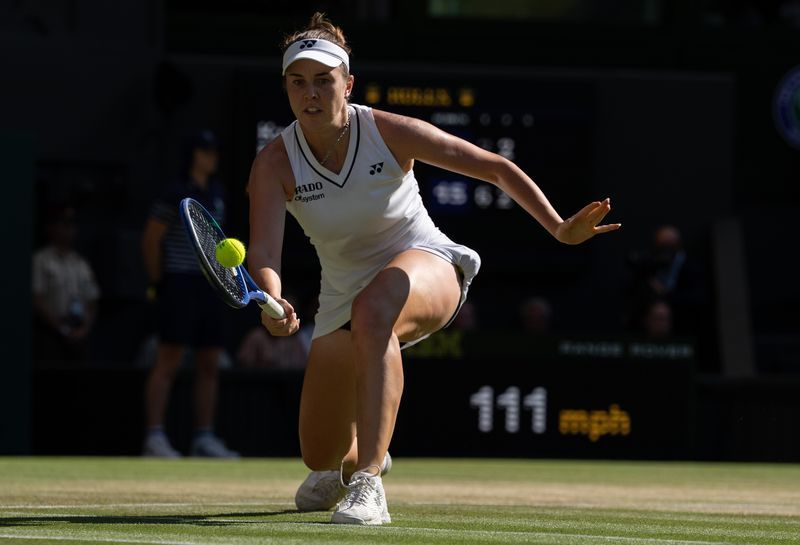
Linda Noskova has joined an elite group of Czech tennis champions after capturing the Wimbledon women's singles title with a stunning three-set victory over compatriot Karolina Muchova on Saturday. The ninth-seeded player, just 21 years old, overcame extraordinary adversity to claim the Venus Rosewater Dish following a collapse that would have ended most players' title dreams. When Noskova served at 5-2 in the second set with five separate match points available, the trophy appeared destined for her hands. Instead, the young Czech allowed her opponent to claw back five consecutive games, sending the match to a deciding set under circumstances that suggested her moment had passed. Few players in their maiden Grand Slam final would possess the psychological fortitude to recover from such a reversal, yet Noskova's response offers a masterclass in resilience under pressure.
The turning point came during a bathroom break when Noskova caught sight of the trophies awaiting the champion. Rather than dwelling on her missed opportunities, she reframed the situation with striking clarity. "I was just telling myself that the match is starting over," she explained afterwards. "The first step I took off court, the trophies were there. I was like, I'm not going to take the small one, I'm taking the big one." This moment of visual motivation—a physical reminder of what remained achievable—appeared to reset her mental state more effectively than any tactical adjustment could have. She returned to court and immediately held serve in the opening game of the third set, a seemingly small accomplishment that proved psychologically crucial.
Once that opening service hold was secured, Noskova's game transformed entirely. Her groundstrokes regained their precision timing, her movement around the court became fluid and purposeful, and her serve reliability returned when it mattered most. By the time she reached match points again at 5-3 in the third set, more than an hour had elapsed since her first opportunity. This time, there would be no escape for Muchova. Noskova's recognition of the importance of that first-game hold suggests a maturity beyond her years—she understood that preventing an early deficit would psychologically sustain her comeback. "If maybe I would have lost the first game, the third set would not have been the same," she reflected, demonstrating the kind of analytical thinking that separates champions from promising talents.
Noskova's path to this historic achievement carries particular significance within the broader context of contemporary Czech tennis. She becomes the third Czech woman to win the Wimbledon singles title in just four years, continuing a remarkable run of success that reflects the depth of talent emerging from the central European nation. More impressively, she is the youngest women's champion since her fellow Czech Petra Kvitova claimed the first of her two titles in 2011. This generational succession underscores how Czech tennis has maintained competitive excellence across decades, producing a pipeline of players capable of competing at sport's highest level. Her victory extends a legacy that includes champions like Karolina Pliskova, demonstrating that Czech women's tennis remains a force in international competition.
Beyond the statistics and match narrative lies a more compelling human dimension that characterises Noskova's worldview and approach to both sport and life. The young champion wears a distinctive nose ring and has demonstrated a maturity and perspective that extends far beyond the tennis court. She has spoken openly about her mother Ivana, who died from cancer two years ago, drawing emotional strength from her memory during tournament competition. This connection to personal loss provides context for understanding her resilience during Saturday's final—she has already navigated far greater heartbreak than a lost tennis match could represent. Her ability to compartmentalise disappointment and maintain emotional equilibrium appears rooted in this deeper understanding of life's fragility.
Noskova's character extends into her professional choices and social consciousness. Last year, she deliberately used her off-season to volunteer in Zanzibar, working at a school for a charity organisation rather than pursuing the conventional rest-and-recovery approach favored by many professional athletes. That experience fundamentally altered her perspective on her career and privileges. "When I came back, I was definitely more appreciative of everything that I have," she said, suggesting that exposure to different circumstances had broadened her understanding of global inequality. This willingness to step outside the insulated world of professional tennis and engage with communities beyond her own reflects a philosophical approach to her platform and responsibilities.
Her environmental consciousness and stated commitment to nature advocacy further illustrate Noskova's multidimensional character. She grew up in a village within a Czech forest, an upbringing that appears to have fostered a deep connection to natural ecosystems. She has described herself as "very much a nature lover" and has already begun volunteering work focused on environmental protection. Significantly, she has articulated a post-tennis career plan centered on conservation work, demonstrating that she views her athletic career as one chapter within a longer life dedicated to broader purposes. This perspective stands in contrast to many younger athletes who view their sport as their entire identity, suggesting psychological maturity and realistic planning that will serve her well regardless of how her tennis career ultimately unfolds.
The implications of Noskova's Wimbledon triumph extend beyond individual achievement into the realm of sporting psychology and mental resilience. Her recovery from five lost match points represents a case study in how perspective, preparation, and psychological flexibility enable athletes to overcome seemingly insurmountable adversity. The pivotal role played by a momentary visual reminder—glimpsing the trophies—demonstrates how environmental factors can unlock mental resources when conventional motivation falters. Her explicit reflection on the importance of holding serve in the third set's opening game shows how process-oriented thinking can anchor an athlete's attention during high-pressure moments. These elements combine to create a blueprint for handling crisis under elite-level pressure that extends beyond tennis into other competitive and professional contexts.
For Malaysian and Southeast Asian tennis audiences, Noskova's achievement offers several layers of relevance. Her victory demonstrates that breakthrough Grand Slam success remains possible for players outside the conventional talent pipelines and commercial powerhouses that typically dominate professional tennis. Her environmental advocacy and community-focused approach to wealth and platform resonate with growing values among younger athletes across the region regarding social responsibility. Additionally, her triumph at such a young age suggests that the window of opportunity for players to establish themselves at the highest level of professional tennis may extend longer than previously assumed, offering encouragement to emerging talents in the region who may currently feel behind schedule. The depth of her character development alongside her sporting excellence provides a counter-narrative to the often-narrow portrayal of professional athletes as one-dimensional competitors.
Noskova's post-match reflections captured the emotional weight of her achievement with appropriate gravity. "It was all worth it, so I will definitely never forget this week, these two weeks," she said, acknowledging that the preceding fortnight had represented a profound test of her character and capabilities. She had entered the final as the ninth seed without expectations of winning, then faced a scenario that would have provided a convenient narrative closure for failure. Instead, she authored a different story—one of recovery, resilience, and unwavering commitment to her ultimate objective. As she absorbs the reality of becoming a Grand Slam champion at just 21 years old, Noskova carries with her the lessons learned during those crushing moments when five different paths to victory slipped through her grasp. Those missed opportunities, paradoxically, may prove as valuable to her future success as the trophy itself.

