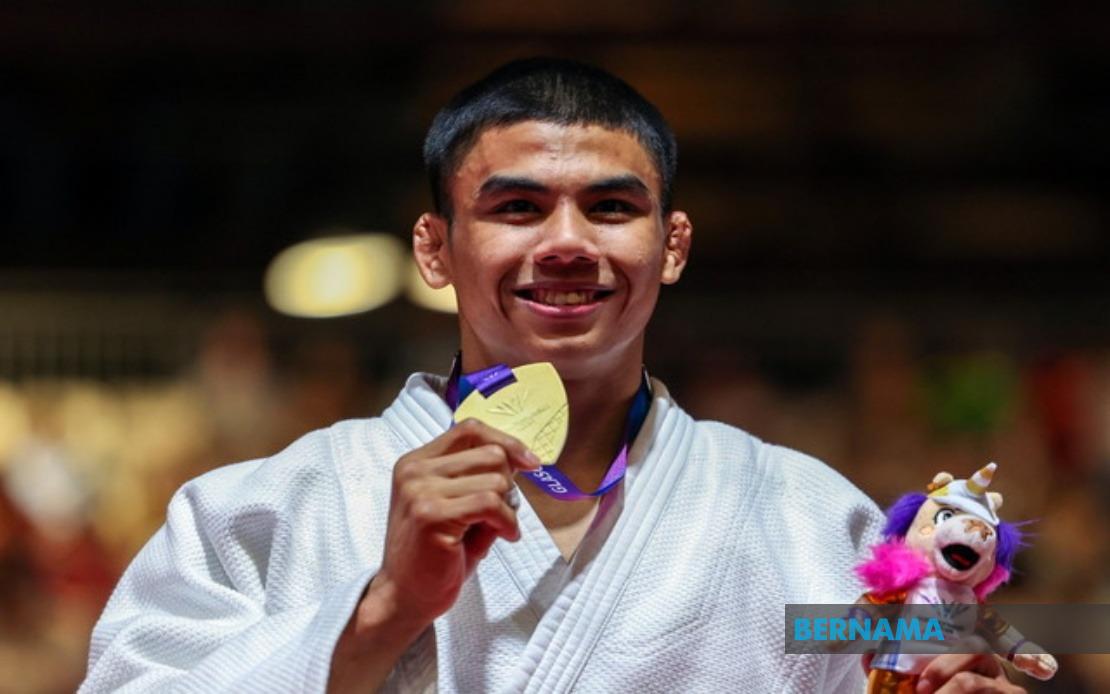
At just 21 years old, Amir Daniel Abdul Majeed has already accomplished what many judokas aspire to achieve—earning a Commonwealth Games gold medal. Yet his recent pivot into coaching has presented him with an entirely unexpected challenge, one that he confesses carries considerably more weight than stepping onto the competition mat. Speaking at the IDCC Ideal Convention Centre during SUKMA Selangor 2026 in Shah Alam, the young mentor reflected on how his role as assistant coach of the Penang judo contingent has introduced a form of pressure he had not previously encountered as an athlete.
The psychological shift from personal competitor to team mentor represents a fundamental transformation in how Amir approaches the sport he loves. During his years as an active judoka, he bore responsibility only for his own performance—managing his nerves, executing technique, and delivering results that depended primarily on his individual effort. That singular focus created a contained pressure sphere. Now, overseeing 13 athletes introduces exponential complexity. Each member of his squad carries their own anxieties, technical limitations, and potential for both breakthrough and setback. Amir finds himself accountable not merely for his coaching decisions but for the emotional and competitive trajectories of an entire group.
What makes this transition particularly poignant is Amir's personal connection to his charges. Many of these judokas have trained alongside him since childhood, and he has witnessed their development from junior competitors into athletes capable of contending at Malaysia's premier multi-sport event. This familiarity, while creating deeper bonds and mutual understanding, simultaneously amplifies the emotional stakes of coaching. When an athlete he once competed with fails to execute under pressure or struggles with injury, the disappointment reverberates differently than it would with unknown competitors. This psychological dimension of coaching—the accumulated investment in individual athletes' journeys—represents a dimension of the sport that statistics and medal counts cannot fully capture.
Penang's showing at SUKMA Selangor 2026 validated Amir's early work in his coaching capacity. The state's judo team concluded their three-day participation with a medals haul of three gold, one silver, and five bronze—a tally sufficient to secure joint-top status with Johor in the overall medal standings. This respectable performance underscores that Amir's transition to coaching has not diminished his ability to contribute meaningfully to Malaysian judo's competitive progress. The medals earned reflect not only the talent level of Penang's athletes but also the quality of guidance they received during their preparation and competition phases.
Beyond his current coaching responsibilities, Amir's competitive aspirations remain very much alive and directing his broader trajectory in the sport. He is awaiting formal confirmation of his selection for the Aichi-Nagoya 2026 Asian Games in Japan, with the selection meeting scheduled to convene imminently. The prospect of competing in Japan's Asian Games—one of the sport's marquee continental competitions—represents a significant waypoint on his mapped journey toward Olympic participation. For Malaysian judokas, the Asian Games serve as a critical testing ground where they can measure their development against the region's strongest competitors while gaining valuable experience on an international stage.
Amir's understanding of the Aichi-Nagoya Games encompasses awareness of the quality differential between Malaysian domestic competition and the elite level encountered in Japan. The Asian Games will feature judokas from powerhouse nations such as Japan, South Korea, and China—countries with decades of sustained investment in judo development, elite coaching infrastructure, and pipeline systems that produce generation after generation of world-class competitors. For a Malaysian athlete of Amir's ambitions, competing in this environment provides exposure to techniques, tactical approaches, and competition intensity that cannot be replicated through domestic tournaments alone.
His articulated goal of securing multiple bouts during the Asian Games reflects sophisticated thinking about athlete development. Each match represents not merely points or medals but a learning opportunity—a chance to identify technical gaps, test new strategic approaches, and build the mental resilience required for sustained international competition. This mentality, where matches are valued as developmental experiences rather than solely as opportunities to collect medals, distinguishes athletes with genuine Olympic aspirations from those content with domestic success.
The alignment between Amir's coaching role and his competitive ambitions creates an interesting dynamic within Malaysian judo. As an assistant coach, he gains insight into how top athletes develop, what mistakes emerging competitors make, and how to structure training for maximum competitive readiness. Simultaneously, his own continued participation at elite levels maintains his credibility as a mentor and demonstrates to younger athletes that their coach not only teaches theory but actively practices what he preaches. This dual engagement—coaching while still competing—remains relatively rare among young Malaysian athletes and speaks to his commitment to advancing the sport comprehensively.
The SEA Games Malaysia 2027 looms as another significant marker on both Amir's competitive calendar and Malaysian judo's collective roadmap. Successfully navigating the Asian Games in 2026 would position him advantageously for a home continental championship, where competing in Malaysia while serving as either an active athlete or mentor would amplify whatever contributions he makes to his sport. The thirteen-month span between the Asian Games and the SEA Games offers a critical window for consolidating gains, addressing weaknesses identified in Japanese competition, and preparing for a more intense campaign at home.
For Malaysian sporting observers, Amir Daniel's current chapter illustrates broader realities about athletic careers in developing sports nations. Few athletes of his calibre can sustain indefinite careers at the highest competitive levels; coaching transitions often become not optional sidebar activities but necessary professional pivots. What distinguishes athletes like Amir is their willingness to embrace this evolution while maintaining competitive aspirations. Many judokas of lesser ambition might have withdrawn from active competition entirely upon accepting a coaching position. Instead, Amir treats his dual roles as complementary rather than mutually exclusive, enriching both his contribution to Malaysian judo and his personal development as an athlete.
The transition from mat athlete to sideline mentor that Amir currently navigates encapsulates a broader lesson within Malaysian sports development. Success at the international level requires not merely talented individual performers but also the cultivation of experienced coaches who understand elite competition's demands. By remaining actively involved in competition while simultaneously guiding emerging talent, Amir is positioning himself to contribute to Malaysian judo's long-term progression. His journey from Commonwealth Games medallist to assistant coach represents not the beginning of decline but rather the expansion of his influence within a sport to which he remains deeply committed.

