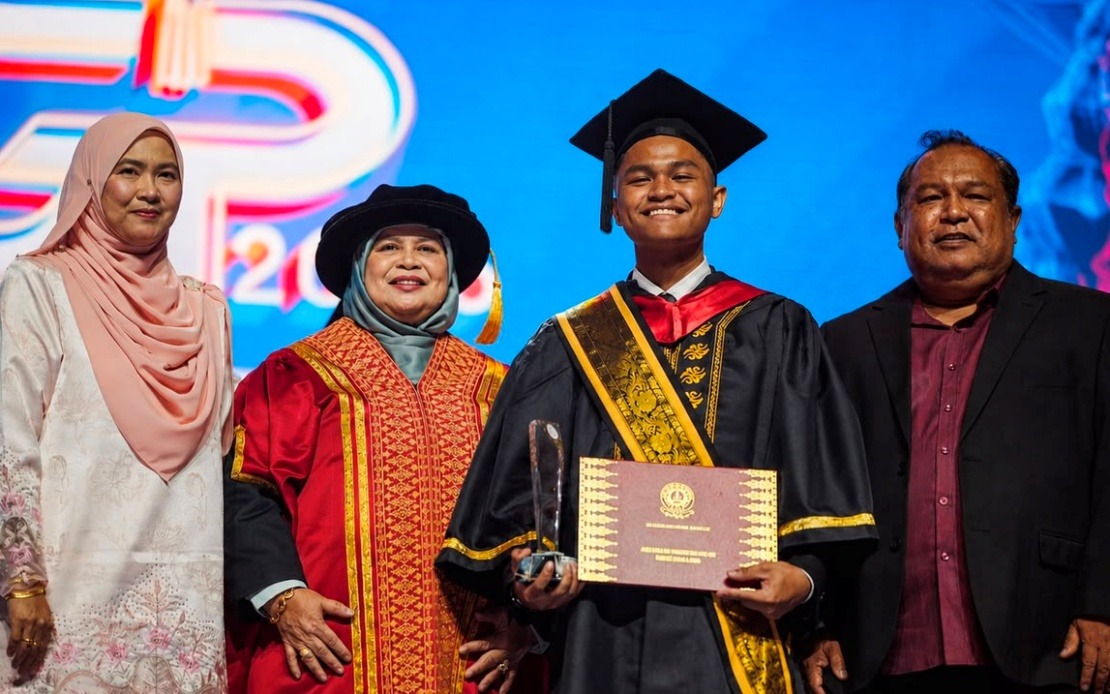
Muhammad Aaqif Dino Faezal's educational trajectory exemplifies how strategic government sponsorship can unlock international opportunities for talented Malaysian students. The 19-year-old, who began his secondary education at MARA Science Junior College (MRSM) Tun Ghafar Baba in Melaka, has secured admission to Imperial College London to pursue a degree in Geology, marking a significant achievement for both the scholar and Malaysia's talent development infrastructure. His recognition as the 2026 MARA College Graduate Icon on August 20 reflects not only his academic excellence but also the transformative power of Majlis Amanah Rakyat (MARA) in bridging the gap between aspiring Malaysian students and world-class educational institutions.
The financial barrier to overseas education has long remained one of the most significant obstacles facing talented students from middle and lower-income backgrounds in Malaysia. Muhammad Aaqif candidly acknowledged that without MARA's sponsorship support, pursuing higher education abroad would have remained an unrealistic aspiration. The cost of international study encompasses not merely tuition fees but equally substantial living expenses, international travel, and accommodation in expensive cities—factors that collectively place premium university experiences beyond reach for many deserving Malaysians. By removing this critical constraint, MARA's investment in young talent creates ripple effects that extend far beyond individual achievement, potentially reshaping Malaysia's human capital in critical sectors and strengthening the country's competitive position in the global knowledge economy.
Muhammad Aaqif's pathway through the system demonstrates the effectiveness of MARA's structured approach to talent identification and development. Having completed his International Baccalaureate Diploma Programme (IBDP) at Kolej MARA Banting (KMB) between 2024 and May 2026 under the Young Talent Development Programme (YTP), he benefited from a comprehensive educational ecosystem designed to prepare Malaysian students for international-standard academic rigour. The IBDP curriculum's emphasis on critical thinking, interdisciplinary learning, and global perspective proved instrumental in preparing him not merely for Imperial's entrance requirements but for the intellectual demands of studying at one of the world's most prestigious scientific institutions. His exceptional performance in this demanding programme—culminating in 44 out of 45 points—underscores both his individual capability and the quality of education delivered through MARA's college network.
The distinction between academic achievement alone and holistic excellence forms a central tenet of MARA's educational philosophy, and Muhammad Aaqif's record reflects this broader vision. During his time at KMB, he simultaneously pursued demanding coursework and assumed substantive leadership responsibilities as president of the Students' Representative Council (MPP). This dual focus produced measurable benefits beyond the typical resumé enhancement: he developed sophisticated time-management capabilities essential for success in competitive international environments, honed genuine leadership competencies through real-world student governance, and cultivated self-confidence grounded in practical experience rather than theoretical study. These qualities—often overlooked in purely academic merit assessments—constitute precisely the attributes that distinguish exceptional graduates who navigate unfamiliar institutional contexts with resilience and adaptability.
KMB director Arfaseela Amir's assessment of Muhammad Aaqif's development illuminates MARA's strategic objective of cultivating intellectually capable individuals who simultaneously possess robust character foundations. The institution's emphasis on producing graduates equipped for international competition while maintaining strong ethical moorings represents a deliberate pedagogical choice, particularly significant in the Malaysian context where concerns periodically surface regarding whether overseas-educated professionals retain sufficient connection to national development priorities. By insisting that excellence encompass character development, collaborative capacity, and community engagement alongside intellectual achievement, MARA attempts to ensure that internationally trained talent remains oriented toward constructive contribution to Malaysian society rather than purely individual advancement abroad.
Muhammad Aaqif's intended focus on the oil, gas, and energy sectors reflects a thoughtful alignment of personal expertise with Malaysia's strategic economic interests. His geology specialization positions him to contribute substantively to Malaysia's extractive industries and broader energy transition challenges—sectors where technical expertise combined with deep national context understanding proves particularly valuable. Rather than pursuing studies in abstract theoretical domains disconnected from practical application, his choice suggests a maturity of purpose and awareness of how international education can serve national development objectives. For MARA and Malaysian policymakers, such instances where internationally educated talent consciously directs expertise toward priority national sectors validate the investment logic underlying scholarship programmes.
The recognition framework surrounding the MARA College Graduate Icon Award itself merits examination as an institutional mechanism for reinforcing desired values. By selecting the award recipient from among Best Graduate Award awardees based on criteria encompassing not merely academic achievement but leadership qualities, societal contribution, and icon-status potential, MARA signals that excellence requires multidimensional development. This approach contrasts with educational systems that elevate purely academic rank-ordering, instead embedding institutional values into prestige hierarchies. For Malaysian students navigating their educational choices, such frameworks offer clarification regarding what their educational institutions genuinely value, potentially encouraging the kind of well-rounded development that Muhammad Aaqif exemplified.
Muhammad Aaqif's positioning as the second of three siblings introduces an understudied dimension of educational opportunity—the family dynamics surrounding sponsored education. His reflections emphasising family sacrifice and support suggest that understanding individual achievement requires recognizing the household context within which sustained academic effort occurs. MARA scholarship programmes, by reducing financial barriers for individual beneficiaries, simultaneously acknowledge and honour the broader family investment in that beneficiary's education. For Malaysian families navigating educational decisions with limited resources, programmes like MARA's Young Talent Development Programme effectively democratize access to credentials that historically remained concentrated among more affluent households, thereby altering intergenerational trajectory possibilities.
The significance of Muhammad Aaqif's admission to Imperial College London extends beyond his personal advancement to represent Malaysia's positioning within global knowledge hierarchies. Imperial consistently ranks among the world's top ten universities in earth sciences and related disciplines, making it a preferred destination for serious geology students worldwide. Malaysian presence within such elite institutions, particularly in STEM fields critical to future economic competitiveness, strengthens Malaysia's informal networks within global scientific communities and contributes to the country's intellectual reputation. Each Malaysian graduate from Oxbridge, Imperial, MIT, or comparable institutions potentially becomes an ambassador for Malaysian talent and a node within international professional networks from which Malaysia benefits as these individuals progress through their careers.
The emotional resonance Muhammad Aaqif described upon receiving the award—his reflection on challenges overcome and collective support received—points toward the psychological dimensions often overlooked in discussions of educational policy. Scholarship programmes function not merely as mechanisms for resource transfer but as instruments that communicate institutional recognition of student capacity and worthiness. For a young person navigating the competitive pressures of international-standard education while managing financial precarity, explicit recognition by a prestigious national institution carries affirmation value that extends beyond the scholarship's material benefits. This psychological dimension may prove particularly significant for Malaysian students whose family backgrounds offer limited exposure to elite educational institutional cultures, requiring them to navigate unfamiliar environments with less inherited cultural capital than more privileged peers.
As Muhammad Aaqif embarks on his Imperial College London journey in September, his trajectory will likely be observed within Malaysian educational circles as a case study in successful talent development and internationalization. His progression from MRSM through KMB to Imperial represents an increasingly common pathway for high-achieving Malaysian students, yet remains sufficiently rare and challenging that each successful completion warrants analytical attention. The question of whether he ultimately fulfils his intention to contribute expertise to Malaysia's energy sectors—or whether, as frequently occurs, international education proves the first step toward permanent relocation—will itself constitute valuable data regarding the returns on MARA's talent investment and the challenges of retaining internationally educated professionals within Malaysia's knowledge economy.

