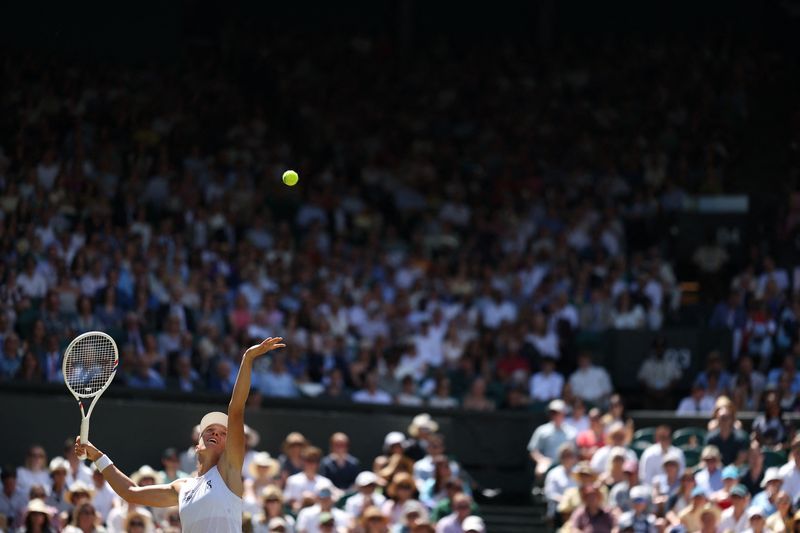
Alexandra Eala's remarkable run at Wimbledon reached new heights on Saturday when the rising Filipino sensation defeated defending champion Iga Swiatek in a thrilling third-round encounter at the All England Club in London. The 19-year-old left-hander claimed a commanding 7-6(9) 6-2 victory over Poland's third-seeded Swiatek in a match that demonstrated both her exceptional court prowess and emotional depth. The victory catapulted Eala into the second week of a Grand Slam tournament for the first time, marking a watershed moment in her professional career and cementing her status as one of tennis's most exciting emerging talents.
Swiatek's title defence crumbled in the face of Eala's relentless baseline attack and unwavering composure under pressure. The Polish champion had arrived at the All England Club searching for consistency after an unexpected early exit at the Bad Homburg tune-up tournament just days before the Grand Slam began. Though Swiatek had successfully navigated her previous two rounds, dispatching Taylor Townsend and Karolina Pliskova with relative ease, she found herself outmatched against an opponent playing with the confidence and precision of a seasoned veteran despite her young age. The match unfolded as a fierce contest between two contrasting styles, with Eala's powerful shot-making ultimately overwhelming Swiatek's usually reliable clay-court sophistication, even on grass.
The opening set proved to be a fiercely contested affair that went to a tiebreaker, with neither player yielding any easy opportunities. Eala's dominant baseline game, powered by her formidable left-handed technique, gave her an early edge that forced Swiatek to dig deep into her reserves. The momentum swung back and forth throughout the opening stanza, with both competitors extracting maximum effort from each point. When the set reached its climactic tiebreaker, Eala's nerve held firm as she seized the crucial 9-7 victory, capturing the 40-minute set and establishing psychological dominance. Swiatek's frustration became apparent as she displayed visible irritation, directing animated comments toward her coaching team in the stands and at one point forcefully striking her racket against a courtside chair.
Eala's intensity only intensified in the second set as she seized the momentum from her opening-set triumph. The Filipino star earned an immediate double break, racing to a commanding 3-0 lead that appeared to place victory within striking distance. Her left-handed power shots continued to trouble Swiatek's defensive positioning, with Eala targeting the Polish champion's weaker side and dominating the baseline exchanges. However, Swiatek mounted a brief counter-offensive, retrieving one of the broken serves in an attempt to shift the match's trajectory. Yet Eala's aggressive mindset remained unshaken, and she ultimately closed out the contest with characteristic authority, clinching victory with a precise forehand winner. The win secured a fourth-round showdown with 2024 runner-up Jasmine Paolini, positioning Eala for a potentially even more challenging test.
In her post-match remarks, an emotionally overwhelmed Eala struggled to articulate the magnitude of her accomplishment. The young star reflected on her improbable journey from childhood training sessions in the Philippines alongside her brother and grandfather, conducting daily practice in her worn socks and light-up shoes while sporting childlike determination. She acknowledged the significance of her achievement for her home nation while simultaneously demonstrating the hunger that defines truly elite competitors. Eala articulated how opportunities like facing a multiple-time Grand Slam champion represent rare blessings that demand complete commitment and unwavering focus. She paid tribute to Centre Court itself, describing it as the dream venue she had fantasised about since childhood, and expressed profound gratitude toward the enthusiastic crowd whose support energised her performance throughout the contest.
Eala's narrative resonates particularly powerfully across Southeast Asia, where tennis success at the highest levels of professional competition remains relatively rare. The Philippines, like many regional nations, has produced occasional promising players but rarely sees homegrown talent reach the second week of major championships. Eala's breakthrough carries symbolic weight extending far beyond the sport itself, demonstrating that athletes from less traditionally dominant tennis nations can compete successfully against the world's most established players when combining talent with relentless dedication. Her victory over Swiatek, a player with three Grand Slam titles already in her collection at just 25 years old, suggests that tennis's traditional hierarchies may be gradually shifting toward a more globally distributed competitive landscape.
Swiatek's defeat also carries broader implications for understanding the evolution of women's professional tennis. The champion's struggle on grass serves as a reminder that grass-court prowess remains a specialised skill requiring specific preparation and technical adjustments. Despite Swiatek's 2023 Wimbledon triumph, her performance at this year's tournament demonstrated the difficulty of mounting back-to-back successful campaigns at any major championship. The Polish champion's early loss to less prominent opponents during warm-up competitions suggested that her clay-court dominance does not automatically translate to sustained grass-court excellence. Eala's victory therefore reflects not merely individual brilliance but also the intensifying competitiveness at professional tennis's highest echelon, where any slight diminution in form creates openings for emerging challengers.
The Centre Court atmosphere during Eala's victory provided a compelling backdrop for her breakthrough performance. The crowd's enthusiastic support for the underdog challenger seemed to energise her court presence, while Swiatek's visible frustration suggested that the psychological dimensions of the contest had shifted decisively in Eala's favour by the match's conclusion. Eala's youthful exuberance, combined with her appreciative acknowledgment of the crowd's backing, created a narrative appeal that transcended the technical dimensions of the competition. The tennis establishment's traditional deference toward established champions seemed momentarily suspended in recognition of Eala's legitimate achievement and authentic emotional response.
Eala's advancement into the second week represents validation of the investment the Philippine tennis federation has made in developing her career, though her own family's contribution to her development cannot be overlooked. Her grandfather's daily involvement in her training, alongside her brother's partnership in practice sessions throughout her childhood, underscores how familial support structures prove essential for developing world-class competitors outside traditional tennis powerhouses. These personal relationships, conducted without the elaborate infrastructure available to players from wealthier tennis nations, ultimately proved sufficient to cultivate the technical and mental capabilities necessary for defeating a reigning champion. Eala's ascent therefore offers inspiration to aspiring players throughout the region who may lack access to the resources available to European and North American competitors.
Looking toward her fourth-round engagement with Paolini, Eala faces a formidable opponent who reached the 2024 Wimbledon final just months prior. Paolini's recent success at the highest levels indicates that Eala's next challenge will prove substantially more demanding than her victory over Swiatek, regardless of the momentum she has generated. Nevertheless, Eala's demonstrated ability to execute under extreme pressure against an elite opponent suggests that she possesses the mental resilience and technical foundations necessary for sustained success at the Grand Slam level. Her emotional maturity, evident in acknowledging both her achievement's magnitude and her continuing hunger for advancement, distinguishes her from many players who falter psychologically after breakthrough victories.
Eala's journey from childhood afternoons playing alongside her brother in Philippine tennis courts to defeating a three-time Grand Slam champion on grass encapsulates the increasingly global nature of professional tennis excellence. Her breakthrough arrives at a moment when women's tennis is experiencing unprecedented competitive depth, with multiple nationalities and backgrounds represented among the sport's most accomplished competitors. As Eala continues her Wimbledon campaign, she carries with her not only her own aspirations but also the hopes of a tennis-loving nation that rarely witnesses its representatives achieving sustained success at the sport's highest level. Her victory over Swiatek represents far more than a single match result; it constitutes a validation of perseverance, a demonstration of global talent distribution, and an inspirational narrative for young athletes throughout Asia confronting the challenge of competing against the world's most established tennis powers.

