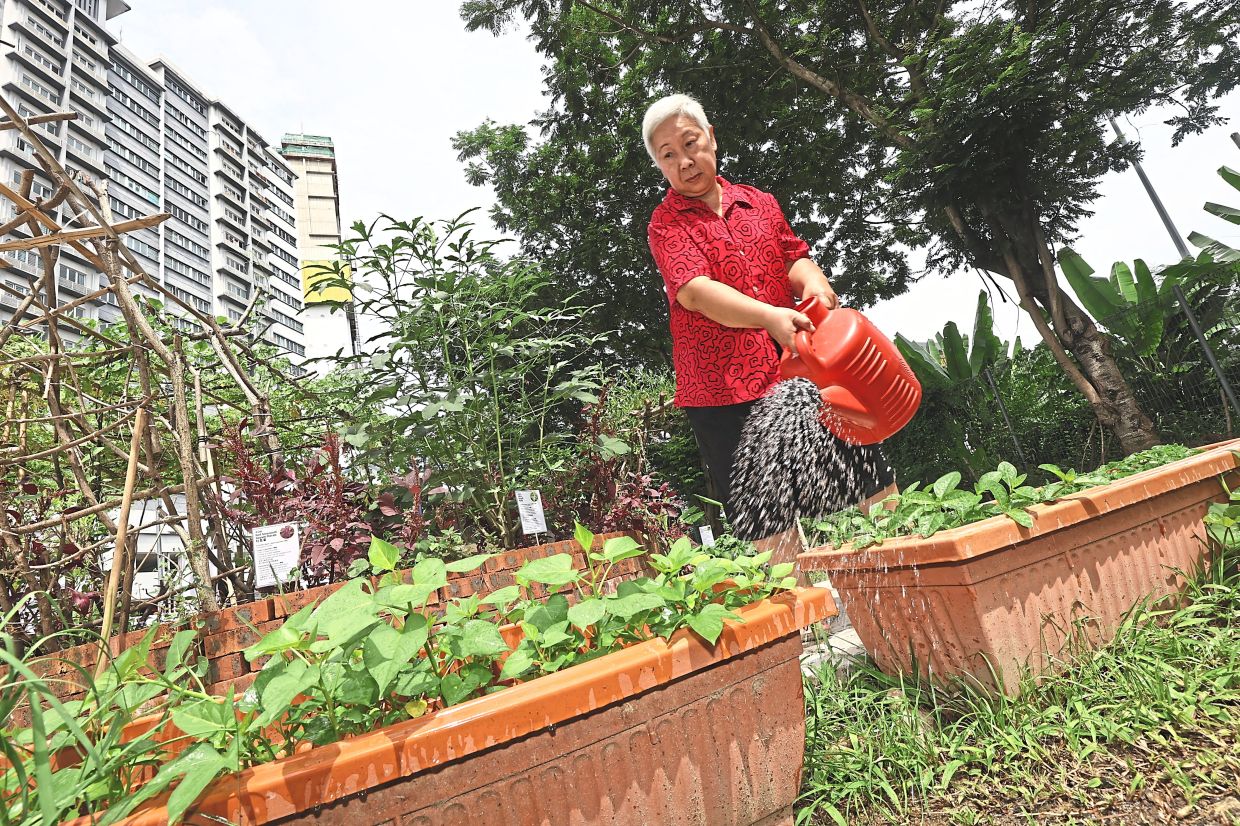
What was once an overgrown, abandoned field deteriorating behind 1Razak Mansion in Kuala Lumpur has undergone a remarkable metamorphosis into a flourishing community garden. The barren space, initially choked with wild vegetation and bordered by the building's waste facilities, now features meticulously arranged plantings of herbs, vegetables, fruit-bearing trees, and ornamental flowers. This transformation, recently celebrated at the official launch of the 1Razak Mansion Food Forest, represents more than just horticultural reclamation—it addresses a pressing demographic reality affecting urban Malaysia's residential communities.
The project emerged from a deliberate partnership between social enterprise PWD Smart FarmAbility, the building's management corporation, and engaged residents. What distinguishes this initiative is its explicit recognition of the residential composition at 1Razak Mansion, where approximately 80 percent of occupants are senior citizens. As Minister Hannah Yeoh highlighted during the launch ceremony, this demographic concentration demands thoughtful programming that extends beyond conventional physical activity offerings. While residents already enjoy established exercise classes such as tai chi, the recognition that mental wellbeing requires equally robust attention represents a significant shift in how urban residential spaces approach holistic community care.
For resident Alice Fernandez, aged 64, the garden has already integrated itself into daily routines and become a source of measurable benefit. The transformation holds particular significance because the previously neglected corner sat uncomfortably close to the refuse facilities, effectively positioning it as a space residents actively avoided. The beautification and functional redesign have fundamentally altered its social utility. Fernandez articulates how the garden simultaneously addresses economic pressures facing fixed-income seniors while nurturing psychological restoration. Access to harvestable produce directly reduces household expenditure on groceries, a consideration of genuine consequence for retirees managing limited pensions. Beyond material advantage, the simple act of tending plants—watering, weeding, observing growth cycles—provides structured purposeful activity that combats the isolation and purposelessness that frequently accompanies retirement.
Fernandez's newly established routine of visiting the garden after her morning jog demonstrates how the space has become woven into the social fabric of daily life at 1Razak Mansion. She has progressed from casual visitor to active participant, voluntarily contributing maintenance labour during leisure hours. This transition from passive beneficiary to engaged stakeholder typifies how well-designed community spaces can catalyse broader participation and ownership. The garden has inadvertently created what urban planners recognise as a "third place"—neither home nor workplace, but a valued community gathering point that encourages social interaction and physical movement.
Thieeben Sivabalasingam, 38, occupied a behind-the-scenes role during the project's realisation, managing logistical coordination throughout the construction phase. His visceral reaction upon witnessing the completed garden alongside his three-year-old son Aiden underscores how transformative environments affect not merely the elderly population but younger generations exposed to sustainable practices. Sivabalasingam's observation about the difficulty of envisioning the finished product during the material delivery stage illustrates the deliberate, methodical approach that characterised the garden's development. The cumulative labour of numerous contributors produced something that appeared to materialise organically once completed, though it required sustained coordination and effort.
Sivabalasingam articulates an insight that resonates throughout discussions of successful ageing: senior citizens require not merely sustenance but purpose. The garden provides structured activity requiring regular engagement, establishing rhythms and expectations that combat the psychological deterioration that accompanies purposelessness. Beyond the provision of nutritious food, the act of cultivation offers meaning and forward-looking motivation. This addresses a vulnerability specific to retirement transitions, where loss of work-related structure and identity can precipitate emotional decline.
The garden's significance extended beyond the immediate 1Razak Mansion community, attracting attention from residents of the neighbouring Razak City Residences. Jenny Wong, 70, and her husband KC Wong, 76, travelled specifically to attend the launch, recognising it as a model applicable to their own residential setting. Their observation that the garden represents an opportunity to merge hobby cultivation with environmental responsibility captures how modern retirees increasingly seek engagement that transcends personal recreation to encompass broader community contribution. The Wongs' expressed desire to implement similar initiatives in their residential community demonstrates how successful projects generate replicable templates adaptable across multiple urban settings.
Dr Billy Tang Chee Seng, the 60-year-old founder of PWD Smart FarmAbility, explicitly positions this garden as a foundational stepping stone rather than a completed endpoint. His vision encompasses educational dimensions extending beyond simple harvesting into skills development and scientific literacy. The planned construction of a central kitchen hub will transform the garden from a production space into a teaching laboratory, enabling residents to understand agricultural science while learning practical cooking skills connected to their harvested crops. This progression from production to processing to consumption completes a pedagogical cycle that connects abstract scientific concepts to tangible outcomes.
The incorporation of microscopes for younger residents addresses an equally important dimension: environmental education for children. By introducing microscopic examination of soil composition and microbial communities, the project bridges generational learning gaps and cultivates scientific curiosity rooted in observable, accessible phenomena. This approach to informal science education proves particularly valuable in urban Malaysian contexts where many children lack regular exposure to agricultural processes and ecological systems.
The food forest initiative ultimately represents a sophisticated response to interconnected urban challenges. It addresses food security concerns through community production, tackles mental health vulnerabilities within an ageing demographic, creates opportunities for intergenerational knowledge exchange, and transforms underutilised urban land into productive community assets. For Malaysian urban planners and policymakers observing this model, it demonstrates how relatively modest interventions strategically designed around demographic realities can generate substantial wellbeing improvements. As Malaysia's population ages—with projections indicating that seniors will comprise an increasingly significant demographic cohort—such community-centred solutions offer scalable alternatives to institutional approaches that often marginalise elderly residents from meaningful participation in community life.
The success of 1Razak Mansion's food forest also suggests pathways for addressing broader housing policy questions. As Malaysia continues developing residential communities housing predominantly senior populations, architectural and programmatic planning must integrate spaces and activities explicitly designed around ageing residents' physical and psychological needs. The garden demonstrates that such integration need not entail substantial capital investment but rather requires intentional design thinking, community mobilisation, and willingness to reimagine existing spaces through asset-based rather than deficit-based perspectives.

