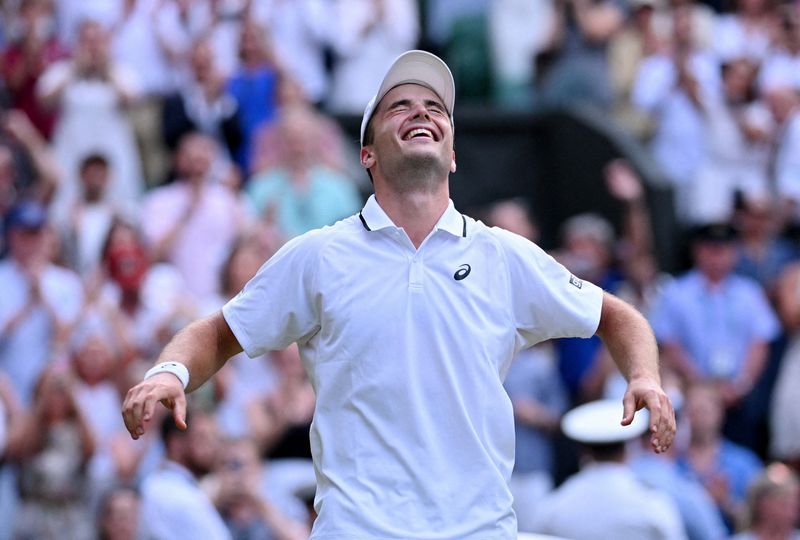
Arthur Fery's journey to the Wimbledon semi-finals reads like a screenplay that studio executives would reject as implausibly optimistic. The 23-year-old wildcard entrant, ranked 114th globally and boasting merely two previous Grand Slam match victories, has defied every expectation to stand on the cusp of tennis history. His path to Friday's semi-final against French Open champion and second seed Alexander Zverev represents one of sport's most compelling underdog narratives, one that could yet culminate in him winning the tournament on his 24th birthday and joining an extraordinarily exclusive club.
Fery's story is uniquely intertwined with Wimbledon itself. Growing up within walking distance of Centre Court, he attended King's College in Wimbledon and came through the British tennis system from childhood. His Anglo-French heritage—born in the Parisian suburb of Sèvres to a French mother who competed professionally and a hedge fund manager father who owns French football club Lorient—might have seen him pursue a different tennis path. Yet when the moment came to choose his sporting allegiance, Fery experienced no internal conflict. His formative years, education, and deep roots in southwest London made his decision to represent Britain feel inevitable rather than opportunistic.
What distinguishes Fery from many young players chasing Grand Slam glory is his deliberate choice to pursue an unconventional trajectory. Rather than joining the professional circuit immediately, he opted for the American university route, matriculating at Stanford University where he majored in science, technology and society. There, he rose to become the nation's top-ranked collegiate player, gaining not just sporting credentials but also an educational foundation. This measured approach suggests a maturity and strategic thinking that has clearly transferred to his on-court performance, where he demonstrates a calmness under pressure that belies his lack of previous experience at this level.
His quarter-final victory over ninth seed Flavio Cobolli on Wednesday provided a glimpse of Fery's mental fortitude and technical prowess. Playing on a steamy Centre Court, he dismantled his opponent 6-4, 7-6(4), 6-0, becoming only the fifth British man in the professional era to reach the Wimbledon semi-finals. The performance drew admiration from tennis royalty, with eight-time Wimbledon champion Roger Federer observing approvingly during Fery's five-set thriller against Grigor Dimitrov in the previous round. More symbolically, Queen Camilla watched from the Royal Box on Wednesday, congratulating him personally after the match, while Princess Kate had cheered him on in an earlier round.
Fery's physical presence belies his competitive stature. At five feet nine inches tall, he appears to access shots that his frame suggests should be beyond reach, returning balls with a determination and athleticism that frustrated Cobolli throughout their encounter. His ability to feed off crowd energy transformed Centre Court into his personal advantage, the familiar surroundings providing psychological comfort that few other players on the professional tour could experience at this venue. When asked about the psychological weight of his remarkable run, Fery demonstrated the philosophical detachment that has characterised his responses throughout the tournament, noting simply that the rapid succession of matches kept him focused rather than allowing time for apprehension to accumulate.
Fery's semi-final appearance arrives at a moment when British tennis desperately required a rallying point. The home nation suffered a catastrophic opening round, with fifteen of its nineteen singles players eliminated in the first round. Suddenly, an unlikely candidate has become the standard bearer for British tennis at its most prestigious tournament. The irony is not lost on French observers, who might reflect that France nearly produced a Wimbledon champion through Fery's early representation. His father told L'Équipe that his son was "a true Wimbledon boy," drawing a parallel to how unusual it would be for a child raised in Boulogne to win at Roland Garros. The family's decision to base themselves in London created the conditions for this remarkable narrative.
Fery now confronts Alexander Zverev, a player of considerably greater experience and ranking. Zverev brings the prestige of a French Open title and world number two seeding, marking a significant escalation in quality from the players Fery has defeated so far. Yet Fery's trajectory suggests he has grown into this tournament, each match providing additional experience and confidence. His measured demeanor—the phrase "staying in my bubble and just carrying on" encapsulates his philosophy—indicates someone unlikely to be overwhelmed by the magnitude of the occasion or opponent.
Should Fery overcome Zverev, he would face an opponent in the final on his birthday with an opportunity that has materialised for only one previous wildcard in Wimbledon's modern history. Goran Ivanisevic's 2001 triumph remains the benchmark against which all wildcard dreams are measured. Fery's journey has the elements of that narrative—the unlikely entrant, the local connections, the emotional support from the crowd and royalty alike—yet his is distinctly his own story, rooted in a young man who chose his path deliberately rather than stumbling into it.
The question now becomes whether Fery's composure and emerging mastery will prove sufficient against the elevated quality that awaits. His college education and measured approach to life off court suggest someone capable of processing success without losing perspective. Zverev will represent a substantial step up, but Fery has already demonstrated an ability to elevate his game when circumstances demand. The Wimbledon boy's dream, improbable though it remains, has already exceeded what most observers would have predicted three weeks ago, and the tournament's conclusion may yet provide a conclusion that rivals anything in its storied history.

