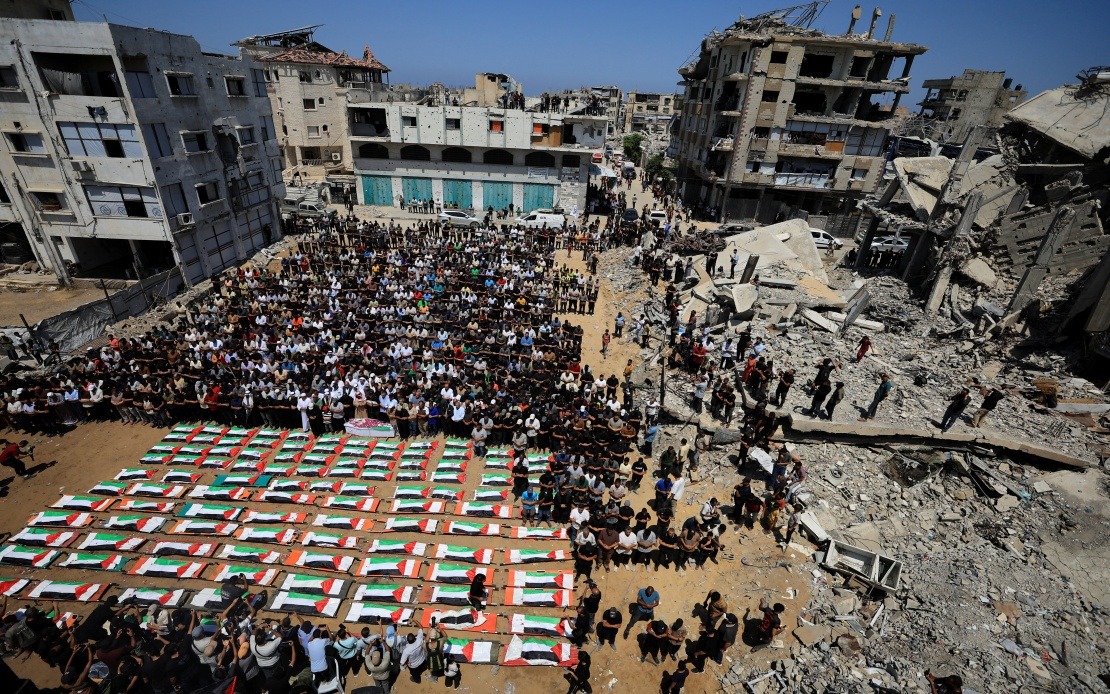
The situation facing ordinary Gazans has become increasingly precarious as negotiations over the ceasefire's second phase encounter fresh obstacles, leaving families like that of Saeed Helles suspended between cautious optimism and mounting despair. The 55-year-old father of five has spent recent days tracking diplomatic developments with intense focus, driven by the urgent medical needs of his 13-year-old daughter Saja, who requires cancer treatment available only outside Gaza. For Helles and thousands of others in the territory, the success or failure of these talks will determine not merely political outcomes but the immediate prospects for survival, recovery, and family reunion.
When Hamas indicated its willingness to accept the mediators' framework for moving beyond the initial ceasefire phase, Palestinians experienced a genuine sense that the worst might finally be ending. Helles recalled this moment of tentative relief, describing how his family had begun preparing Saja's travel documents for Egypt, where she could access the specialised oncology care her condition demands. The prospect of border crossings reopening, of patients being able to seek treatment abroad, and of displaced families returning to rebuild their lives seemed suddenly within reach. Yet this fragile optimism proved short-lived, as conflicting statements about implementation details quickly reintroduced uncertainty into an already fraught situation.
The disappointment deepened notably following announcements from what sources identified as the US-led mediation framework regarding Israel's approach to the second phase. Statements indicating that Israeli military withdrawal from specific territorial positions would occur only after completed weapons decommissioning and tunnel dismantling created immediate tension with Hamas's stated position that further negotiations depend upon Israeli forces halting operations, fully implementing first-phase commitments, and vacating Gaza entirely. This fundamental disagreement over sequencing and conditions has effectively stalled momentum, leaving the specific timeline for any second phase entirely unclear.
For patients like Saja, who currently receives treatment while hospitalised in Gaza City, each passing day represents genuine medical risk. As her father emphasised with evident anguish, delays in securing evacuation translate directly into reduced chances of successful treatment outcomes. The emotional toll extends beyond individual cases—medical administrators across the territory report cascading consequences of these diplomatic stalemates. Mohammed Abu Nada, directing the Gaza Cancer Centre, documented the scale of the medical emergency underlying these negotiations: approximately 11,000 cancer patients face critical shortages of essential medications, whilst roughly 4,000 individuals holding valid medical referrals for external treatment remain trapped within Gaza due to persistent crossing restrictions.
The human cost of these delays has become measurable and tragic. Abu Nada reported that approximately three cancer patients die daily from inadequate treatment, a mortality rate that continues accelerating as supplies dwindle and evacuation opportunities remain foreclosed. He warned explicitly that further restrictions on border crossing operations would substantially worsen humanitarian conditions already at critical levels. The medical infrastructure itself faces terminal decline—without reliable pharmaceutical supply chains and without the ability to transfer severe cases internationally, institutions meant to provide care are essentially warehousing dying patients.
Yet the second-phase negotiations carry significance extending far beyond medical emergencies, touching fundamental questions of displacement, property, and the possibility of rebuilding lives. Mariam Qudaih, a 46-year-old mother of four whose family was displaced from eastern Khan Younis, articulated how these diplomatic developments have become inseparable from hopes of eventually returning home. Although her residence has been destroyed, reduced to rubble by military operations, Qudaih had permitted herself to imagine returning, standing amid the ruins of her former life, and beginning reconstruction even under severely constrained conditions. She had reassured her children that repatriation might soon become possible, allowing them to re-establish themselves on their own land.
The emotional mechanism of false hope—the repeated cycle of anticipation followed by disappointment—has become itself a form of suffering for displaced persons like Qudaih. Each announcement suggesting negotiation progress rekindled her expectation that return might soon become achievable. Yet each subsequent complication or disagreement sent her back to the beginning, reinforcing the recognition that the pathway home remains distant and uncertain. She described this oscillation as psychologically exhausting, particularly when managing children's expectations, which pivot sharply between excitement about homecoming and renewed resignation to displacement.
Local political analysts observe that these diplomatic complications are generating substantial frustration among Palestinians who perceive that military operations continue whilst diplomatic processes unfold, suggesting that decisions made in negotiating rooms do not reflect genuine power-sharing arrangements. Mustafa Ibrahim, analysing the situation from Gaza, argued that the Israeli position linking military withdrawal to completed disarmament creates structural asymmetries in the negotiating framework. By conditioning Israeli moves on verifiable disarmament completion, the arrangement provides Israel substantial leverage over the timeline for implementing second-phase commitments, potentially enabling indefinite delay if claims arise regarding incomplete weapons decommissioning or tunnel removal.
The broader implications for regional stability merit consideration from Southeast Asian perspectives, particularly given how ceasefire frameworks, displacement resolution, and cross-border movement affect international engagement. The failure to establish clear, implemented mechanisms for moving beyond initial ceasefire phases creates precedent regarding what implementation actually means in contemporary conflict resolution. If second phases remain indefinitely stalled in negotiation, the practical distinction between ceasefire and continued conflict becomes increasingly blurred, with humanitarian consequences for civilian populations becoming the primary distinguishing feature.
Across Gaza, the situation remains suspended in this uncomfortable middle ground where formal warfare has technically ceased but displacement persists, medical evacuation remains impossible, and reconstruction cannot commence. For individuals like Helles and Qudaih, representing thousands of others facing similarly acute circumstances, the second phase represents the essential prerequisite for any meaningful recovery. Whether diplomatic negotiators can bridge the apparent gaps between Israeli and Palestinian positions regarding implementation sequencing will determine whether hope eventually crystallises into tangible progress or whether this latest ceasefire follows the historical pattern of unresolved conflicts, leaving civilian populations perpetually suspended between war and peace, neither fully ended nor genuinely resolved.

