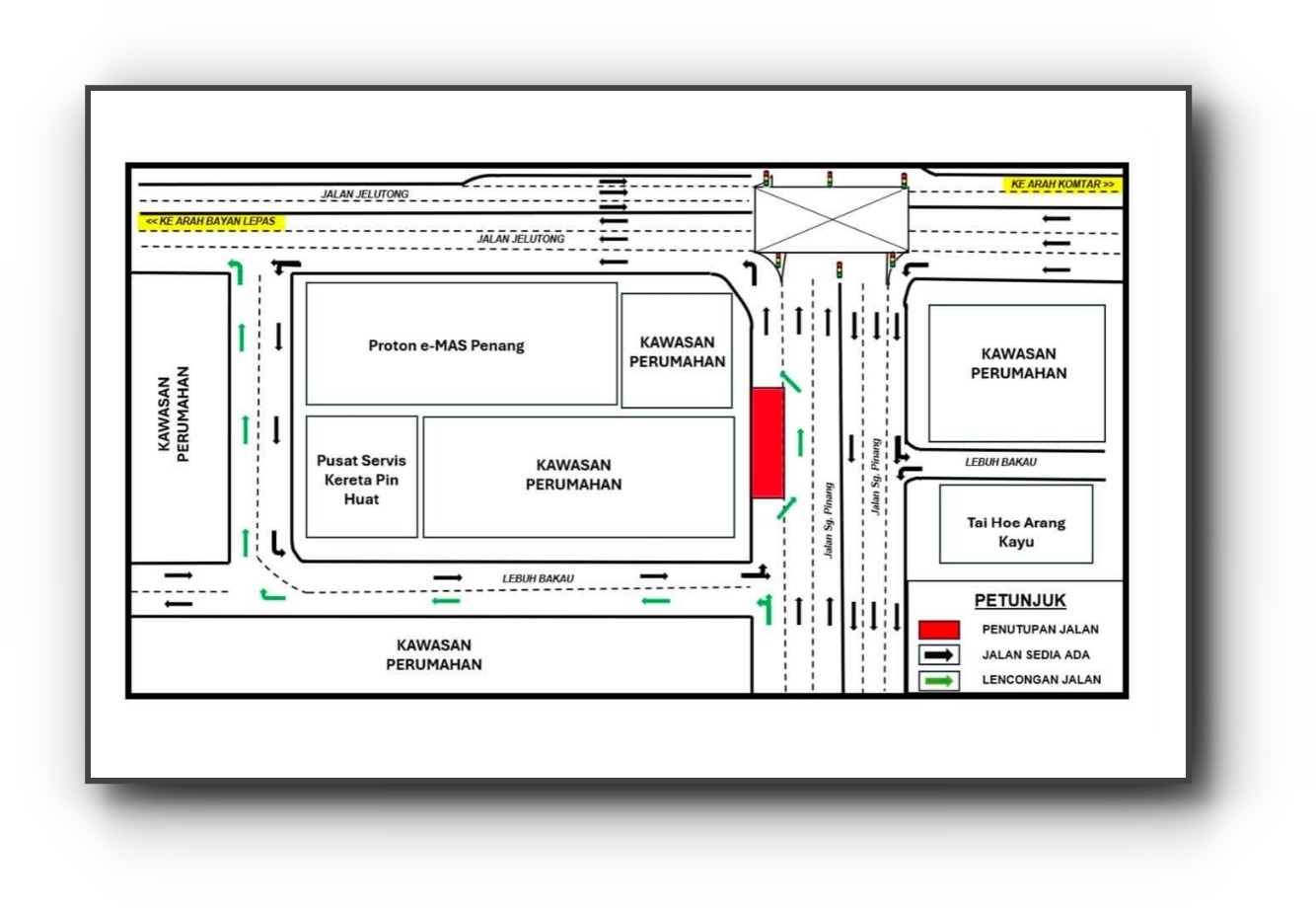
The Penang state government has announced a partial closure of a major thoroughfare in George Town to accommodate critical utility infrastructure works by national power utility Tenaga Nasional Bhd (TNB). Beginning tomorrow at 9 am and continuing through September 6 at 11.59 pm, the leftmost lane of Jalan Sungai Pinang heading towards Jalan Jelutong will be completely unavailable to traffic for the full 10-day duration.
Sungai Pinang state assemblywoman Lim Siew Khim disclosed the closure details through a social media announcement this evening, providing motorists with essential planning information ahead of the disruption. The affected section extends between the Lebuh Bakau junction and the traffic light intersection where Jalan Sungai Pinang meets Jalan Jelutong, representing a substantial stretch of one of the district's busier corridors during peak hours.
The utility relocation project, though necessary for maintaining and upgrading Penang's electrical infrastructure, will inevitably create congestion on surrounding roads during the specified period. TNB's work is part of broader network modernisation efforts across the state, though the timing during the late August period may coincide with increased commercial and residential traffic patterns typical of the season.
To mitigate traffic flow disruption, state authorities have designated Lebuh Bakau as the primary alternative route for vehicles intending to reach Jalan Jelutong. The remaining three lanes on Jalan Sungai Pinang will continue operating normally, allowing two-way traffic to pass through the area, albeit with reduced capacity and likely extended travel times during peak periods.
Lim, who chairs the Penang state Social Development, Welfare and Non-Islamic Religious Affairs Committee, has emphasised the importance of enhanced road safety measures throughout the closure period. Her administrative role positions her as a key liaison between constituents and state infrastructure planning bodies, making her responsible for communicating such disruptions effectively to affected communities.
Comprehensive traffic management infrastructure will be deployed along the work zone to guide motorists safely through the modified roadway conditions. Safety signboards will provide clear directional guidance and warning notices, while traffic cones will physically demarcate the closed area and guide vehicles into open lanes. Additional traffic controllers, known locally as flagmen, will be stationed at critical points to manually direct traffic flow and respond to unexpected congestion or incidents.
For regular commuters and commercial operators relying on this corridor, advance route planning becomes essential. The 10-day timeline, while substantial, remains relatively contained compared to larger infrastructure projects. However, the closure of the leftmost lane during morning and evening rush hours could create significant delays, particularly for vehicles heading towards Jalan Jelutong for onward connections to other parts of George Town and northern Penang.
The broader context of utility work underscores the ongoing challenge Malaysian cities face in balancing urban development with essential infrastructure maintenance. Coordinating such projects during business hours reflects the reality that power utility networks require daytime access, yet this creates inevitable disruption to daily traffic patterns. Improved coordination between public works departments and traffic management authorities could potentially shift future similar projects to less congested periods.
Businesses and residents in the immediate vicinity should anticipate delivery delays and adjust operational schedules accordingly. Logistics companies utilising this route for distribution may experience additional transport costs if drivers must take longer alternative paths, potentially flowing through to consumer prices for goods transported through George Town during this period.
The state government's advance notice demonstrates improved transparency in infrastructure planning compared to historical practice in some Malaysian jurisdictions. Providing notification through official channels allows stakeholders sufficient time to adjust travel patterns and business operations, reducing the friction that might otherwise arise from unannounced closures.
Motorized two-wheeler users, who constitute a significant proportion of George Town traffic, should exercise particular caution during this period. Reduced lane availability and the presence of heavy construction equipment creates elevated accident risk for motorcyclists who may attempt to navigate through congested areas. The presence of flagmen and enhanced signage aims specifically to protect vulnerable road users from such hazards.
Upon completion on September 6, TNB will presumably restore the leftmost lane to full operational capacity, though initial repairs may require several days of monitoring before traffic returns entirely to normal patterns. The success of this project will inform how future utility upgrades are scheduled and managed across other congested areas of Penang.

