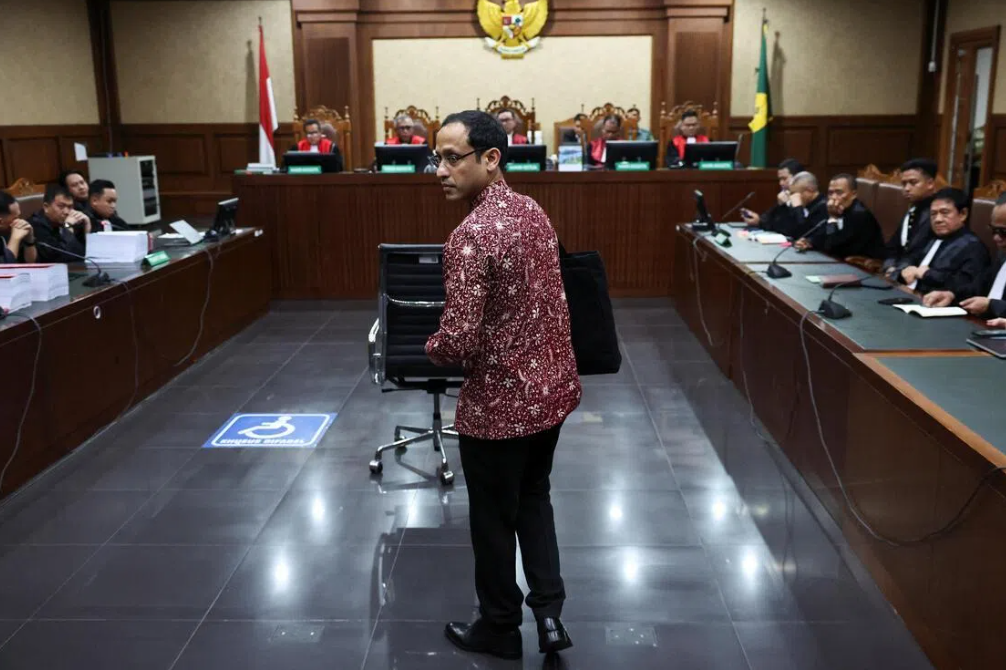
The conviction of Nadiem Makarim on Tuesday represents a stunning downfall for one of Indonesia's most celebrated technology entrepreneurs. The Jakarta Corruption Court handed down a 10-year prison sentence to the 41-year-old former education minister, concluding a trial that captured public imagination and raised broader questions about whether talented professionals from outside politics can safely enter government service. The judgment also imposed a 1 billion rupiah fine alongside a 809.6 billion rupiah restitution order, with an additional five years of imprisonment attached should he fail to repay the substantial amount.
Makarim's trajectory from celebrated startup founder to convicted felon illustrates the complex intersection of innovation, politics, and accountability in contemporary Indonesia. Before his 2019 appointment as education minister under former president Joko Widodo, he had transformed Gojek from a motorcycle taxi application into Southeast Asia's first unicorn—a privately held company valued at roughly US$10 billion. The super app expanded well beyond its courier and ride-sharing origins to encompass food delivery, digital payments through GoPay, and numerous other services. His appointment was widely seen as bringing Silicon Valley-style pragmatism and technological sophistication to Indonesia's education sector, positioning him as a symbol of a new generation of leadership unburdened by traditional political constraints.
The corruption case centred on a massive laptop procurement programme initiated during the pandemic's most disruptive phase. Between 2020 and 2022, when Indonesian schools pivoted abruptly to distance learning, the education ministry embarked on purchasing approximately 1.1 million Chromebook devices for distribution to classrooms nationwide. Prosecutors alleged this initiative caused state losses totalling 2.18 trillion rupiah and benefited Makarim personally to the tune of 809 billion rupiah through transactions involving PT AKAB, Gojek's parent company. They further contended that Google's significant investment in Gojek influenced the decision to procure Chromebooks rather than exploring alternative laptop options that might have better suited Indonesia's infrastructure challenges.
The court's reasoning revealed fundamental concerns about Makarim's decision-making process and motivations. Chief Judge Purwanto articulated that the panel had established guilt on the basis that the policy's "manner and purpose" demonstrated "an abuse of authority intended to unlawfully benefit certain parties." The judges specifically determined that Makarim had "consciously and intentionally directed the Chromebook procurement policy" with motives centred on strengthening the strategic business relationship between Google and his own corporation. This conclusion struck at the heart of the defendant's credibility—a violation of ministerial oath grounded not merely in technical procedural failures but in alleged corrupt intent.
Problematically for Makarim's defence, the Attorney-General's Office produced evidence suggesting this approach had been questioned before his appointment. Studies conducted by the ministry in 2018 had concluded that Chromebook laptops would prove ineffective in remote and rural areas lacking dependable internet connectivity—a finding that appeared to undermine claims that the procurement represented an optimal solution to pandemic-era educational disruption. Prosecutors additionally referenced an August 2019 group chat discussion concerning a Chromebook-focused digitalisation strategy that predated his formal cabinet appointment, suggesting the initiative's foundation had been laid with Makarim's involvement before he assumed ministerial authority.
Yet Makarim's legal team mounted a spirited defence grounded in good-faith pandemic response and substantial programme accomplishment. They argued that the education minister had acted responsibly during an unprecedented crisis threatening Indonesia's educational continuity, with no personal financial benefit derived from the procurement. By 2023, they noted, approximately 97 per cent of the 1.1 million Chromebooks had been successfully distributed to 77,000 schools across the archipelago—a logistical achievement that suggested genuine commitment to educational access rather than corrupt enrichment. The prosecutors had originally sought an 18-year sentence plus 5.6 trillion rupiah in restitution, making the court's 10-year verdict a partial vindication of the defence narrative.
The trial's unusual public prominence underscores shifting attitudes toward accountability among Indonesia's elite. Gojek motorcycle drivers attended court sessions wearing company uniforms to demonstrate solidarity, a striking visual reminder of the company's cultural footprint among Indonesia's working class. Court proceedings were livestreamed, generating social media calls for organised viewing parties, while the court received amicus curiae briefs supporting Makarim's position—procedural rarities in Indonesian judicial practice. These phenomena reflected genuine affection for Makarim as a domestic success story and technological innovator, alongside broader concerns about whether the verdict might discourage talented professionals from transitioning into public service.
Makarim's family pedigree likely influenced public and judicial perceptions of his character, though not ultimately his conviction. His father, Nono Anwar Makarim, stands as a prominent legal practitioner, while his maternal grandfather participated in Indonesia's independence struggle—credentials that situated him within Indonesia's nationalist elite rather than as an outsider to the political establishment. Yet these advantages proved insufficient to overcome the corruption court's determination that his actions during his ministerial tenure violated the public trust.
In his final defence plea delivered before sentencing on June 23, Makarim reframed the case as extending beyond mere procurement disputes. He appealed to the judges' sense of Indonesia's future, arguing that the verdict would shape how the nation's youth perceived public service and whether talented professionals outside traditional politics would consider government careers. Addressing the bench directly, he posed a rhetorical question that encapsulated his defence's emotional core: "Youth across all of Indonesia, and the diaspora in every corner of the world, await your answer to the question echoing in their hearts: 'Is this country still safe for us to serve?'" This plea attempted to elevate the case beyond individual accountability into a meditation on Indonesia's capacity to attract and retain talented outsiders willing to sacrifice private sector success for public good.
The sentencing's implications extend beyond Makarim's personal fate to influence Indonesia's broader governance landscape. The conviction signals that even prominent entrepreneurs enjoying substantial public goodwill face serious consequences for abuse of ministerial authority, potentially reassuring citizens that accountability mechanisms function across social strata. Conversely, the harsh sentence and substantial restitution orders may discourage talented technology professionals from entering government, potentially depriving Indonesia of expertise urgently needed to modernise infrastructure and governance systems. This tension between accountability and incentivising competent administration remains unresolved.
Makarim's case also raises questions about the interplay between technological innovation and institutional power in developing economies. His appointment reflected aspirations that private sector dynamism could inject efficiency into government, yet the corruption allegations suggest that entrepreneurial thinking and political authority sometimes operate according to incompatible logics. The Chromebook procurement may have represented an attempt to apply startup-style decision-making—rapid iteration, technology-centric solutions, strategic partnerships—to a public sector environment where transparency, procedural regularity, and equitable treatment of vendors carry fundamental importance. Whether Indonesia can successfully bridge these different operational cultures remains an open question as the nation continues modernising its institutions.
On the eve of sentencing, Makarim thanked his supporters through a post on a LinkedIn account managed by his legal team, maintaining his conviction that Indonesia's judicial system would ultimately deliver justice. "After five months on trial, I still believe in justice," he wrote, striking a defiant yet respectful tone that acknowledged the court's authority while preserving hope for potential appeal or reversal. This posture—neither bitter recrimination nor complete capitulation—may shape how Indonesia's entrepreneurial class and younger generation perceive the verdict, with profound implications for the nation's ability to attract and retain talented governance talent from beyond traditional political networks.

