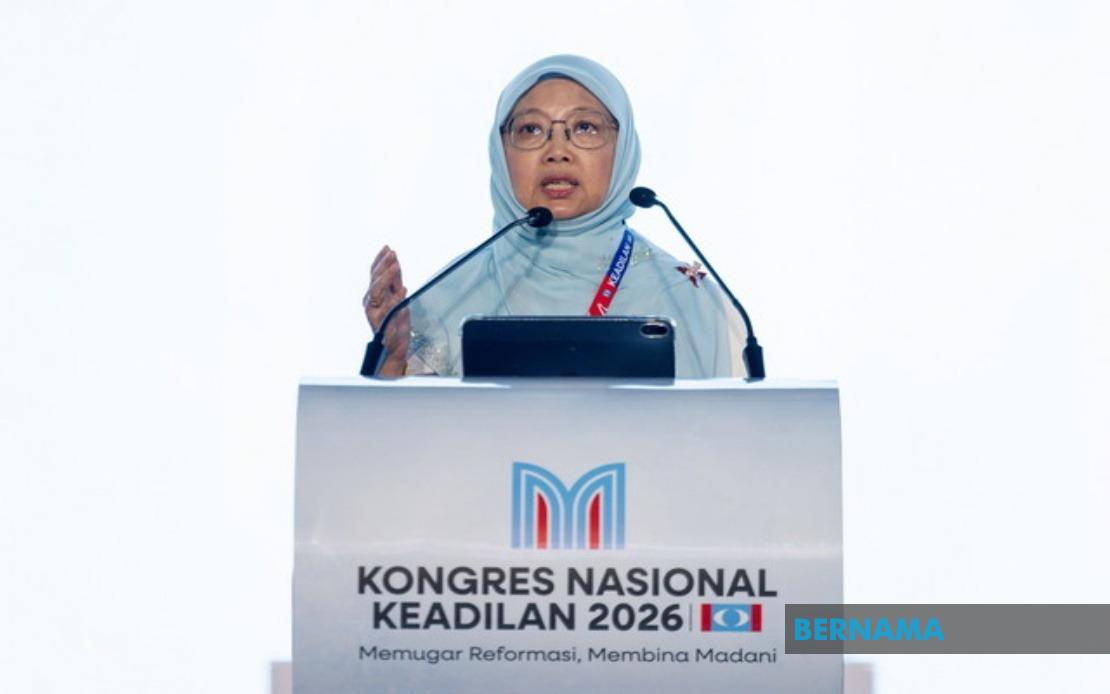
The PKR vice president Datuk Seri Dr Zaliha Mustafa has sounded a clarion call to her party, cautioning that attaining government represents not a destination but a threshold—one where the genuine work of translating reform principles into tangible governance must begin. Speaking at the PKR 2026 National Congress in Melaka, she reframed the party's quarter-century struggle as fundamentally distinct from a mere quest for administrative control, underscoring instead a deeper commitment to restructuring how the nation itself is governed.
Zaliha's remarks come at a pivotal juncture for PKR, which has now transitioned from opposition agitator to governing coalition member. This shift introduces what observers have long anticipated as the toughest phase of any reform movement—the bridge between idealistic campaign promises and the grinding machinery of bureaucratic implementation. Her intervention suggests PKR leadership recognises a looming credibility gap, one that emerges when parties exchange the simplicity of opposition critique for the complexity of executing reform within existing institutional frameworks. For Malaysian observers accustomed to watching opposition movements dissipate upon gaining power, Zaliha's acknowledgment of this threshold carries particular weight.
The PKR vice president articulated a vision of reform that explicitly rejects the notion of overnight transformation. Instead, she advocated for what might be termed "strategic gradualism"—a carefully sequenced approach to institutional renovation that distinguishes between reforms deployable immediately and those requiring extended negotiation, consultation, and foundational preparation. This stance directly addresses a persistent tension within reform movements: the pressure from grassroots supporters for sweeping, visible change colliding with the institutional reality that sustainable reform requires institutional buy-in, legislative alignment, and implementation capacity. Zaliha's invocation of Khalifah Umar Abdul Aziz, referenced by PKR president Anwar Ibrahim, signals an attempt to ground the party's approach in a historical exemplar of measured but purposeful governance change.
Yet beneath this rhetorical emphasis on strategic patience lies a sharper challenge. Zaliha acknowledged that PKR shoulders responsibility across multiple reform fronts: institutional strengthening, corruption combating, abuse of power prevention, and ensuring equitable justice access. These are not modest undertakings. The government cannot meaningfully address institutional decay, entrenched corruption, or power asymmetries without confronting vested interests embedded within the very structures PKR now operates. Her call for party members to "reprimand and correct" internal weaknesses suggests an awareness that reform credibility depends on demonstrating willingness to police one's own cadre—a politically fraught necessity that often tests party unity.
A significant dimension of Zaliha's address focused on what she termed the "communication gap"—the danger that government achievements remain unknown or misunderstood by the public. This concern reflects a sophisticated understanding of political capital in the digital age. In Malaysia's fragmented media environment, where social media platforms have become crucial battlegrounds for narrative control, a government can implement effective policies yet lose public credit if it fails to articulate their impact in accessible, emotionally resonant terms. Zaliha's emphasis on moving beyond technical policy announcements toward messaging that connects with popular sentiment indicates PKR recognises that policy success and public perception have become decoupled in contemporary politics.
The vice president's warning against ceding social media narrative dominance to opposition voices carries particular salience for Southeast Asian governance. Across the region, political movements have mobilised digital platforms with considerable sophistication, and controlling online discourse has proven as consequential as controlling legislative majorities. PKR's apparent vulnerability on this front—Zaliha felt compelled to urge the party to "master the narrative" rather than assume it would emerge organically—suggests the party may be losing information warfare contests despite holding government office. This pattern has preceded the collapse of several reformist movements internationally, where administrations implemented sound policies yet lost electoral support through narrative failure.
Zaliha's conceptualisation of "winning the feelings" of the people, beyond merely winning legislative numbers or policy enactment, introduces an emotional register often absent from technical governance discourse. This formulation acknowledges that political legitimacy in democracies rests not solely on outputs but on how citizens psychologically experience government competence and trustworthiness. A citizen may rationally understand that a particular policy improves their circumstances yet emotionally feel that government does not represent their values or interests. PKR's apparent concern about this affective dimension suggests the party may be navigating a legitimacy challenge more subtle than simple policy failure—a challenge common to reformist movements that struggle to sustain the moral authority that propelled them to power.
The structural vulnerabilities Zaliha identified—communication deficiencies, narrative passivity, insufficient translation of administrative outputs into public understanding—point toward deeper institutional constraints. Reform movements often transition to government with cadres trained in opposition tactics: mobilisation, criticism, coalition-building across disparate groups. But governing demands different competencies: message discipline, institutional hierarchy, sustained public engagement, and the capacity to explain complexity without conceding moral authority. PKR's apparent need to rebuild these capabilities suggests the party may have underestimated the skill gaps separating oppositional agitation from governmental communication.
For Malaysian observers, the implications extend beyond PKR's narrow institutional future. The party's trajectory will signal whether contemporary Southeast Asian reformist movements can sustain transformative momentum once institutionalised. Should PKR demonstrate the capacity to execute institutional reform while maintaining public engagement, it would establish a template for regional reform movements often accused of losing purpose upon gaining power. Conversely, if PKR's governance period replicates patterns where reform parties eventually become indistinguishable from their predecessors, it would confirm skepticism about whether institutional reform represents a coherent political project or primarily a mechanism for elite circulation.
Zaliha's insistence that the party cannot assume public understanding of government achievements implicitly acknowledges a democratic accountability principle: citizens possess the prerogative to remain unmoved by administrative improvements if government fails to articulate their relevance. This stance differentiates PKR from technocratic governance models that prioritise policy outputs over public comprehension. Yet maintaining this democratic sensibility while implementing complex, often unpopular reforms presents genuine tension. Communities may resist institutional reforms that serve long-term structural health but impose immediate costs. The party must navigate between explaining why change is necessary and acknowledging legitimate concerns about transition disruption.
Looking forward, PKR faces a critical period where its reform credentials will be empirically tested rather than theoretically defended. The party cannot retreat into opposition rhetoric about what "should" be done; it must demonstrate what "can" be accomplished within existing constitutional and institutional constraints. Zaliha's emphasis on measured implementation, clear directional consistency, and sustained public engagement provides a framework for this transition, but frameworks alone prove insufficient. The coming months and years will reveal whether PKR possesses both the institutional capacity and political will to translate 27 years of reform advocacy into demonstrable governance transformation. For a Southeast Asian region where reform movements often fade upon encountering bureaucratic realities, this test carries implications extending well beyond Malaysia's borders.

