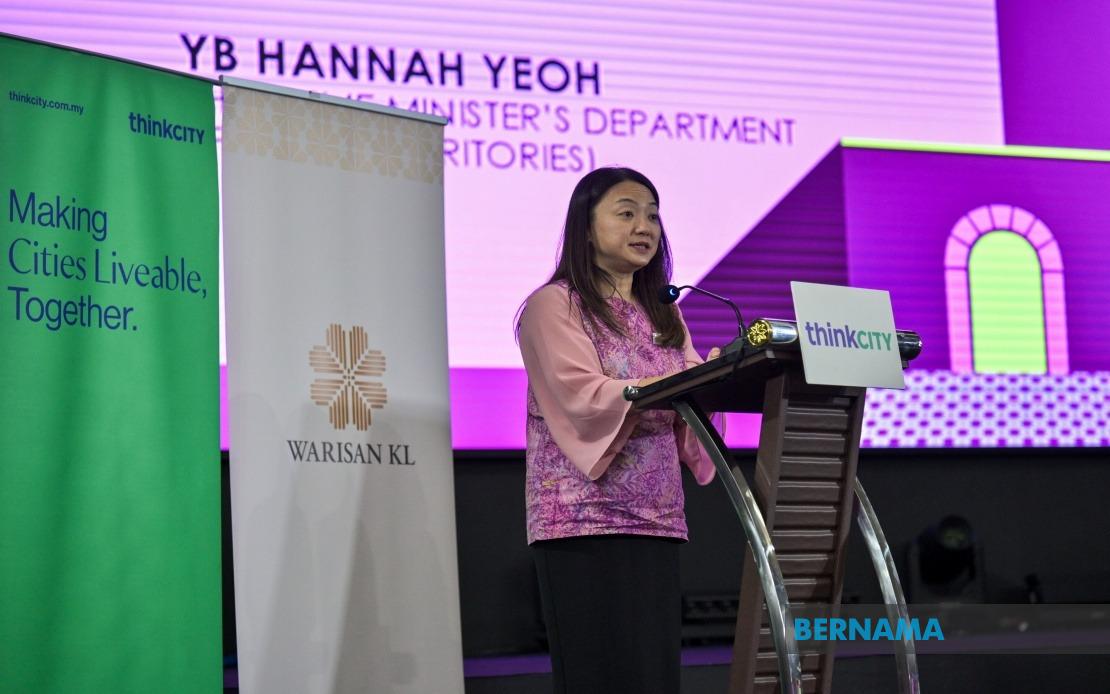
The federal government is investing RM1 million to breathe new life into the heart of Kuala Lumpur, unveiling a strategic initiative designed to marry heritage preservation with contemporary urban renewal. Hannah Yeoh, Minister in the Prime Minister's Department overseeing the Federal Territories, launched the Downtown Kuala Lumpur Grants Programme 2026 on July 8, signalling a deliberate pivot towards revitalising Malaysia's capital through cultural and economic drivers rather than infrastructure alone.
The programme structures support through competitive grants ranging from RM30,000 to RM100,000 for each vetted project, targeting a spectrum of beneficiaries including local business operators, creative practitioners, and grassroots communities. This tiered funding approach allows smaller neighbourhood initiatives to compete alongside larger heritage restoration schemes, potentially democratising access to development resources in the downtown corridor. The mechanism represents a departure from conventional top-down urban planning, instead channelling resources directly to on-the-ground stakeholders with intimate knowledge of their localities.
Hannah's articulation of the initiative reflects a broader philosophical reorientation about what constitutes successful urban development. She emphasised that Kuala Lumpur's future will not be determined by the accumulation of new structures, but rather by its capacity to retain residents, workers, investors, and returning migrants. This framing responds to concerns about downtown decay and the suburban sprawl phenomena afflicting major Asian cities, where central business districts hollow out despite architectural heritage. The minister's characterisation of the city as narrating two concurrent stories—its colonial and post-independence past alongside its unfolding future—positions heritage not as a static museum artefact but as living infrastructure animating contemporary civic life.
The financial commitment, drawn from the Ministry of Finance's allocation, explicitly designates arts, culture, and heritage as economic generators rather than cultural luxuries requiring subsidy. This alignment reflects Malaysia's 2020 accreditation as a UNESCO Creative City, a designation carrying tangible implications for how policymakers justify spending on cultural initiatives. By coupling heritage preservation with job creation and tourist attraction, the government frames cultural investment within the language of economic productivity—a rhetorical strategy that may appeal to fiscal conservatives while advancing creative sector development.
Crucially, the initiative targets reform of Kuala Lumpur City Hall, the municipal authority responsible for downtown governance. Hannah explicitly stated her objective to transform the institution's public perception from regulatory obstacle to economic facilitator. This institutional rebranding suggests frustration with bureaucratic impediments to downtown investment and reflects pressure to streamline approval processes for developers and entrepreneurs. The reframing of municipal government as enabler rather than gatekeeper carries implications for how commercial interests navigate urban planning, potentially accelerating project approvals but requiring vigilant oversight to ensure heritage values aren't sacrificed for expedited development.
Think City, designated as the strategic partner managing programme administration, will establish detailed eligibility criteria and manage application processes. This outsourcing of programme coordination to a specialised urban development organisation may accelerate decision-making and inject technical expertise, though it also introduces an additional institutional layer between applicants and government resources. Think City's involvement suggests the government views this initiative through the lens of international best practices in cultural-led urban regeneration, potentially drawing on experiences from other Southeast Asian cities attempting similar downtown revival strategies.
The programme's implications extend beyond Kuala Lumpur's municipal boundaries. Downtown revitalisation in Malaysia's premier city sets precedent and potentially establishes templates for heritage preservation and cultural investment in other federal territories and secondary urban centres. Penang, Malacca, and Georgetown have already demonstrated commercial viability of heritage tourism; Kuala Lumpur's initiative may catalyse similar investments elsewhere, reshaping how Malaysian cities conceptualise heritage assets. For Southeast Asian policymakers monitoring regional urban development trends, this approach represents an alternative to wholesale modernisation that has characterised much Asian urbanism over recent decades.
The targeting of creative practitioners and arts practitioners responds to growing recognition of cultural industries' economic footprint, particularly in knowledge economies seeking differentiation from manufacturing-dependent competitors. By explicitly welcoming creative sector applications, the government acknowledges that downtown revitalisation increasingly depends on attracting and retaining artistic talent—a demographic that may gravitate towards historic neighbourhoods with distinctive character over sanitised corporate districts. This mirrors successful downtown revivals in cities from Bangkok to Ho Chi Minh City, where artistic communities pioneered neighbourhood transformation before gentrification accelerated.
The RM1 million allocation, while meaningful, requires contextualisation against Kuala Lumpur's overall development expenditure and the scale of downtown challenges. Per-project grants of RM30,000 to RM100,000 impose real constraints on project scope, suggesting the programme targets incremental improvements and community-scale initiatives rather than comprehensive downtown restructuring. Prospective applicants will need to design pragmatic interventions yielding visible impact within financial parameters, potentially favouring community activation, façade improvements, and creative programming over structural rehabilitation or major infrastructure redevelopment.
The initiative's success will hinge partly on promotion and application volume. Hannah's appeal to entrepreneurs and creative practitioners with novel ideas suggests awareness that many potential applicants may lack familiarity with government grants processes or confidence in application success. Think City's role in publicising criteria and supporting applicants thus becomes operationally critical. The programme's visibility among target communities—street-level merchants, heritage property owners, artistic collectives—will substantially influence whether it reaches intended beneficiaries or defaults to well-connected institutions already adept at securing government funding.
Looking forward, this Downtown Kuala Lumpur Grants Programme potentially establishes precedent for ongoing federal commitment to downtown renewal, contingent on demonstrated impact and stakeholder satisfaction. Initial programme outcomes will likely influence whether funding extends beyond 2026 or serves as template for subsequent tranches. For Southeast Asian observers, this moment signals Malaysian willingness to strategically invest in heritage as economic asset rather than nostalgic indulgence—a positioning with considerable implications for how regional cities approach urban preservation and cultural development in coming years.

