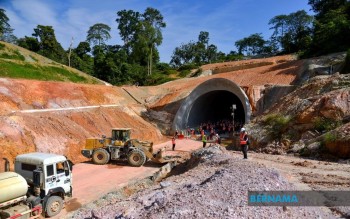
Malaysia's government has approved an ambitious portfolio of 46 development projects for Pasir Puteh parliamentary constituency in Kelantan, committing RM207.2 million to reshape the region's economic landscape through strategic infrastructure investments. The initiative represents a concentrated effort to position the Pasir Puteh area as a modern logistics and downstream industrial hub, capitalising on the presence of the East Coast Rail Link's cargo and passenger facility as the primary economic catalyst.
Deputy Economy Minister Datuk Mohd Shahar Abdullah outlined the strategic vision during parliamentary oral questions, explaining that the approved allocation extends beyond simple infrastructure spending. The projects encompass land preparation and comprehensive infrastructure development specifically designed for the Pasir Puteh downstream industrial zone, carefully coordinated under the ECRL Integrated Land Use Master Plan to ensure cohesive long-term growth rather than ad-hoc development.
The positioning of Pasir Puteh as a logistics gateway stems from tangible geographic advantages that planners see as transformative. The ECRL station's proximity to the Tok Bali Supply Base creates what officials describe as a unique competitive advantage, enabling the constituency to function as an integrated logistics and industrial corridor. This configuration addresses a fundamental gap in Kelantan's economic infrastructure, historically a challenge for the state's development relative to more industrialised western regions of Peninsular Malaysia.
For Malaysian economic observers, the emphasis on leveraging the ECRL represents a broader strategic shift in how the government views major transport infrastructure. Rather than treating railways as isolated projects, authorities now conceptualise them as anchors for broader economic transformation. This mirrors international best practices where rail networks catalyse industrial clustering and foreign investment concentration, creating employment spillovers throughout adjacent communities.
The government's dual focus on attracting investment and narrowing regional development disparities underscores the political calculus behind this allocation. Datuk Mohd Shahar specifically noted that developmental spending targets not merely project completion but the strategic reduction of economic gaps between different regions of Malaysia. This approach reflects acknowledgment that some constituencies have historically lagged in infrastructure quality and investment attraction compared to developed corridors like the Klang Valley and Penang.
Under Malaysia's 13th Malaysia Plan framework, which runs through 2030, these 46 Pasir Puteh initiatives form part of a larger ecosystem of regionally tailored interventions. The Deputy Economy Minister stressed that the 13MP philosophy rejects one-size-fits-all development models, instead identifying each locality's inherent strengths and directing investments accordingly. Where an area possesses logistics potential, funding channels toward logistics infrastructure; where tourism represents the comparative advantage, tourism-focused development takes priority.
The implementation timeline commences in the current year and extends through 2030, providing a seven-year window for project realisation. This extended timeframe reflects the complexity of the undertaking, requiring coordination between federal authorities, Kelantan state government, and potentially private sector partners. The staggered approach also allows for adaptive management, permitting course corrections as market conditions and investment patterns evolve.
Monitoring mechanisms built into the framework represent an attempt to ensure accountability in how allocated funds are deployed. The MyRMK system will track project progress, with regular parliamentary reporting obligations obliging the government to maintain transparency with elected representatives. This institutional architecture aims to prevent the historical problem of announced allocations that fail to translate into tangible community benefits.
For Kelantan specifically, these investments address longstanding concerns about economic marginalisation relative to other Malaysian states. The east coast region has traditionally struggled to attract manufacturing investment and diversified industries compared to Selangor, Penang, and Johor. A functioning ECRL-anchored logistics hub could materially alter this dynamic, positioning Kelantan's workforce and geography as assets for supply chain operations serving both domestic and ASEAN markets.
The broader regional implications extend beyond Kelantan's borders. The ECRL itself connects multiple states along Malaysia's east coast and will eventually link to Thailand, positioning the entire corridor as part of emerging cross-border trade routes. Successfully developing Pasir Puteh as a logistics node may generate demonstration effects throughout the ECRL's catchment area, encouraging similar integrated development efforts in other stations' vicinities.
The private investment dimension remains crucial to success. Government infrastructure and land development alone cannot guarantee economic dynamism; attracting logistics companies, manufacturing firms, and supply chain operators requires competitive positioning against alternative locations, both within Malaysia and throughout Southeast Asia. The RM207.2 million represents catalytic government spending rather than complete funding, with expectation that successful positioning will mobilise substantially larger private capital inflows.
For Malaysian businesses operating in logistics and manufacturing sectors, Pasir Puteh's development trajectory warrants strategic attention. The emergence of a new industrial cluster typically creates opportunities for suppliers, service providers, and ancillary businesses. Companies currently serving the Klang Valley or Penang industrial corridors may find competitive cost structures and available land increasingly attractive at the emerging Pasir Puteh node, particularly if rail connectivity proves reliable and efficient.
The success of this initiative will largely depend on implementation quality and the government's ability to deliver promised infrastructure on schedule. Regional development projects frequently encounter delays and cost overruns, potentially limiting their catalytic impact. Kelantan's experience with previous major infrastructure investments will inform investor confidence in government delivery capabilities. If Pasir Puteh achieves its planners' vision, it could serve as a replicable model for leveraging Malaysia's other transport megaprojects toward broader regional development objectives.

