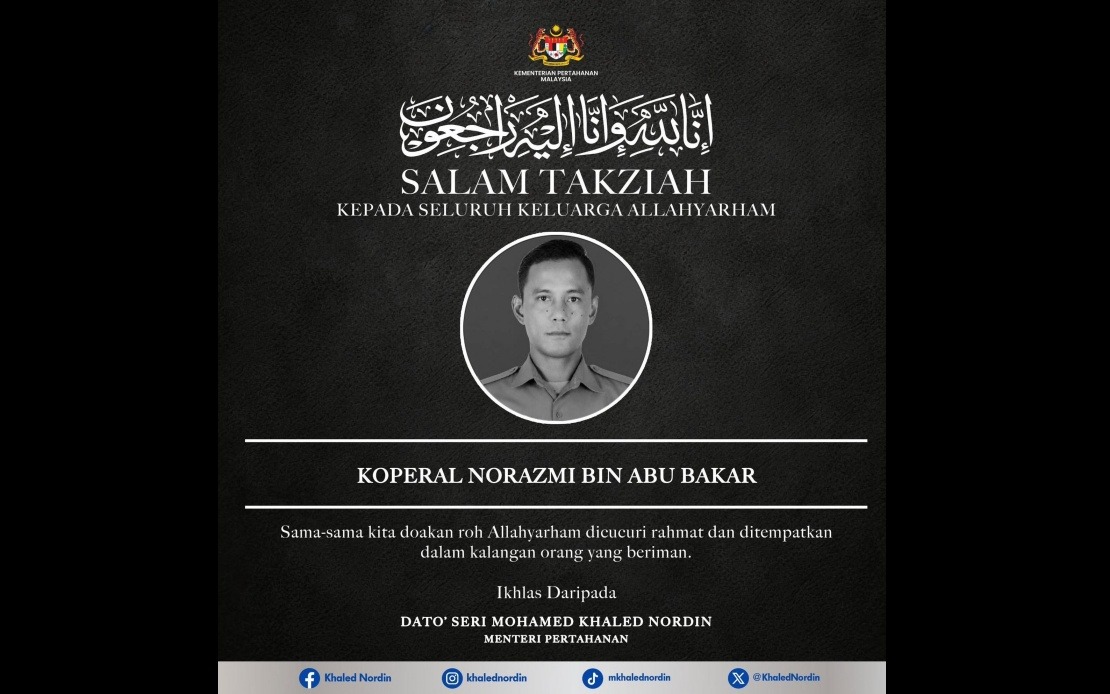
The Malaysian government and Defence Ministry have extended their sympathies to the bereaved families following a fatal training accident that claimed the lives of two servicemen on June 16. Corporal Norazmi Abu Bakar, attached to the 6th Battalion of the Royal Malay Regiment, and Private Siti Khadijah Sungip, serving with the 1st Squadron of the Royal Army Engineers Regiment, were killed during a grenade-throwing exercise at Hobart Camp firing range in Gurun, Kedah.
Defence Minister Datuk Seri Mohamed Khaled Nordin released a statement expressing deep sorrow over the incident and conveying the ministry's heartfelt condolences to the victims' families. The minister emphasised that both the Defence Ministry and the broader Malaysian government stand in solidarity with the bereaved during this difficult period, calling for strength and resilience for those left behind. In his statement released through social media, Mohamed Khaled Nordin highlighted the profound loss and acknowledged the sacrifice these service members had made in their duties to the nation.
The tragic incident occurred at approximately 10:57 am when the explosion happened during routine training operations. Both personnel sustained severe injuries in the blast and were immediately transported to emergency medical services. Despite rapid evacuation efforts, the victims succumbed to their injuries while being conveyed to Sultan Abdul Halim Hospital in Sungai Petani, indicating the severity of the trauma sustained during the explosion. The loss represents a sobering reminder of the inherent risks military personnel face during training exercises, even under controlled conditions at designated firing ranges.
The death of Private Siti Khadijah Sungip is particularly significant as female combat engineers remain a relatively small proportion of the Royal Army Engineers Regiment. Her loss underscores the broader commitment of Malaysian women serving in frontline military roles and the dangers they encounter alongside their male counterparts. The incident highlights the complex challenges of military training, where even well-established safety protocols and experienced handlers cannot entirely eliminate the unpredictable nature of explosive devices used in instruction.
Army Chief General Tan Sri Azhan Md Othman has initiated a comprehensive investigation to establish the precise cause of the explosion. The inquiry will likely examine multiple factors including equipment condition, adherence to standard operating procedures, environmental conditions at the time of the exercise, and individual actions during the training session. Such investigations are crucial not only for understanding what went wrong in this specific instance but also for identifying systemic vulnerabilities that could be addressed to prevent future occurrences.
Grenade-throwing training represents a fundamental component of infantry and combat engineer preparation, yet it carries inherent risks that military establishments worldwide have grappled with for decades. The exercise itself is designed to develop practical competency in employing explosive devices under controlled circumstances. However, the inherent unpredictability of explosive materials means that even minor deviations from protocol or unforeseen circumstances can result in catastrophic outcomes. The incident at Hobart Camp reflects broader global concerns about balancing the necessity of realistic military training with comprehensive safety measures.
The Defence Ministry's swift acknowledgement and immediate commencement of investigations demonstrate institutional responsibility in responding to the tragedy. Malaysian military authorities have established protocols for such incidents, recognising both the operational necessity of maintaining training standards and the paramount importance of personnel safety. The commitment to a thorough investigation signals to military personnel and the public that accountability and continuous safety improvement remain central to institutional values.
For the broader Malaysian armed forces, this incident serves as a critical moment for reassessing training methodologies and safety infrastructure across all exercises involving explosive materials. The investigation findings will likely inform recommendations affecting not only grenade-throwing exercises but potentially other high-risk training activities. Military institutions operate under enormous pressure to prepare personnel effectively while minimising preventable casualties, and each serious incident provides valuable lessons for refining protocols.
The emotional toll on military communities cannot be understated. Units lose not merely individual service members but trusted colleagues and friends, creating ripple effects throughout barracks and operational structures. The loss of a private from the engineering regiment and a corporal from the infantry battalion impacts multiple organisational hierarchies and training pipelines. Support systems for affected personnel and counselling services become critical in the aftermath of such tragedies.
This incident also resonates within Southeast Asia's military community, where similar training accidents have occurred across the region. Military establishments from Thailand to Indonesia to Singapore maintain comparable grenade and explosives training programmes, and the circumstances in Kedah will inevitably prompt regional reflection on safety standards. International military partnerships sometimes involve shared training methodologies and safety audits, potentially extending the ripple effects of this investigation beyond Malaysian borders.
The government's expression of condolences, while ceremonial, represents official acknowledgement of the sacrifice embedded in military service. These formal statements serve multiple functions: recognising the deceased's contributions, affirming state commitment to military personnel, and signalling to families that their loss is recognised at the highest institutional levels. For grieving families, such acknowledgements provide some measure of collective recognition during their private anguish.