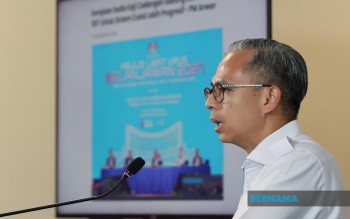
The Malaysian government has opted to allow Finance Minister II Datuk Seri Amir Hamzah Azizan sufficient runway to construct a thorough examination of a proposed hybrid taxation architecture that would blend components of the Goods and Services Tax with the existing Sales and Services Tax framework. Government spokesperson Datuk Seri Fahmi Fadzil, who doubles as Communications Minister, revealed this decision during a post-Cabinet briefing in Putrajaya on August 19, emphasizing that the resulting analysis would subsequently be presented to the Cabinet for deliberation and determination.
The deliberate pacing reflects the complexity inherent in restructuring a cornerstone of Malaysia's fiscal architecture. Fahmi underscored that this initiative remains in its nascent phase, with the Ministry of Finance requiring adequate space to conduct its investigative work without precipitous conclusions. The scope of the examination encompasses not merely theoretical models but also an honest reckoning with practical experience—drawing on valuable insights from Malaysia's earlier encounter with GST implementation and cataloguing the operational challenges that have emerged under the current SST regime.
Prime Minister Datuk Seri Anwar Ibrahim has charted the intellectual course for this undertaking, having instructed the Cabinet that a comprehensive investigation into the feasibility of a hybrid system was warranted. The Cabinet has endorsed this direction, setting in motion a methodical process whereby technical expertise within the finance ministry would be harnessed to evaluate whether selective features of the GST could be grafted onto Malaysia's established SST framework without reproducing past difficulties.
When pressed on whether Anwar had stipulated a concrete deadline for the report's completion or whether the proposal might feature in the forthcoming budget announcement, Fahmi declined to confirm either detail, noting that no specific timeframe had been articulated during the Cabinet session itself. This measured ambiguity suggests that policymakers are prioritizing thoroughness over speed—a calculation that carries significance given the sensitivity of tax reform in Malaysian political discourse and the potential economic ramifications of hasty design choices.
Anwar's own positioning on this matter, articulated just prior to the Cabinet discussion, sketches the parameters of acceptable reform. The Prime Minister affirmed that Malaysia would maintain the SST as its foundational taxation architecture, preserving institutional continuity and avoiding the wholesale upheaval that accompanied the GST transition under the previous administration. However, he signalled openness to incorporating specific GST mechanisms should technical analysis demonstrate their efficacy and acceptability within Malaysia's broader economic and social context.
This incremental approach reflects lessons learned from Malaysia's earlier tax policy turbulence. The GST, introduced in 2015, became a lightning rod for political opposition due to its perceived regressivity and implementation challenges. When the government switched back to SST in 2018, the transition itself created disruptions and unresolved complications that continue to constrain revenue collection and create compliance friction for businesses. By now considering a hybrid model rather than wholesale replacement, policymakers are attempting to thread a needle between stability and modernization.
For Malaysian business interests and consumer advocates, the timeline's flexibility carries both reassurance and uncertainty. Extended deliberation provides opportunity for stakeholder input and refinement of concepts, yet protracted timelines often signal institutional friction or unresolved technical questions. The Finance Ministry's mandate to review lessons from both systems suggests that consultations with the business community, economic researchers, and implementation specialists will inform the eventual proposal.
The regional context adds another dimension. Neighbouring countries employ varied consumption tax architectures—Singapore relies on a goods and services tax while Thailand operates a value-added system. Understanding how a hybrid Malaysian model would interface with regional trade and investment flows likely forms part of the Finance Ministry's evaluation matrix, particularly given the ASEAN economic integration framework and cross-border commercial considerations.
For the broader Malaysian public, the eventual proposal will warrant careful scrutiny regarding its distributional consequences. A poorly designed hybrid could either replicate the regressive characteristics that undermined GST acceptance or, conversely, prove insufficiently progressive to meet modern fiscal adequacy standards. The Finance Ministry's examination of how different population segments and business scales would experience a hybrid system therefore assumes critical importance.
The decision to grant additional preparation time also reflects institutional constraints within Malaysia's bureaucratic apparatus. Comprehensive tax modelling, stakeholder consultation, and inter-agency coordination cannot be compressed into truncated timelines without sacrificing analytical rigour. By explicitly permitting the Finance Minister II the space to work methodically, the Cabinet signals that this initiative will not be rushed through Cabinet for announcement in the upcoming budget if the analysis remains incomplete.
This deliberative rhythm stands in contrast to occasional tax announcements that emerge with minimal prior consultation or technical groundwork. The emphasis on allowing the Finance Ministry to work through issues before Cabinet discussion represents a commitment to evidence-based policymaking in an area where implementation missteps carry significant economic and political consequences. Whether this measured approach ultimately produces a tax architecture superior to either existing GST or SST frameworks will become apparent only once the Ministry presents its findings and Cabinet endorses or refines its recommendations.

