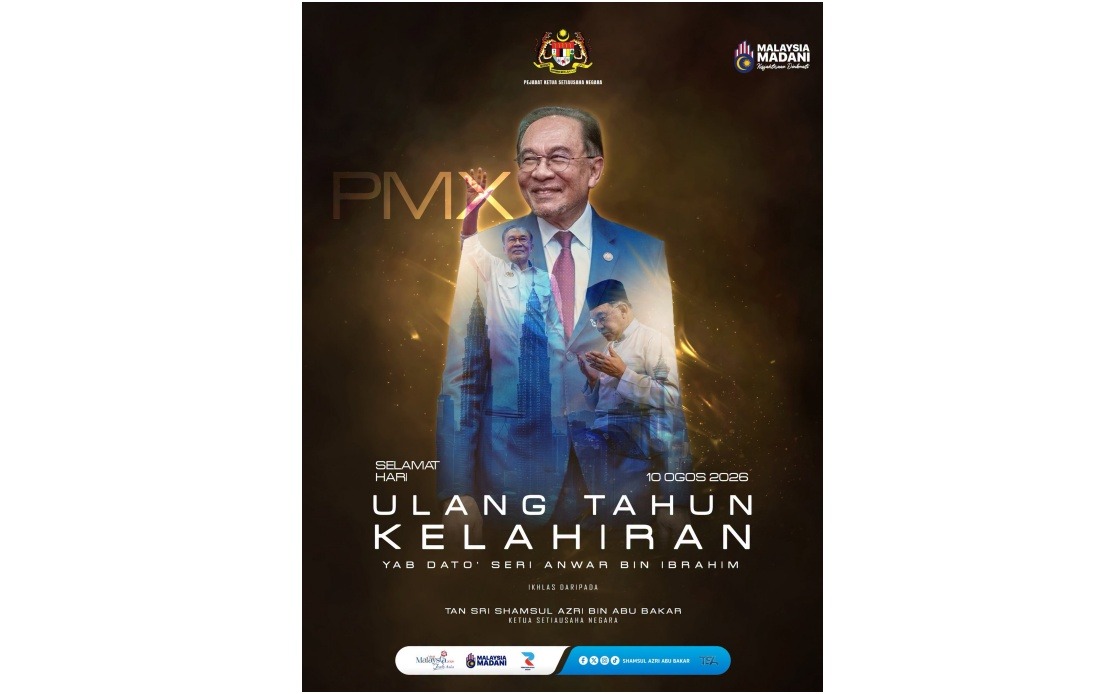
Prime Minister Datuk Seri Anwar Ibrahim marked his 79th birthday on August 10 with warm wishes extended by senior government officials and key institutions across Malaysia's administrative apparatus. The Chief Secretary to the Government (KSN) Tan Sri Shamsul Azri Abu Bakar led the well-wishers, publicly expressing hope that the Prime Minister will enjoy sustained good health, physical strength and wisdom as he continues steering the nation's affairs through a complex period of transformation.
In his Facebook message, Shamsul Azri underscored the civil service's commitment to supporting the government's broader agenda for institutional reform and public sector renewal. His carefully worded statement reflected the intricate relationship between the Prime Minister's office and the permanent bureaucracy, signalling that Malaysia's administrative machinery remains aligned with the leadership's policy direction. The Chief Secretary's remarks carried particular weight given his position as the top civil servant in the country, effectively representing the institutional voice of federal government administration.
The Prime Minister's Office complemented these official wishes through a video message distributed across social media platforms, employing language that emphasised continuity of effort and sustained public trust in governance. The message—"Efforts continue, the trust is fulfilled, and to Allah SWT we place our trust"—struck a balance between recognising the work ahead and invoking religious sentiment appropriate for a Muslim-majority nation. This framing suggests an administration conscious of maintaining momentum on its reform platform while acknowledging the spiritual dimensions important to Malaysian society.
The Malaysia MADANI official social media account also participated in the birthday commemoration, extending formal blessings for the Prime Minister's continued strength and capacity to serve national interests. The use of the MADANI framework—signifying the government's contemporary development philosophy—in delivering birthday wishes demonstrates how modern Malaysian governance integrates personal recognition of leadership with broader policy messaging. The reference to divine protection and blessing reflects the religious-cultural context that shapes official discourse in Malaysia.
These coordinated expressions of support take on added significance given Malaysia's complex political landscape and the Prime Minister's advanced age. At 79 years old, questions about leadership succession and institutional stability inevitably surface in broader political conversations, particularly in Southeast Asia where leadership transitions can trigger uncertainty. The timing and tenor of these public messages suggest an effort to project confidence in current governance continuity while subtly affirming the strength and energy required for demanding executive responsibilities.
The involvement of multiple government entities—from the Chief Secretary's office to the Prime Minister's own office and the Malaysia MADANI social media channels—indicates a carefully orchestrated institutional response rather than spontaneous well-wishing. Such coordination reflects standard practice in Malaysian government communications, where major political messaging typically flows through established channels with appropriate hierarchy and protocol. The relative formality of these greetings contrasts with personal birthday celebrations that may occur privately.
For Malaysian readers and the broader Southeast Asian region, these birthday wishes carry implications beyond mere courtesy. They demonstrate the structural stability of Malaysia's government apparatus and the alignment between senior civil servants and elected leadership, a relationship that occasionally experiences tension in Malaysian politics. The Chief Secretary's explicit commitment to supporting reform initiatives signals bureaucratic backing for the administration's policy agenda, which remains crucial for implementation of government programmes across federal and state levels.
The religious language permeating these messages—references to divine blessing, Allah SWT's protection, and spiritual guidance—reflects the importance of Islam in Malaysian public life and governance. This rhetorical choice ensures the birthday greetings resonate culturally while maintaining the formal tone appropriate for state occasions. For a Prime Minister who has navigated multiple political comebacks throughout his career, such public affirmation of institutional support carries genuine political value.
From a regional perspective, Malaysia's public acknowledgement of its Prime Minister's milestone birthday reflects the country's status as a stable democracy with functioning institutions. Neighbouring Southeast Asian nations, some experiencing greater leadership volatility, may observe how Malaysia manages transitions and continuity through institutional means. The coordination of birthday wishes across government bodies demonstrates mechanisms of institutional loyalty and hierarchical organisation that underpin Malaysia's administrative system, distinguishing it from less formally organised governance structures elsewhere in the region.
The Prime Minister's advanced age also contextualises ongoing discussions about Malaysia's development trajectory and leadership renewal pipelines. At 79, Datuk Seri Anwar Ibrahim represents a generation of senior political figures who remain actively involved in governance across Southeast Asia, raising questions about succession planning and the retention of institutional knowledge. The government's public expression of confidence in his continued capacity to lead suggests no immediate transition contemplated, though such messages typically avoid explicit discussion of leadership timelines or succession arrangements.
Moving forward, these birthday wishes establish a public record of institutional support that may prove valuable for the administration's political positioning. In Malaysian politics, where coalition dynamics and factional interests constantly negotiate power-sharing arrangements, clear demonstrations of bureaucratic loyalty and institutional cohesion provide stabilising anchors. The Chief Secretary's involvement particularly matters, as the civil service constitutes the permanent state apparatus that outlasts electoral cycles and political governments.

