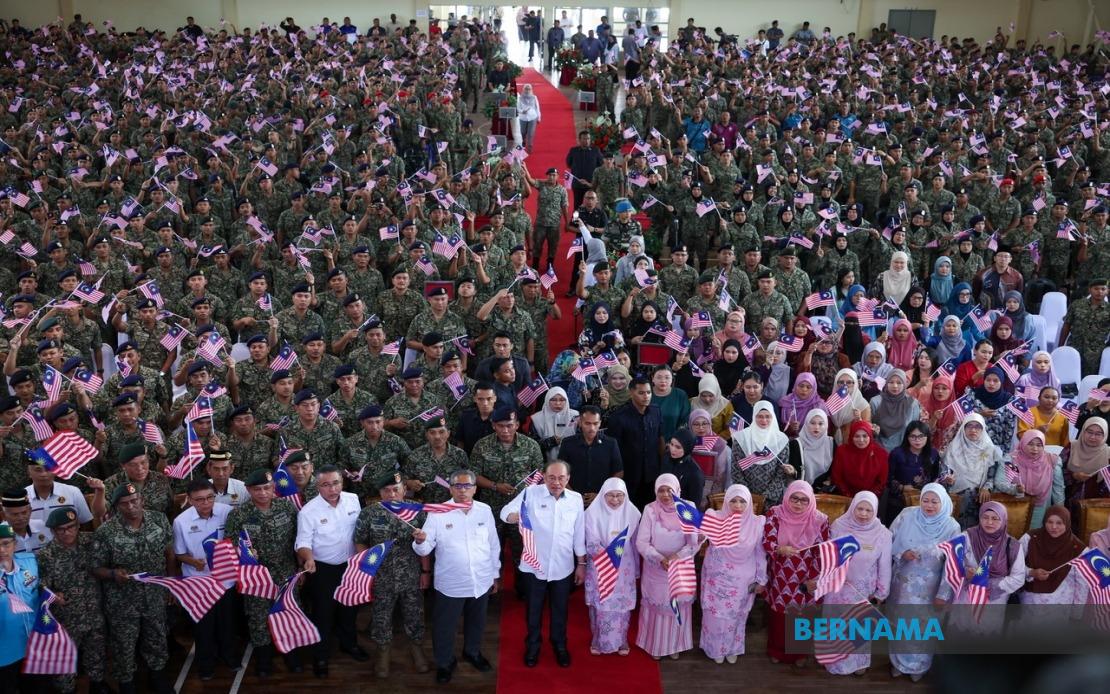
Prime Minister Datuk Seri Anwar Ibrahim has directed the government to examine the promotion framework governing senior officers in the Malaysian Armed Forces (MAF), seeking to eliminate unnecessary delays in career advancement that appear more pronounced in the military than across the broader civil service. Speaking in Tampin on July 27, Anwar emphasised that the acceleration of this bureaucratic process warrants priority attention, as current advancement timelines have created a disparity between military and civilian public sector progression.
The initiative represents a targeted intervention in personnel management within the defence establishment. Anwar acknowledged that whilst the number of senior officers affected is relatively modest, the structural nature of the problem demands careful examination. He stressed that the armed forces must not perceive themselves as overlooked or sidelined by government policy, particularly given the critical nature of their national security responsibilities. This sentiment underscores broader concerns about military morale and retention of talented officers who might face career frustration under existing systems.
The Prime Minister noted that members of the armed forces have already benefited from the revised compensation framework introduced through the Public Service Remuneration System (SSPA), which restructured salary bands across the government workforce. However, the promotion pathway remains a separate concern requiring distinct remedial action. Anwar indicated that whilst the salary overhaul has provided some relief, it has not adequately addressed the temporal dimensions of career progression, where advancement opportunities remain constrained compared to civilian service equivalents.
Central to Anwar's announcement was his request to Chief Secretary to the Government Tan Sri Shamsul Azri Abu Bakar to evaluate whether the existing promotion protocols can be streamlined. This delegation signals that the Prime Minister is treating the matter with appropriate urgency whilst ensuring that the machinery of government conducts thorough technical analysis. The government intends to assess the financial implications of any procedural modifications, recognising that accelerated promotion cycles may carry budgetary consequences across salary scales and pension liabilities that require careful calculation before implementation.
The high-level nature of the consultations reflects the seriousness with which the government regards this challenge. Present at the discussion were Deputy Defence Minister Adly Zahari, Chief of Defence Forces General Tan Sri Malek Razak Sulaiman, and Army Chief General Tan Sri Azhan Md Othman. This gathering of defence leadership demonstrates that military hierarchy has been directly engaged in framing the problem and will contribute to crafting solutions. The involvement of uniformed personnel at the highest echelon suggests that the armed forces command structure has been advocating for reform and views this governmental initiative as responsiveness to their concerns.
Anwar committed to finalising the proposal through a dedicated meeting he would personally chair, indicating that decisions on this matter will not languish in committee but will receive executive-level attention and resolution. This timeline commitment carries political weight, signalling to the defence establishment that governmental support for the reform is substantive rather than rhetorical. The Prime Minister's willingness to personally oversee the conclusion of the review underscores the importance he attaches to ensuring military personnel feel valued and prioritised within the broader administration.
For Malaysia's defence sector, the implications extend beyond individual career trajectories. Military effectiveness and institutional cohesion depend substantially on personnel retention and satisfaction. When promotion pathways become protracted, capable officers may seek opportunities elsewhere or experience diminished morale, potentially affecting readiness and performance. By addressing this structural issue, the government acknowledges that maintaining a professional, motivated armed forces requires attention to career incentives and advancement mechanisms that keep pace with civilian service standards.
Regionally, Malaysia's strategic position in Southeast Asia requires a robust defence apparatus capable of attracting and retaining top talent. Competition for capable military leaders is not merely domestic; officers who perceive limited advancement prospects may emigrate to neighbouring nations or leave uniformed service entirely. The promotion system review therefore carries implications for national capacity-building in defence and security sectors. Countries throughout the region are simultaneously modernising their military infrastructure and management practices, and Malaysia's actions in this arena reflect awareness of such competitive dynamics.
The government's explicit commitment to communicate reassurance to the armed forces—the phrase that they will neither be "left behind nor marginalised"—reveals official understanding that defence personnel harbour anxieties about institutional status and prioritisation. By directly addressing these concerns through structural reform, Anwar signals that the government recognises military contributions and seeks to create career environments comparable to or exceeding those available in civilian bureaucracy. This messaging matters for institutional loyalty and public commitment from military leadership.
The financial assessment component of the review acknowledges realistic constraints on government resources. Malaysia, like other developing economies, must balance defence spending against education, healthcare, and infrastructure investment. Any promotion acceleration will carry cost implications, whether through compressed salary progression, expanded senior ranks, or modified pension calculations. The government's insistence on understanding these financial ramifications before deciding ensures that enthusiasm for military personnel welfare does not inadvertently create unsustainable fiscal commitments.
Implementation challenges will likely emerge during the detailed design phase. Promotion systems in large organisations involve complex interactions with pension schemes, salary bands, seniority conventions, and inter-service equity considerations. The Defence Ministry and Civil Service Department will need to ensure that any changes do not inadvertently create distortions or resentments across different commands or service branches. The deliberative approach Anwar has outlined should permit thorough vetting of potential unintended consequences.
The review also reflects evolving governance philosophy under the current administration, where targeted problem-solving replaces blanket policies. Rather than attempting comprehensive civil service overhaul, the government is identifying specific sectoral challenges—in this case, military advancement impediments—and crafting proportionate responses. This granular approach permits customised solutions that account for the particular contexts and requirements of different sectors.

