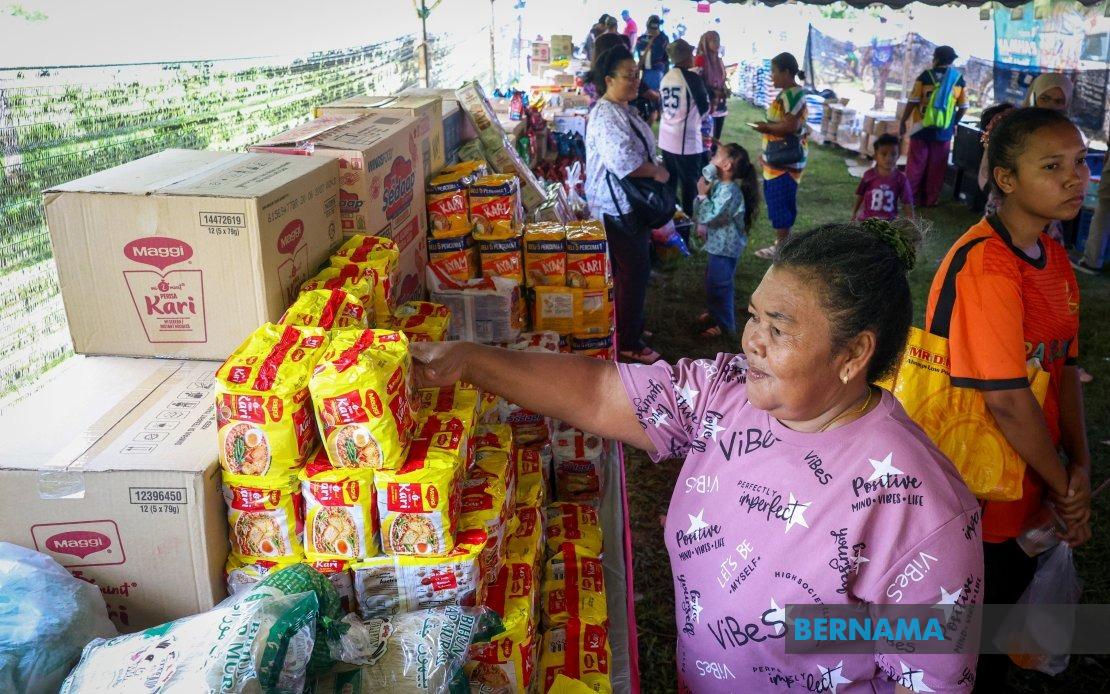
The Rahmah MADANI Sales Programme (PJRM) has arrived at Pasik Resettlement Scheme (RPS) in Gua Musang, bringing subsidised essential goods directly to over 1,000 Temiar Orang Asli residents who previously endured lengthy journeys to access cheaper provisions. This expansion of the federal subsidy initiative addresses a critical accessibility gap for one of Peninsular Malaysia's most geographically isolated indigenous communities, allowing households to redeem their SARA credits—accumulated through the Rahmah Basic Contribution scheme—without the burden of costly travel to distant distribution points.
The practical impact on household finances has been immediately visible to residents. Kampung Ayong villager Ramli Chimbong, a 51-year-old community member, articulated the transformation in stark terms: previously, a single shopping trip required him to rent transport for the two-and-a-half hour journey to Kampung Jerek and back, incurring expenses of at least RM600 when accounting for vehicle rental, meals, and miscellaneous costs. This financial drain effectively negated much of the value these remote residents derived from their SARA balances, forcing them to choose between foregoing subsidised purchases or absorbing substantial out-of-pocket expenses. With PJRM now operational at Pasik, this equation has reversed entirely—residents can access government-subsidised goods on their doorstep, preserving their household budgets for other necessities.
Price differentials between village retailers and the subsidised programme underscore why this initiative carries such significance for low-income households in rural Orang Asli settlements. A nine-kilogramme bag of rice that local merchants stock at RM40 is available through PJRM for RM29—a 27.5 percent saving on a staple commodity purchased regularly. For communities operating on subsistence incomes, such reductions compound across multiple weekly purchases, translating into meaningful improvements in food security and purchasing power. The village retailer margin, while understandable given isolation and transport costs, had become a significant tax on poverty that this programme now alleviates.
SMS Maju Solution, the private operator managing the Pasik distribution point, mobilised an initial inventory reflecting substantial anticipated demand. The company delivered 100 different essential goods categories, including 300 bags of rice, 300 trays of eggs, and 300 live chickens—a breadth of stock suggesting that programme planners anticipated strong uptake. The early-morning queuing, with residents arriving as soon as operations commenced at 9 am, validated this expectation. Such enthusiasm indicates that residents had already experienced the value proposition through word-of-mouth from neighbouring communities where PJRM operated, demonstrating how social networks amplify policy awareness in communities with limited formal communication infrastructure.
Another dimension of the programme's success lies in substantial unspent SARA balances held across the community. SMS Maju Solution proprietor Sabariah Mohamed Sayuti noted that numerous households retained balances between RM300 and RM800—sums that represent meaningful purchasing power when applied to subsidised essential goods. The prevalence of such balances, with very few accounts depleted to RM100 or below, suggests that prior inaccessibility rather than income inadequacy had prevented residents from utilising their entitlements. The programme functions simultaneously as both an anti-poverty measure and as an efficiency mechanism, ensuring that allocated government benefits actually reach intended beneficiaries rather than accumulating unused in digital accounts.
The logistical challenges of serving remote settlements, while ultimately surmountable, underscore the operational complexity underlying what appears to residents as straightforward marketplace access. During the Pasik operation, SMS Maju Solution encountered vehicle damage when a tyre burst on the rocky and mud-laden access roads characteristic of interior Orang Asli settlement areas. Such incidents, easily overlooked in urban policy discussions, represent genuine barriers to service delivery in Malaysia's peripheral regions and illustrate why programme operators require specialised local knowledge and genuine commitment to remote-area service provision. The willingness to manage these operational difficulties reflects a supply-chain decision that prioritises inclusive coverage over profit optimisation.
Nenggiri state assemblyman Mohd Azmawi Fikri Abdul Ghani positioned the programme within the broader context of government cost-of-living support initiatives, emphasising that PJRM specifically addresses inflationary pressures affecting rural communities disproportionately. Indigenous settlements in interior Kelantan lack the competitive retail environments that moderate prices in urban areas; consumers cannot readily comparison-shop or access alternative suppliers. The monopolistic retail dynamics, combined with high transport costs, historically translated into price premiums on essential goods that PJRM directly counters. For policymakers, the programme represents a targeted intervention acknowledging that blanket inflation cannot be addressed through uniform measures—geographically isolated communities require geographically customised solutions.
The assemblyman's advocacy for expanding PJRM across all Orang Asli settlements reflects recognition that Pasik represents merely one node in a broader national network of remote indigenous communities facing similar accessibility and affordability challenges. Peninsular Malaysia contains numerous resettlement schemes and traditional settlements distributed across interior Perak, Pahang, Terengganu, and Kelantan—many more remote and underserved than Pasik. Systematic expansion would require coordinating with state government land administration, identifying suitable local distribution partners, and managing complex supply-chain logistics across highly fragmented geography. Nevertheless, the demonstrated success at Pasik provides a proof-of-concept template that could inform policy scaling.
For Malaysian readers following development and welfare policy, the Pasik expansion illustrates how the Rahmah MADANI initiative—a central pillar of the current government's cost-of-living strategy—operationalises differently across diverse socioeconomic contexts. Urban and peri-urban populations accessed PJRM through fixed retail locations involving minimal search costs. Remote Orang Asli communities faced a different implementation equation: accessibility required government initiative to bring distribution capabilities to dispersed populations rather than expecting those populations to mobilise transport to distribution points. This differentiated implementation reflects evolving policy sophistication in recognising that identical programmes require contextualised delivery mechanisms to achieve equitable outcomes.

