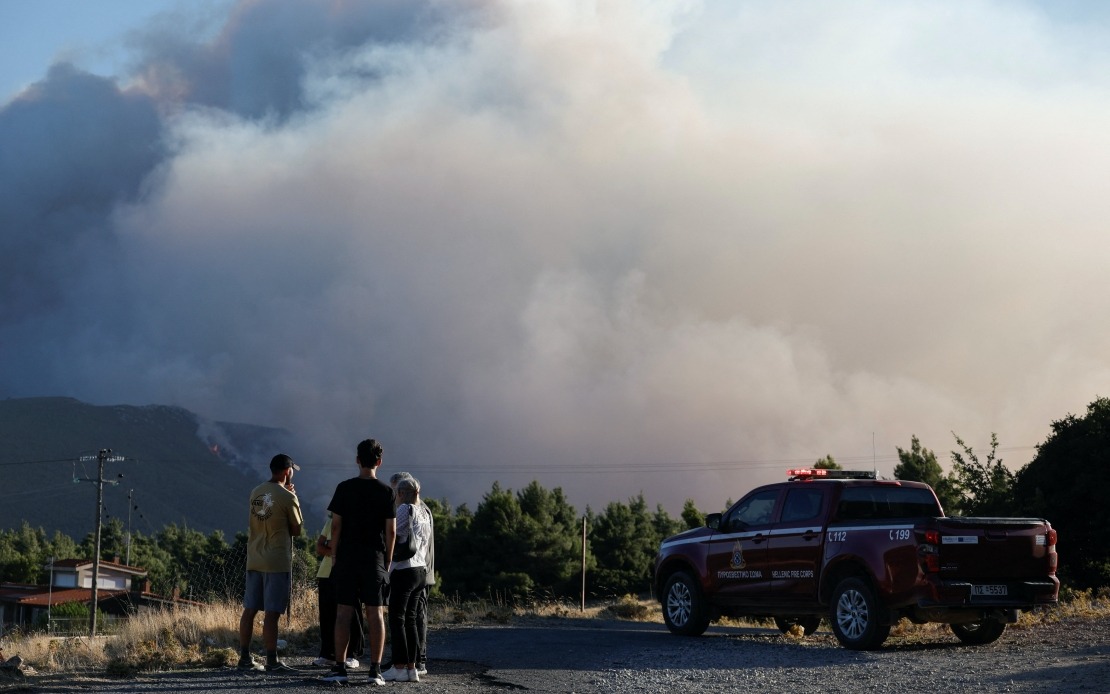
Firefighting efforts in Greece intensified on Sunday as crews battled a sprawling wildfire that has emerged as one of the most significant threats to the Athens metropolitan region in recent times. The conflagration, centred in the Kithairon Mountains, required the continuous deployment of hundreds of emergency personnel who worked through the night to contain the advancing flames. With support from military vehicles and volunteer rescue teams, these responders established a defensive perimeter to protect populated areas from the encroaching fire, demonstrating the scale and severity of the emergency.
As dawn broke over the region, the firefighting operation shifted into a new phase as aerial units resumed their critical role in battling the blaze. Firefighting planes and helicopters returned to active duty, dropping water and fire retardant on the most dangerous hotspots. This combination of ground and air operations reflected the multi-layered approach required to combat a wildfire of such magnitude, where traditional ground-based methods alone proved insufficient to halt the fire's progression.
The geographical characteristics of the region compounded the crisis considerably. Strong winds repeatedly accelerated the fire's spread, creating dangerous conditions that shifted the trajectory of the flames unpredictably. The townships of Veniza and Psatha experienced the most severe impacts, with residents and emergency officials facing the prospect of rapid evacuation as the fire advanced through their areas. The wind-driven nature of the fire meant that firefighting efforts often had to adapt quickly to changing conditions, requiring constant reassessment of priorities and resource deployment.
By Sunday's progress reports, the flames had advanced to within just a few kilometres of Megara, a significant population centre located approximately 50 kilometres west of Athens. This proximity represented a critical turning point in the crisis, as the threat shifted from rural and semi-rural areas to an established urban municipality with thousands of residents. The advancing fire prompted heightened alerts throughout the region and raised concerns about potential evacuation orders affecting multiple communities within the greater Athens area.
The international dimension of the response underscored the severity of Greece's wildfire situation. At least 500 firefighters from Greece, Romania, and France worked collaboratively to contain the blaze, demonstrating regional solidarity during the emergency. This cross-border deployment reflected the mutual aid agreements established among European nations for disaster response, enabling rapid mobilization of specialized crews and equipment to support overwhelmed local authorities.
Parallel to the main fire in the Kithairon Mountains, another significant conflagration continued to burn on Cephalonia, one of Greece's major Ionian islands. However, state broadcaster ERT reported that this secondary fire had not yet threatened any populated towns, suggesting that its spread remained relatively contained compared to the Athens-area emergency. This simultaneous occurrence of major fires illustrated the broader wildfire challenge facing Greece during the high-temperature summer season.
Earlier fires on Crete had largely been extinguished by Sunday, though the damage assessment revealed the human cost of the disaster. Media reports indicated that approximately 200 homes had been destroyed in Cretan communities, though official confirmation of this figure remained pending. Several towns had been placed under mandatory evacuation orders, displacing families and disrupting normal life as residents fled to safety ahead of advancing flames.
The cumulative environmental damage across all active fires proved substantial. Meteorological analysis estimated that approximately 10,000 hectares of land in the northwestern and western regions surrounding Athens had been destroyed by the active fires, representing a significant loss of forest cover and agricultural land. This acreage figure underscored the geographic scale of the emergency and the extensive restoration efforts that would be required once the immediate crisis subsided.
Investigative action had already commenced as authorities identified individuals allegedly responsible for starting some fires. Fire department officials reported that 13 people had been arrested nationwide on charges of negligent arson, suggesting that human negligence or carelessness played a role in igniting some of the blazes. This criminal dimension of the crisis highlighted the broader questions surrounding fire prevention, public safety education, and enforcement of regulations designed to reduce the incidence of human-caused fires during high-risk periods.
For Malaysian observers, the Greek wildfire emergency serves as a cautionary reminder of climate-related risks facing diverse regions globally. Southeast Asia's own experience with large-scale fires—particularly the transboundary haze events affecting Malaysia, Indonesia, and Singapore—demonstrates that no region is immune from such disasters. The Greek response, involving rapid international cooperation and deployment of specialized resources, provides a model for effective crisis management that regional authorities might study when planning their own wildfire and disaster response protocols.
The ongoing situation in Greece reflects broader challenges emerging as climate patterns shift globally. Rising temperatures, prolonged dry periods, and unpredictable wind patterns create conditions favouring rapid fire spread in regions previously considered lower-risk. Greek authorities, along with their European partners, face the complex task of balancing emergency response, environmental protection, and long-term adaptation strategies to address what many climate experts characterize as the new normal for Mediterranean and southern European summers.

