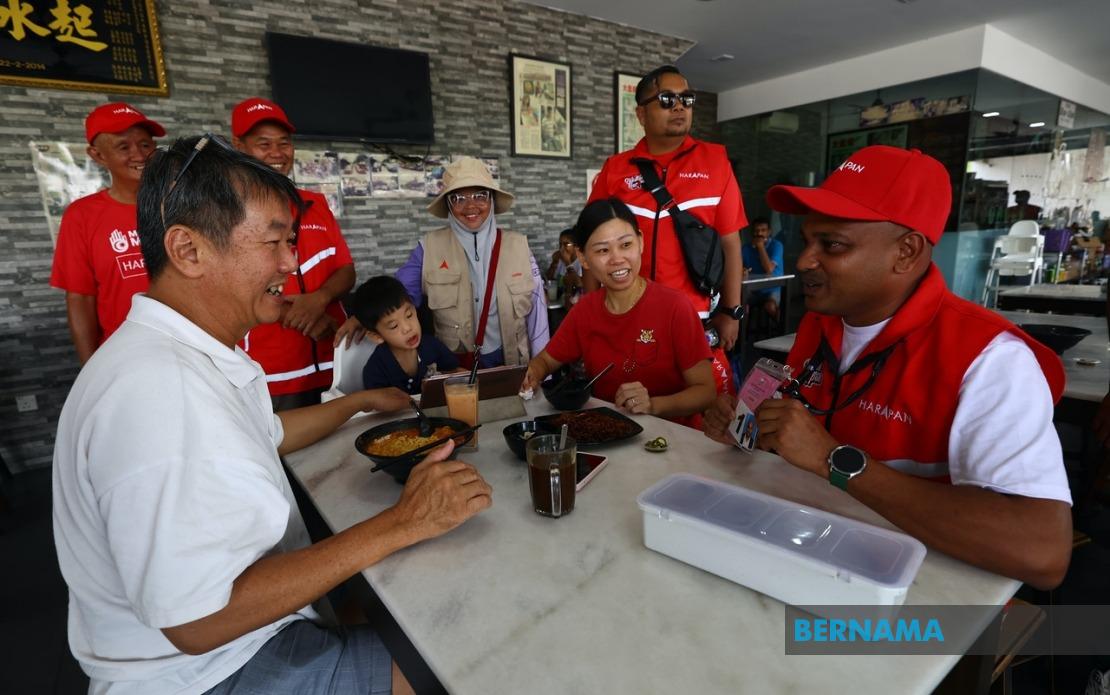
With the Johor state election just five days away, Pakatan Harapan's candidate for Layang-Layang, Guna Balakrishnan, is mobilising his campaign machinery to maximum capacity in a final effort to connect with every eligible voter in the 25,181-strong constituency. Having already reached nearly four-fifths of the electorate, Guna recognised the critical importance of the remaining fifth, pledging to elevate his outreach efforts substantially before voters cast their ballots on July 11.
Speaking at the PH campaign headquarters in Kluang, Guna articulated the challenge with characteristically vivid language, declaring that if his current efforts represented 100 per cent, he would need to double that commitment to 200 per cent to ensure comprehensive voter engagement. This aggressive final-stretch approach reflects the intensity of a three-way contest in which his coalition faces both the Barisan Nasional candidate Chua Jian Boon and the sitting representative, Abd Mutalip Abd Rahim of Perikatan Nasional, in a race that will help determine the composition of Johor's state government.
Central to Guna's pitch to voters is his manifesto, which synthesises practical local concerns with broader developmental aspirations. The document prioritises flood mitigation—a pressing issue in several areas of the constituency—alongside systematic improvements to road infrastructure and street lighting that residents frequently cite as priorities. Beyond these tangible infrastructure concerns, the manifesto ventures into digital equity, recognising that rural communities often lag urban areas in internet connectivity and that reliable broadband access increasingly determines economic and educational opportunity.
The human capital dimension of Guna's agenda reflects contemporary developmental thinking that emphasises capability-building across diverse demographic groups. His commitment to expanding Technical and Vocational Education and Training opportunities for young people addresses a persistent skills gap in Malaysia's labour market, while dedicated support for women entrepreneurs targets both gender equity and entrepreneurial dynamism. These elements position the candidate as attuned to national economic priorities, not merely local grievances.
Particularly noteworthy is Guna's pledge to establish a Senior Citizens Activity Centre—termed PAWE in local parlance—an initiative reflecting Malaysia's demographic transition as the population ages. By framing this as part of an inclusive vision rather than a peripheral welfare gesture, Guna signals that his governance philosophy encompasses all life stages and economic circumstances within the constituency. This intergenerational approach, encompassing youth vocational training and elderly welfare simultaneously, suggests a longer-term community vision.
Local sentiment appears receptive to these commitments. Trader Tan Ah Kiat, interviewed at the campaign headquarters, articulated the practical appeal of Guna's platform, emphasising how flood mitigation and drainage improvements directly address chronic infrastructure deficits that affect commerce and daily life. Tan's validation highlighted how even aspirational policy positions must ultimately address physical, tangible community problems to resonate with voters negotiating practical hardship.
The emphasis on digital connectivity drew particular commendation from community member R. Kalaiselvan, who recognised that internet coverage gaps constrain both educational advancement and entrepreneurial possibility for rural residents. In an era when economic competitiveness increasingly depends on digital access, and when pandemic-era remote work and learning exposed infrastructure inadequacies, this element of Guna's platform addresses a genuine developmental bottleneck.
Kalaiselvan's broader observations underscore how a coherent policy platform—one addressing youth opportunity, women's economic participation, and senior welfare simultaneously—projects a comprehensive rather than fragmented governing vision. The capacity to articulate how different demographic groups benefit from complementary initiatives suggests strategic policy thinking rather than ad hoc vote-catching.
The Layang-Layang contest sits within the broader Johor political narrative, where state-level elections serve as important barometers of coalition strength and governing competence. Johor's significance as Malaysia's second-largest state by population, and as a traditional kingmaker in national politics, means that performance in constituencies like Layang-Layang ripples beyond local governance into state-level outcomes and coalition mathematics affecting Putrajaya itself.
Pakatan Harapan's campaign messaging emphasises its track record of delivering transformative change, a framing that implicitly acknowledges voter desire for governance renewal and policy innovation. Whether framed around infrastructure, education, or elderly care, the coalition's pitch centres on demonstrable capability and proven delivery—a deliberate counterpoint to arguments that might emphasise merely political rhetoric or personality.
With early voting scheduled for July 7 and the full election following four days later, the final campaign week will be decisive. Guna's intensive push to contact the remaining fifth of voters represents standard electoral arithmetic—in tight races, narrow margins often determine outcomes, making comprehensive voter contact a practical necessity rather than optional refinement.
The Layang-Layang contest ultimately reflects broader questions about what voters in Malaysian constituencies prioritise when making electoral choices. The responsiveness to Guna's manifesto—emphasising both immediate infrastructure fixes and longer-term capability-building—suggests that local electorates increasingly evaluate candidates on substantive policy platforms rather than factional loyalty alone, a development that may reshape how Malaysian politics conducts itself in the coming electoral cycle.

