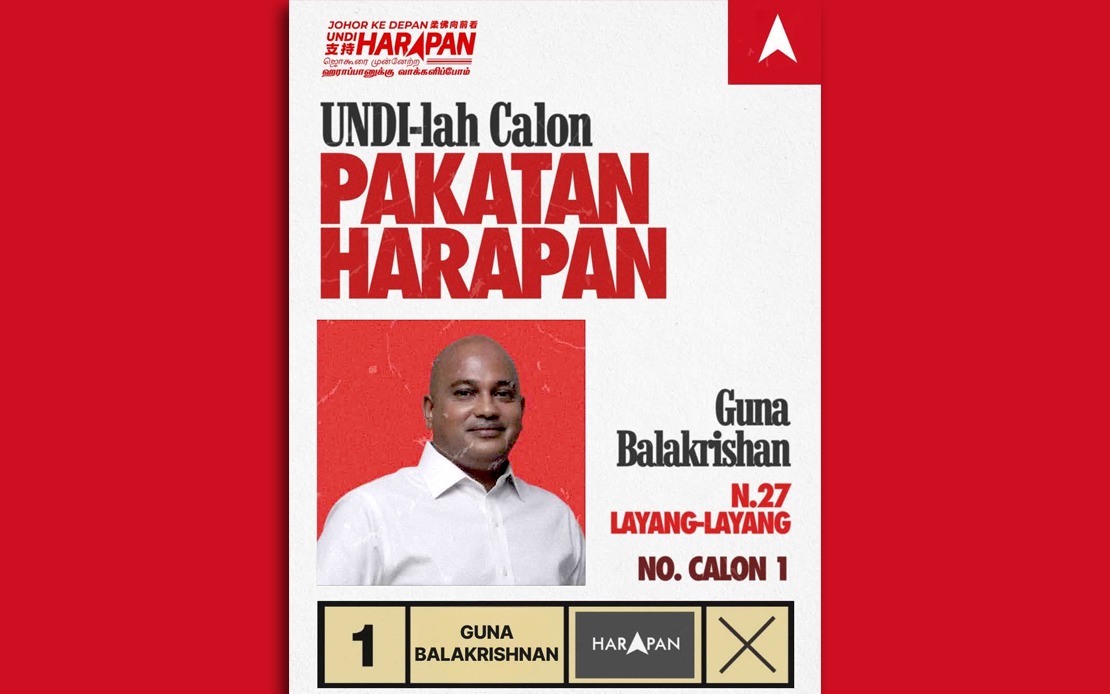
Pakatan Harapan's candidate for the Layang-Layang state seat, Guna Balakrishnan, has presented an expansive development blueprint intended to reshape the constituency through targeted investments in infrastructure, economic revitalisation, and community welfare. The manifesto encompasses six core pledges that collectively reflect a vision of inclusive growth where all demographic segments benefit from state-level initiatives. Speaking during a campaign engagement in the area, Guna underscored his intention to function as a responsive representative genuinely embedded within the community, capable of translating resident concerns into actionable policy outcomes.
The most pressing issue anchoring Guna's platform concerns the chronic flooding that continues to devastate multiple residential areas throughout the constituency. Communities in Kampung Senda, Sungai Sayong, Kampung Tengah Renggam, Ulu Benut, Simpang Renggam, and Kampung Chokro have experienced recurring inundation that disrupts livelihoods and poses safety risks to families. Rather than framing flood management as a perpetual challenge, Guna's approach emphasises expedited implementation of mitigation infrastructure, systematic drainage enhancement, and proactive maintenance protocols for road networks and public facilities. This signals a departure from reactive crisis management toward preventative systems that would reduce vulnerability during monsoon seasons.
Beyond physical infrastructure, Guna's campaign priorities encompass digital connectivity as a foundational development requirement for rural areas. He has committed to expanding internet coverage in underserved zones, recognising that technological access directly enables educational participation and business operation in the modern economy. Complementing digital infrastructure improvements, Guna proposes enhancing street lighting networks, a practical measure that enhances both security perceptions and evening mobility for residents. These investments in basic services reflect an understanding that economic participation and quality of life depend substantially on utilities that urban constituencies often take for granted.
Economic empowerment constitutes another dimension of Guna's manifesto, with particular focus on small-scale traders and merchants who form the backbone of local commerce. He has outlined support mechanisms for grassroots entrepreneurs alongside a strategy to capitalise on Renggam's tourism potential. Rather than relying solely on external investment, the proposal emphasises endogenous development where local residents capture value from regional attractions, generating income diversification that reduces economic vulnerability. This approach recognises that sustainable prosperity emerges when communities possess agency over their economic futures rather than depending entirely on state or federal patronage.
Youth development features prominently in Guna's platform through two interconnected initiatives. The first involves expanding access to Technical and Vocational Education and Training (TVET) pathways, which provide alternatives to traditional academic routes and align education with labour market demands. The second proposes establishing a motorsports track facility that would channel youth interest in automotive culture toward organised, skill-building activities. This dual approach acknowledges that young people require both formal vocational credentials and safe spaces for recreational pursuits that can ultimately develop transferable talents.
Gender and ageing populations receive specific attention within the manifesto framework. Guna has highlighted women's entrepreneurship as a priority area, signalling intent to remove barriers constraining female business participation. For senior citizens, he proposes establishing a Senior Citizens Activity Centre (PAWE), a facility designed to maintain active engagement and social connection for older residents. This intergenerational focus reflects demographic realities facing Malaysian constituencies, where both women-headed households and rapidly ageing populations require targeted policy responses.
Central to Guna's positioning is his explicit assertion that these pledges represent genuine commitments rather than ephemeral campaign rhetoric. He has framed the state assemblyman role as a bridge function connecting grassroots concerns to government systems, emphasising that effective representation requires both upward advocacy and downward accountability. This framing addresses a persistent tension in Malaysian politics where constituent expectations frequently diverge from elected representative capacity, a dynamic particularly pronounced in state-level contests where resource constraints remain substantial compared to federal-level initiatives.
The Layang-Layang contest unfolds within a competitive three-way race involving Guna, Barisan Nasional incumbent Chua Jian Boon, and Perikatan Nasional's Abd Mutalip Abd Rahim, who currently holds the seat. The constituency encompasses 25,181 registered voters, providing a meaningful electoral base capable of determining electoral outcomes through differentiated turnout patterns. This configuration ensures that victory depends on consolidating support across demographic segments and geographic zones within the constituency.
The Johor state election scheduled for July 11, with early voting commencing July 7, occurs within a complex political landscape where national coalition dynamics intersect with local development priorities. For Malaysian voters, particularly those in constituencies facing similar infrastructure deficits and economic constraints, Guna's manifesto illustrates broader contestation over how state governments should prioritise resource allocation. The manifesto's emphasis on inclusive development, flood mitigation, and grassroots economic empowerment reflects recognisable concerns across multiple Malaysian constituencies, suggesting that these thematic priorities resonate beyond Layang-Layang's specific boundaries.
The campaign pledge structure also demonstrates evolving political communication strategies where candidates increasingly articulate detailed sectoral programmes rather than relying on abstract ideological positioning. This reflects voter expectations that elected representatives provide specificity regarding intended actions rather than generalised commitments to governance competence. Whether implemented comprehensively, partially, or minimally following electoral outcomes remains contingent upon resource availability, bureaucratic capacity, and political will sustained beyond the election campaign cycle.

