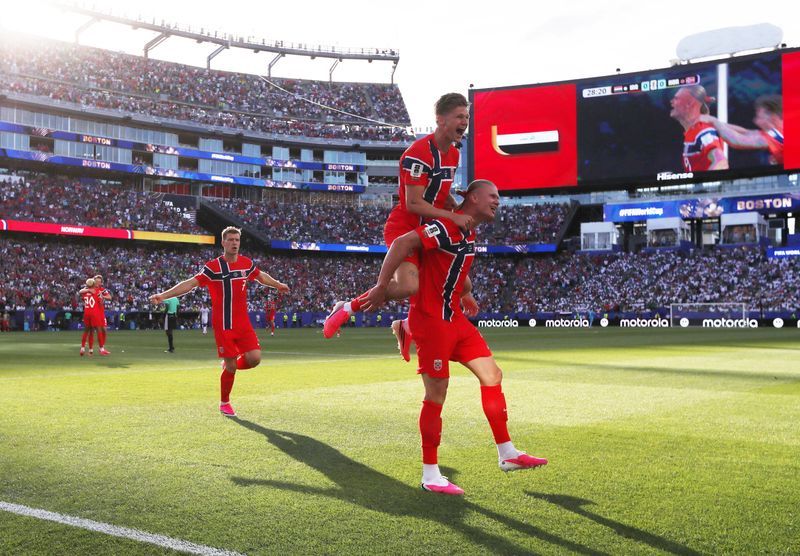
Erling Haaland marked his World Cup debut with a performance befitting football's most lethal striker, netting twice in Norway's commanding 4-1 victory over Iraq on Tuesday. The result delivers a statement of intent from the Scandinavian squad as they begin their World Cup campaign following an absence spanning nearly three decades. Haaland's opening-match double underscores his extraordinary ability to perform when the stakes are highest, yet also raises questions about whether his individual brilliance can elevate a national team still seeking consistency across eleven positions.
The Manchester City forward has now achieved a feat rarely accomplished in modern football: scoring on his debut in the German Bundesliga, English Premier League, UEFA Champions League, and now the World Cup finals. This accomplishment speaks to his rare combination of instinct, positioning, and composure in front of goal. Few observers questioned whether he would deliver on the international stage's grandest occasion, and his first-half brace swiftly answered any lingering doubts about his capacity to translate club form into tournament success. His goals provided Norway with the foundation for victory, though the manner of their construction revealed both his sharpness and his teammates' willingness to service him repeatedly.
Norway's path to victory proved more laboured than the scoreline initially suggests. Throughout significant stretches of the first half, the team struggled to impose their tactical identity on proceedings, with wayward passes and loose touches undermining their attempts to control the game's tempo. Iraq mounted genuine resistance and avoided capitulation despite facing a vastly superior opponent. The coaching staff's strategy became increasingly apparent: position Haaland in dangerous areas and allow his predatory instincts to do the remainder of the work. This tactical framework, whilst effective in Tuesday's circumstances, may present strategic vulnerabilities against more defensively sophisticated opponents encountered deeper in the tournament.
Haaland's first goal demonstrated the poacher's craft in its purest form. David Moller Wolfe's cross from the flank found its intended target, and Haaland's positioning and timing allowed him to finish with clinical precision. The second goal revealed a different dimension to his game: aggressive pressing on the Iraqi defence created a momentary lapse that forced a careless back-pass. Haaland's continued pressure disrupted the goalkeeper's clearance attempt, with the ball ricocheting into the net. Both goals reflected varying aspects of his attacking repertoire—anticipation and predatory finishing on one occasion, relentless pressure and opportunism on the other.
Despite carrying Norway's attacking hopes, Haaland maintains a measured demeanour in the media spotlight. Within an otherwise communicative camp, the striker rarely grants interviews, preferring instead to allow his performances to generate conversation. This characteristic silence proved irrelevant against Iraq's defensive efforts, as neither tactical adjustments nor defensive organisation could effectively neutralise him during the opening forty-five minutes. His reluctance to articulate ambitions verbally appears connected to his approach of letting actions supersede words—a philosophy that has served him exceptionally well throughout his career progression.
Norwegian Prime Minister Jonas Gahr Stoere articulated a fundamental truth before the match: while individuals score goals, only teams can secure victories. This observation appeared prescient given Norway's stuttering overall performance. Manager Stale Solbakken has constructed his side around maximising Haaland's threat, effectively building an attacking system where every player shares responsibility for creating opportunities for their principal goalscorer. The strategy requires flawless execution from supporting players, yet several performers underdelivered in the opening fixture. Captain and creative fulcrum Martin Odegaard produced a surprisingly muted display in midfield, failing to orchestrate the controlled tempo expected of Norway's playmaker.
Defensive lapses provided Iraq with genuine encouragement during the contest. Aymen Hussein capitalised on watchfulness from the Norwegian rearguard to equalise against the run of play, suggesting that concentration issues could prove costly against superior attacking forces encountered subsequently. The defensive vulnerability, combined with inconsistent midfield control, presents concerns for tactical preparation heading into group matches against more formidable competition. Haaland's individual excellence masked these collective shortcomings effectively on this occasion, but more demanding opponents will exploit such deficiencies.
The victory positions Norway atop their group with three points, ahead of France on goal difference following the French team's 3-1 demolition of Senegal earlier in the day. This advantageous group standing, however, comes with Haaland's own acknowledgement that performance standards must elevate substantially. The striker himself recognised that his side failed to execute at their optimal level despite achieving a decisive result. Such self-awareness suggests maturity in recognising that scorelines can obscure underlying tactical and technical shortcomings requiring corrective attention.
For Norwegian supporters and the wider football public, Tuesday's encounter marked a nostalgic return to the World Cup's grandest stage following an agonising quarter-century of exclusion from the tournament. The nation's men's team had not competed at a World Cup finals since 1998, representing an extended period of disappointment and missed opportunities. Haaland's performance provides a symbolic representation of Norway's renewed ambitions and the generation of talent emerging from Scandinavian football. The striker's individual brilliance offers his country genuine hope of progressing beyond the group stage and potentially competing in knockout fixtures.
Haaland's post-match reflection captured the mood appropriately. Despite acknowledging that neutrals expected Norway to secure victory without complications, he expressed gratification that his side had executed the anticipated outcome. His hopes that compatriots were celebrating back home reflected the emotional weight of ending the World Cup absence. For a nation that has produced several excellent players yet struggled to construct sustained tournament success at the highest level, the combination of Haaland's elite-level performance and their own competitive advantage represents a genuine opportunity to exceed historical expectations.