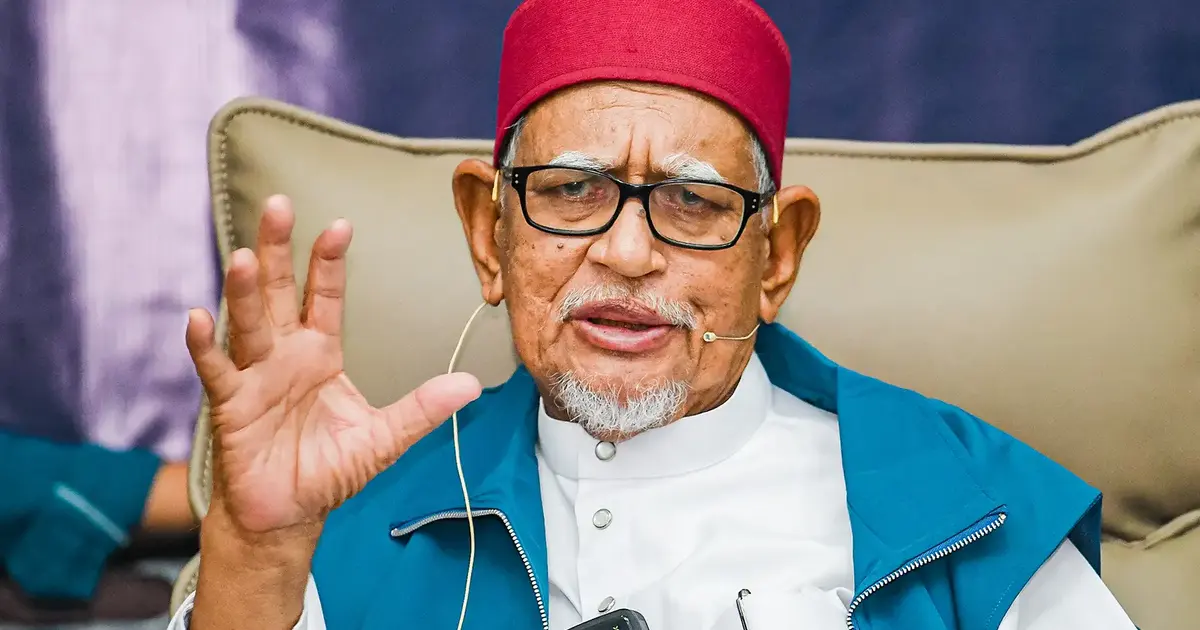
PAS president Abdul Hadi Awang has declared that Bersatu no longer forms part of the Perikatan Nasional coalition, asserting the party's membership has effectively terminated through its own actions. Hadi's statement centres on Bersatu's publicly announced strategy to establish a new political alliance after the Negeri Sembilan state election, which he characterises as an automatic severance from the broader three-party coalition that currently anchors Malaysia's federal government.
The assertion marks a significant escalation in tensions within Perikatan Nasional, which has served as the cornerstone of the current ruling administration since the 2022 general election. The coalition, which comprises PAS, Bersatu, and Umno's splinter Bersatu faction, has faced mounting strains over power distribution, ministerial appointments, and strategic direction. Hadi's pronouncement suggests these underlying fractures have now surfaced into explicit territorial claims about coalition membership itself.
Bersatu's pivot towards forming alternative political partnerships represents a fundamental challenge to the stability of the current government. By signalling its intention to construct a separate coalition structure, the party—which holds significant parliamentary weight through its MPs—appears to be hedging against what party leadership may perceive as diminishing influence within the existing arrangement. This manoeuvre is particularly consequential given Malaysia's current parliamentary mathematics, where slim government majorities depend on maintaining coalition discipline.
The Negeri Sembilan election has become a focal point for these coalition tensions. The state contest appears to have crystallised disagreements over candidate selection, campaign strategies, and the distribution of electoral influence among coalition partners. Rather than serving as a routine state-level contest, the Negeri Sembilan race has transformed into a proving ground for determining which parties retain effective control within Perikatan Nasional's architecture.
For Malaysian observers tracking coalition dynamics, Hadi's statement carries multiple layers of significance. His framing of Bersatu's departure as "automatic" rather than contested suggests PAS views the coalition rupture as inevitable consequence of deliberate action, not a matter requiring formal negotiation or mutual agreement. This rhetorical stance potentially forecloses diplomatic pathways that might otherwise exist for coalition repair. The language chosen indicates PAS considers Bersatu's commitment to the coalition fundamentally compromised.
The implications for federal governance warrant careful attention. Perikatan Nasional's breakdown would force recalibration of parliamentary support architectures that currently enable the government to function. Alternative coalitions, whether centred on Umno, Bersatu's new arrangements, or unexpected Pakatan Harapan negotiations, would substantially alter executive-legislative relationships and policy-making dynamics. These shifts could affect everything from legislative priorities to ministerial portfolios to implementation of major national policies.
Bersatu's strategic repositioning must be understood within the context of party leadership calculations about long-term political viability. The party, which emerged from Umno defections and has occupied an uncertain middle ground within Malaysian politics, may be concluding that maximising autonomy through coalition flexibility offers better prospects than remaining subordinate within Perikatan Nasional's existing power structure. This reasoning reflects rational political self-interest, even as it destabilises government cohesion.
Regional implications also merit consideration. Malaysia's political instability has historically created openings for neighbouring governments to exercise influence or pursue their own diplomatic agendas. Coalition fragmentation typically elevates uncertainty in bilateral relationships and regional forums like Asean, potentially affecting Malaysia's capacity to project unified positions on regional security, economic cooperation, and diplomatic initiatives.
The trajectory of Malaysian coalitions in recent years suggests that formal structures often mask deeper fault lines that eventually demand resolution. The period since 2022 has witnessed repeated negotiations, realignments, and recalibrations as competing factions within Perikatan Nasional jostle for advantage. Hadi's statement may represent not the culmination of these tensions but rather their next phase of public manifestation, with genuine resolution potentially remaining distant.
Moving forward, the question becomes whether Hadi's pronouncement reflects irreversible coalition collapse or represents negotiating posture within ongoing internal discussions. The distinction matters enormously for government stability and legislative functioning. Malaysian political history demonstrates that even severely fractured coalitions can sometimes be reconstructed, though typically at the cost of significant concessions to the aggrieved parties.
The coming weeks will reveal whether Perikatan Nasional undergoes formal dissolution or whether existing partners engage in urgent damage control aimed at preserving the coalition structure. Such dynamics will substantially shape not only immediate electoral calculus around the Negeri Sembilan contest but also the broader political landscape heading towards the next general election, making these coalition manoeuvres consequential far beyond their surface-level constitutional implications.

