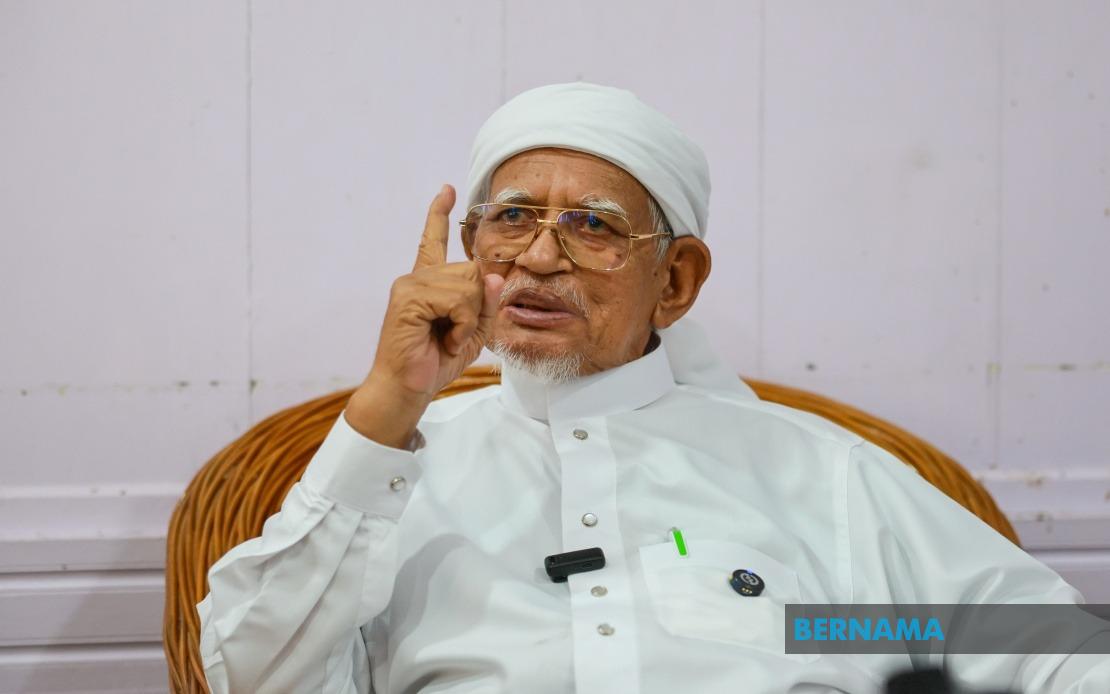
A brewing dispute over coalition membership threatens to deepen fractures within Malaysia's opposition alliance structure, with PAS and Bersatu leaders at loggerheads over whether the latter party retains standing in Perikatan Nasional following its recent manoeuvres. Speaking at the Rusila Mosque in Marang on Wednesday, PAS president Tan Sri Abdul Hadi Awang asserted that Bersatu's position within the coalition has already been forfeited as a matter of automatic consequence, requiring no formal declaration or procedural action from PN leadership. The confrontation reflects mounting tensions over how the various opposition and non-aligned factions navigate an increasingly fractious political landscape in Malaysia.
Abdul Hadi's position rests on a straightforward reading of coalition dynamics: when a component party signals its intention to establish an alternative alliance structure, its membership in the original coalition effectively terminates without requiring explicit notification or formal procedures. He emphasised that PN need not issue any official communication to Bersatu regarding its status, as the mere expression of intent to construct a competing coalition arrangement constitutes a de facto withdrawal. This interpretation suggests that Abdul Hadi views membership clauses as self-executing mechanisms that do not require institutional action by a coalition's decision-making bodies.
The dispute stems from earlier reports that Bersatu president Tan Sri Muhyiddin Yassin had announced plans to establish a new coalition comprising multiple parties, with this realignment to commence after the Negeri Sembilan state election. Such a move would fundamentally alter the composition of Perikatan Nasional, which has served as a platform for opposition-leaning parties and non-aligned factions seeking to coordinate their political strategies outside the Barisan Nasional framework. Muhyiddin's stated intention to forge alternative partnerships has evidently prompted Abdul Hadi to declare that Bersatu's membership tenure has effectively expired.
However, Bersatu secretary-general Datuk Seri Mohamed Azmin Ali mounted a forceful rebuttal, insisting that his party retains full legitimacy as a PN component and that Abdul Hadi possesses neither the constitutional authority nor the personal prerogative to unilaterally determine membership status. Azmin emphasised that the PN Constitution contains no provision permitting automatic revocation of a component party's membership simply because that party has expressed interest in external alignments. He stressed the importance of procedural compliance and constitutional propriety in addressing such significant organisational matters.
According to Azmin, only the PN presidential council possesses the institutional authority to adjudicate questions concerning component party membership, and this power is explicitly codified in Clause 7A of the Perikatan Nasional Constitution. He noted pointedly that the presidential council has not yet convened to deliberate on Bersatu's standing within PN, meaning that no legitimate determination has been made regarding the party's status. This procedural gap suggests that even if tensions have escalated, the formal mechanisms for resolving them remain unused.
The constitutional distinction that Azmin articulated reflects a fundamental principle underlying coalition governance: the difference between sentiment or informal assertions by individual leaders and binding decisions rendered through properly constituted institutional channels. By directing attention to Clause 7A and the presidential council's exclusive jurisdiction, Azmin sought to reframe the debate from Abdul Hadi's declarative stance to the proper constitutional procedures that should govern such consequential matters. This appeal to proceduralism may provide a diplomatic pathway for resolving the dispute without requiring either party to abandon its core position.
Azmin further delegitimised Abdul Hadi's authority by explicitly stating that the PAS president lacks both the right and any form of veto power to determine Bersatu's position within PN. Such language underscores the tension between informal leadership pronouncements and formally constituted powers, a distinction that carries particular weight in Malaysian coalition politics where numerous parties must navigate overlapping jurisdictions and competing authority structures. By asserting that Abdul Hadi has overstepped his purview, Azmin effectively characterised the PAS president's claim as an attempt to exercise authority he does not formally possess.
Beyond the immediate spat, this confrontation illuminates deeper structural vulnerabilities within Perikatan Nasional itself. The coalition was established as a means of uniting diverse opposition and non-aligned factions under a loosely coordinated framework, yet its constitutional provisions appear insufficient to address situations where component parties pursue conflicting strategies or seek to reconfigure their external relationships. The absence of clear, universally accepted procedures for managing such scenarios leaves considerable room for competing interpretations and mutual recriminations, as the current episode demonstrates.
Bersatu's announcement of plans to form an alternative coalition compounds existing tensions between the party and both PAS and other PN members. For PAS, which has positioned itself as a more ideologically coherent faction within the broader coalition, Bersatu's manoeuvres may be perceived as threatening to the viability of PN as a meaningful political force. From Bersatu's perspective, however, flexibility in coalition partnerships may appear necessary given the fluid nature of Malaysian electoral politics and the party's own strategic interests. These divergent imperatives are now colliding openly.
In response to Abdul Hadi's assertions, Bersatu has indicated its intention to lodge a formal complaint with the Registrar of Societies, suggesting that the party intends to pursue this matter through institutional channels rather than through continued public disputation. This escalation signals that Bersatu views Abdul Hadi's claims as sufficiently serious and illegitimate to warrant involvement of relevant regulatory authorities. The decision to formalise the complaint reflects Azmin's earlier emphasis on constitutional procedures and proper institutional mechanisms.
For Malaysian observers and broader Southeast Asian political analysts, this dispute highlights the challenges inherent in maintaining coalition stability when multiple parties hold competing strategic interests and when constitutional provisions do not adequately address contingencies. The outcome of this particular disagreement will likely influence how future coalition disputes are managed and whether PN can survive as a meaningful political structure amid deepening internal divisions. Should Bersatu proceed with establishing its separate coalition while simultaneously claiming PN membership, the resulting ambiguity could undermine the coherence of both alliances.
The timing of this confrontation, occurring in the wake of state election campaigns and amid ongoing speculation about national political realignment, suggests that Malaysian politics continues to experience structural instability at the coalition level. Rather than settling into stable partisan configurations, the opposition landscape remains in flux, with parties regularly reassessing their alliances and seeking optimal positioning ahead of potential elections. In this context, disputes such as the current PN membership controversy are unlikely to represent isolated incidents but rather symptoms of a broader pattern of realignment and repositioning that will continue shaping Malaysian politics for the foreseeable future.

