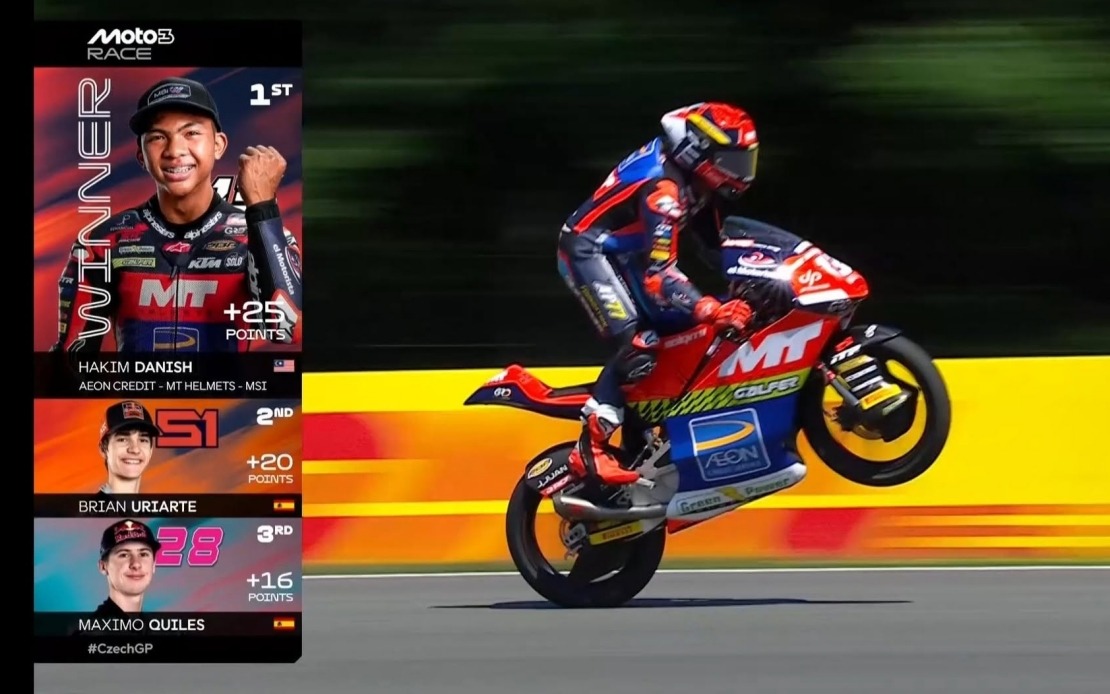
Malaysian motorcycle racing has a new prospect making waves on the international stage. Muhammad Hakim Danish Ramli, the 18-year-old Team AEON Credit-MT Helmets-MSi rider, is gearing up for a crucial weekend at the German Motorcycle Grand Prix at Sachsenring this Sunday, determined to maintain the momentum that has propelled him into contention for the Moto3 Rookie of the Year award. The timing is significant—this race marks the final outing before the summer break, making it an ideal opportunity for the ambitious teenager to solidify his position before the mid-season hiatus.
Hakim Danish's trajectory this season has been nothing short of impressive for a Malaysian competitor in one of motorcycle racing's most competitive junior categories. The rider's breakthrough came at the Czech Republic Grand Prix on June 21, when he claimed his maiden Moto3 victory—a milestone that vindicated months of preparation and strategic development. Just one week later, at the Dutch Grand Prix, he demonstrated consistency by finishing seventh and accumulating nine championship points, evidence of his ability to perform under pressure on successive weekends. These results have positioned him sixth overall in the championship standings, reflecting genuine competitiveness against a field of international talent.
The Sachsenring Circuit, however, presents a distinctly different challenge from recent venues. Located in eastern Germany, the track is renowned among motorcycle racing circles for its unforgiving characteristics that demand technical precision and mental fortitude. Its narrow width leaves minimal margin for error, while the predominance of left-hand turns creates unusual physical demands on riders and machines alike. The circuit's confined nature and go-kart-style layout have earned it a reputation as one of the most technically demanding tracks on the Moto3 calendar, requiring riders to execute the same precision repeatedly throughout a race distance. Hakim Danish has acknowledged these challenges candidly, recognising that success here requires meticulous preparation beyond what suffices at more forgiving circuits.
Recognising the magnitude of the task ahead, Hakim Danish has undertaken comprehensive preparation. His training regimen has intensified in recent weeks, while he has systematically reviewed footage of his own previous race performances to identify areas for refinement. Beyond personal analysis, he has studied last season's Moto3 race at Sachsenring, seeking insights into successful approaches and potential pitfalls. This methodical approach reflects the professional mindset increasingly expected in junior racing categories, where marginal gains in preparation often translate into measurable performance improvements. His confidence levels remain elevated following recent success, though tempered by realistic assessment of the circuit's technical demands.
Previous experience at Sachsenring provides sobering context for his ambitions. Last season, competing in the Red Bull MotoGP Cup at the same venue, Hakim Danish struggled to adapt quickly. His results—10th place in Race 1 and 18th in Race 2—suggest that the circuit's unique characteristics have historically proven difficult for him to master rapidly. Team management is acutely aware of this history and views this weekend as an opportunity for redemption. The focus, according to team manager Zulfahmi Khairuddin, is on helping the young rider overcome previous shortcomings through rapid adaptation and execution of an improved strategy.
The stakes extend beyond a single race result. Hakim Danish currently sits second in the Rookie of the Year championship with 82 points, but faces a significant gap to the category leader, Spain's 17-year-old Brian Uriarte, who commands a 20-point advantage. In Moto3, where points accumulate slowly and competition is fierce, this gap represents the margin between several strong finishes. A victory or podium appearance at Sachsenring would dramatically alter the mathematical landscape of the rookie battle, particularly given that this is one of the final races before the championship's closing stages. Conversely, a poor result would see him fall further behind, potentially diminishing realistic title prospects.
Team management's strategy for the weekend focuses on achieving specific intermediate targets rather than guaranteeing podium finishes. Zulfahmi Khairuddin emphasised that qualifying for the Qualifying 2 session remains a primary objective, as this has proven consistently achievable for Hakim Danish across recent rounds. Q2 qualification positions riders favourably for race day, typically allowing access to front-row starting positions and the strategic advantages therein. The team recognises that sustainable progress requires solid fundamentals—consistent qualification performance and solid qualifying rounds—before pursuing headline-grabbing victories. This pragmatic approach reflects mature thinking within the Malaysian motorcycle racing programme.
Beyond immediate race considerations, this German Grand Prix visit carries longer-term significance. Zulfahmi plans to use the Sachsenring weekend as an opportunity to discuss Hakim Danish's career trajectory and plans for the forthcoming season. These conversations between rider, team management, and potentially sponsors or federation officials typically determine resource allocation and development strategy for upcoming campaigns. For a Malaysian rider competing internationally, such discussions are crucial in securing sponsorship continuity and team commitment necessary for sustained progression through competitive racing categories.
The German Grand Prix represents a critical juncture in Hakim Danish's 2024 season. Success at Sachsenring would validate his recent form, narrow the Rookie of the Year gap, and provide psychological momentum heading into the mid-season break. Conversely, struggling at the challenging circuit would raise questions about his adaptability to different track types—a crucial skill for ambitious young riders targeting higher categories. For Malaysian motorsports followers, the weekend offers an opportunity to observe a homegrown talent operating at genuinely competitive international level, demonstrating that the country can produce machinery racing prospects capable of challenging established racing nations across the Moto3 championship.

