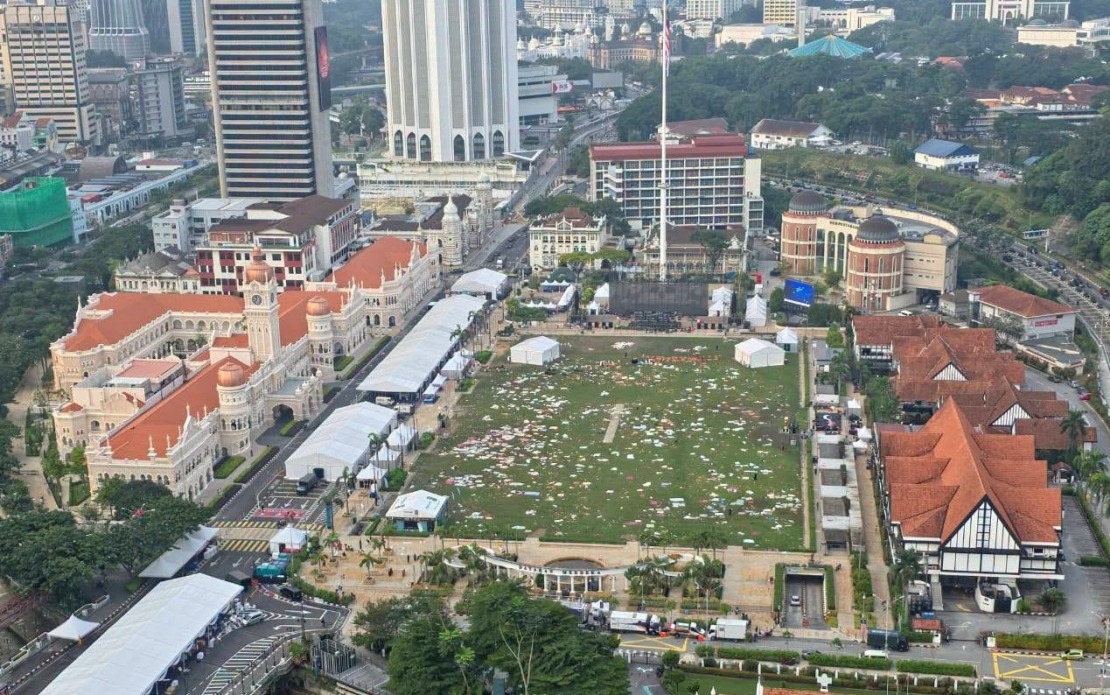
The Malaysian government's approach to civic engagement has taken a sharper focus following the cleanup of Dataran Merdeka in the wake of a public screening of the 2026 FIFA World Cup final. Minister in the Prime Minister's Department (Federal Territories) Hannah Yeoh publicly commended the efforts of Kuala Lumpur City Hall workers while simultaneously delivering a pointed message to citizens about their own obligations in maintaining shared public spaces.
Yeoh's intervention highlights a persistent tension in urban management across Southeast Asia—the gap between public expectations of government service delivery and the reality of resource constraints faced by municipal authorities. The large crowds drawn to the historic square for the World Cup broadcast generated substantial debris that required intensive cleanup operations. Rather than simply celebrating the successful event, the minister chose to use the moment as a teaching point about societal values and personal accountability.
The Federal Territories minister's comments reflect a broader philosophy underpinning the Malaysia MADANI agenda, which Prime Minister Datuk Seri Anwar Ibrahim has consistently framed as a partnership between government and citizens rather than a one-sided provision of services. Yeoh articulated this principle directly, noting that while taxpayers rightfully expect quality public services and DBKL has delivered on its cleaning obligations, this does not absolve individuals of basic responsibility. The minister stressed that disposing of rubbish in designated bins represents a fundamental civic duty that extends beyond what government workers should reasonably be expected to manage.
Dataran Merdeka carries particular symbolic weight in Malaysian consciousness as the nation's independence square and a repository of historical significance. Yeoh emphasized that this heritage status demands collective stewardship, framing the venue not merely as an event space available for public use but as a national treasure requiring preservation. This positioning elevates the litter issue beyond simple cleanliness to a matter of cultural respect and national pride.
The minister's remarks also carry implicit criticism of a consumer mentality that has become increasingly common in developing nations experiencing rapid urbanization. The notion that paying taxes automatically transfers all responsibility for public maintenance to government employees overlooks the interdependent nature of urban life. When thousands of people gather in a central location and leave behind waste, the burden falls disproportionately on a relatively small workforce tasked with restoration.
Yeoh's Facebook post articulated a vision of shared dignity in which citizens recognize themselves as stakeholders in the condition of their city. She pointedly reframed the relationship, noting that Kuala Lumpur belongs to its residents and should not be deliberately soiled with the expectation that others will clean it. This rhetorical approach places the onus on individual conscience rather than regulatory enforcement, appealing to a sense of collective ownership.
The incident also reveals practical challenges facing Malaysian municipalities as events of increasing scale draw larger audiences to central locations. The FIFA World Cup screening represents a type of spontaneous mass gathering that municipal planners must accommodate with adequate waste management infrastructure. While DBKL demonstrated capacity to handle the cleanup, the scale of debris generated raises questions about preventive measures, including adequate bin placement, public education during events, and monitoring during the screening itself.
From a Southeast Asian perspective, this issue resonates across the region where rapid urbanization has sometimes outpaced development of civic consciousness around public space maintenance. Cities from Bangkok to Jakarta to Manila have grappled with similar challenges as growing middle classes engage in more varied public activities. The Malaysian government's decision to emphasize citizen responsibility rather than simply investing in more cleanup capacity represents a policy choice worth monitoring for potential regional implications.
Yeoh's invocation of Prime Minister Anwar Ibrahim's broader philosophy—that national progress encompasses not just infrastructure but also how citizens treat their environment—connects this specific cleanup incident to larger questions about social development. This framing suggests that Malaysia MADANI aspires to cultivate a population that views itself as custodians of shared resources rather than mere consumers of government services.
The minister's approach reflects a delicate political balance. By publicly praising DBKL workers, she validated government competence and responsiveness while simultaneously avoiding the impression that such service provision should be taken for granted. Her simultaneous appeal to citizen responsibility creates accountability in both directions—establishing that government must perform its duties while insisting that citizens must fulfill theirs.
Looking forward, the incident may prompt conversations about how Malaysian authorities can better facilitate civic participation in public space management. Beyond traditional top-down regulation, this might include community-based monitoring, volunteer cleanup initiatives, or public awareness campaigns that reframe personal responsibility as an expression of national pride rather than a burden imposed by authorities.
The Dataran Merdeka situation ultimately encapsulates a fundamental challenge facing modern urban societies: how to maintain dignified public spaces when individual incentives often conflict with collective welfare. Yeoh's intervention suggests that the Malaysian government believes education and moral suasion remain valuable tools alongside municipal capacity, offering a perspective that extends well beyond the literal cleanup of a national square.

