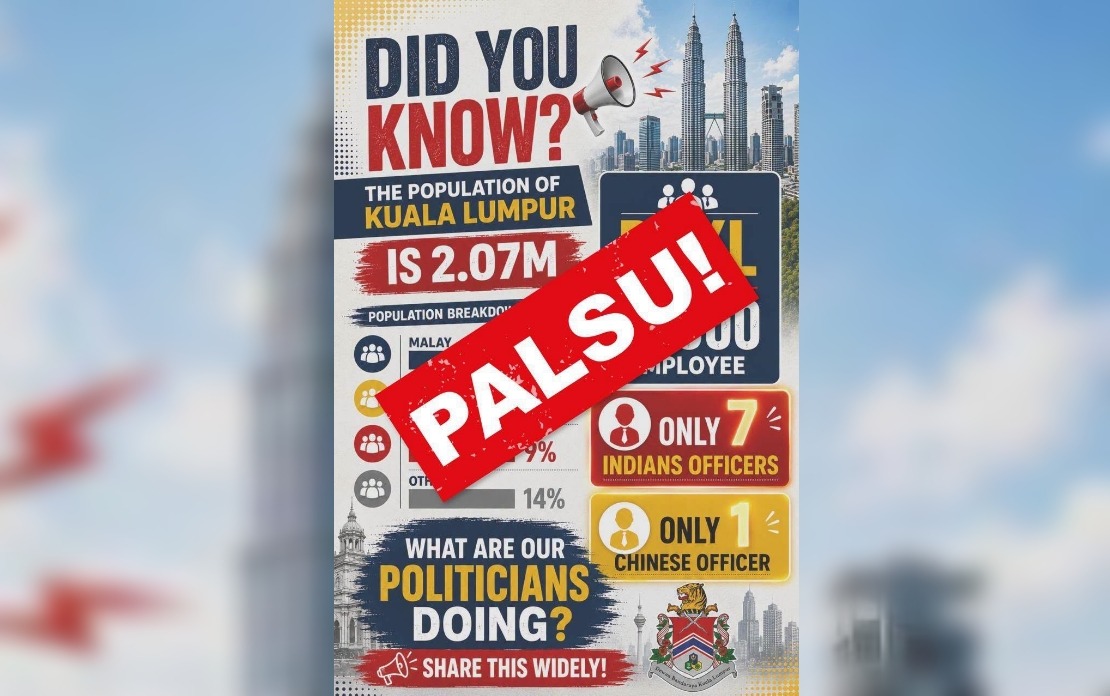
Federal Territories Minister Hannah Yeoh has moved to dispel misinformation regarding the ethnic composition of Kuala Lumpur City Hall's (DBKL) workforce, addressing a false narrative that has gained traction through social media messaging during the current election campaign. The minister directly contradicted a WhatsApp poster claiming dramatically skewed numbers of minority staff members at the local authority, describing the claims as inaccurate and emphasising the importance of preventing electoral manipulation through racial divisiveness.
The false poster in circulation alleged that DBKL employed only seven Indian staff members and a single Chinese staff member, a claim that bears no resemblance to the organisation's actual human resources profile. Such posts represent a common tactic during campaign periods, where exaggerated or entirely fabricated statistics about institutional practices are weaponised to inflame ethnic sensitivities and drive political wedges between communities. By releasing verified figures, Yeoh sought to ground the discussion in documented reality rather than allowing speculation and rumour to shape public perception.
According to official data as of July 1, 2026, DBKL's total workforce stands at 9,131 employees. Within this complement, the authority employs 490 Indian staff members and 22 Chinese staff members—figures substantially at odds with the viral claims. At the management and professional tier, specifically, DBKL counts 10 Indian officers and two Chinese officers among its senior ranks, further demonstrating that the organisation's recruitment extends across ethnic lines and hierarchical levels. These statistics reveal that while minority representation exists, there remains considerable scope for enhancement, a point the minister herself acknowledged publicly.
Yeoh's statement reflects a nuanced position: whilst refuting the false claims outright, she simultaneously recognised that improving workforce diversity at DBKL remains a legitimate governance objective. Rather than dismissing concerns about representation as baseless, the minister has directed the city hall to undertake a comprehensive audit of its recruitment infrastructure. This includes examining hiring practices, reviewing promotion pathways, and assessing the channels through which job opportunities are advertised—recognising that systemic barriers sometimes constrain the diversity of applicants regardless of intentional bias.
The initiative signals an institutional commitment to transparency and merit-based advancement. By instructing DBKL to scrutinise its own processes, Yeoh positioned the government as willing to identify and address genuine shortcomings rather than merely defending the status quo. This approach distinguishes between legitimate accountability and politically motivated attacks, offering a framework through which substantive improvement can proceed without surrendering to electoral pressure tactics.
The minister's warning against exploiting workforce composition as a tool for stoking racial discord carries particular weight during election cycles, when divisive narratives often flourish unchecked. Malaysia's multiethnic fabric remains sensitive to perceptions of discrimination, whether real or exaggerated, and false claims about institutional practices can entrench mistrust between communities. By explicitly cautioning against such exploitation whilst simultaneously committing to genuine reform, Yeoh attempted to establish ethical guardrails around the discussion of diversity and inclusion in public service.
This episode underscores the challenges facing Malaysian institutions in maintaining public credibility whilst operating in an environment saturated with unverified information. The rapid dissemination of false claims through platforms like WhatsApp—where content spreads through private networks with minimal fact-checking—poses particular difficulties for government communicators seeking to correct the record. Yeoh's Facebook post represents an effort to bypass intermediaries and speak directly to the public, though the reach and impact of such counter-messaging often pales in comparison to the viral spread of sensational false claims.
The DBKL workforce controversy also reflects broader patterns in Malaysian electoral politics, where questions of institutional representation and communal equity feature prominently in campaign messaging. For many voters, visible diversity within government bodies symbolises fairness and inclusion, making workforce composition a proxy through which larger anxieties about resource distribution and political representation are expressed. This symbolic dimension means that even accurate workforce data can fail to satisfy those convinced that systemic disadvantage persists, highlighting the limits of statistical rebuttal in addressing deep-seated concerns.
Looking forward, the audit process Yeoh has initiated carries implications beyond DBKL itself. If conducted rigorously and transparently, such reviews across multiple government agencies could establish benchmarks for inclusive recruitment and advancement in Malaysia's federal territories. Conversely, if the process is perceived as superficial or performative—undertaken merely to quiet campaign-season controversy—it may deepen public scepticism about governmental commitment to meaningful reform. The credibility of this initiative will ultimately rest on concrete outcomes and visible changes in workforce composition across ranks and departments.
For Malaysian readers and Southeast Asian observers, this situation illuminates the tension between defending against misinformation and addressing legitimate concerns about representation. While false claims must be countered decisively, doing so without acknowledging real gaps in diversity risks appearing defensive or dismissive. Yeoh's dual approach—refuting falsehoods whilst committing to improvement—attempts this balance, though whether the public perceives this as genuine reform or political theatre remains to be determined as the campaign progresses.

