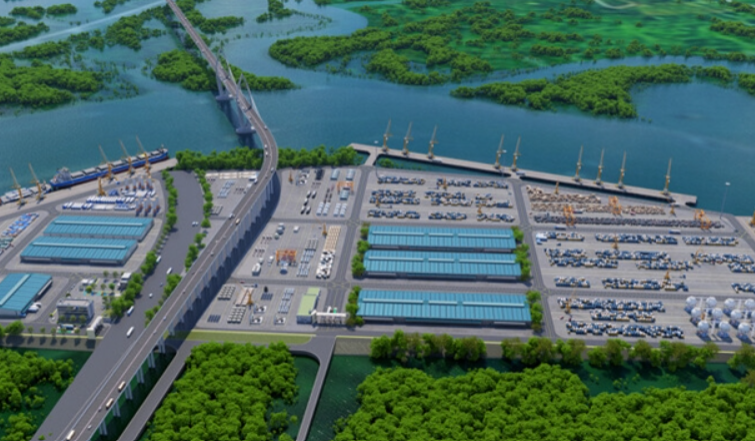
Ho Chi Minh City marked a significant milestone in its infrastructure development on Sunday, July 5, when officials formally commenced work on the QTM International Port, a nearly VNĐ6.9 trillion (US$261 million) facility intended to expand the southern Vietnamese metropolis's capacity to manage international cargo flows. The ceremonial groundbreaking represents a critical investment in maritime infrastructure as the city seeks to consolidate its position as the primary economic engine for Vietnam's southern region and strengthen connections along crucial global shipping corridors.
The port complex will be situated within Phu My Ward at the existing Cai Mep-Thi Vai deep-water port zone, a location chosen for its established capacity to accommodate large oceangoing vessels and its existing connections to major international trade networks. When fully operational, the facility is projected to process approximately 16 million tonnes of cargo annually across an 80-hectare footprint. The development framework spans approximately nine years, with construction divided into two sequential phases beginning in 2026 and concluding by 2034, allowing for phased implementation and staged capital deployment.
Beyond the port terminals themselves, the project encompasses a comprehensive logistics ecosystem designed to streamline cargo handling and distribution. The investment includes an integrated warehousing and logistics centre occupying nearly 200,000 square metres, reflecting recognition that modern port infrastructure must extend beyond waterside berths to incorporate storage, processing, and distribution functions. This integrated approach aligns with evolving global maritime practice, where successful ports function as nodes within broader supply chain networks rather than as standalone facilities.
The port's design specifications underscore ambitions for significant operational scale. The facility will feature eight berths initially capable of accommodating vessels up to 60,000 deadweight tonnes, with engineering plans to eventually receive ships of 100,000 DWT. This capacity progression enables the port to serve progressively larger container ships and bulk carriers, positioning Ho Chi Minh City to capture growth in transpacific and European-Asian trade flows that have increasingly relied on larger, more efficient vessels over the past decade.
Ho Chi Minh City's administrative restructuring has intensified the strategic rationale for expanded port infrastructure. The recent merger of three localities significantly expanded the municipality's territorial footprint and population, consequently enlarging the hinterland dependent on the city's maritime gateways for international commerce. Hoang Nguyen Dinh, vice chairman of the HCM City People's Committee, articulated this connection at the groundbreaking ceremony, noting that cargo movement demands had increased substantially following the territorial consolidation and necessitated modernisation of logistics networks capable of handling international volumes.
Empirical evidence supports these infrastructure development assessments. During the first six months of the calendar year, maritime and inland waterway cargo volumes passing through Ho Chi Minh City registered growth of 7.3 percent compared to the equivalent period in the prior year, demonstrating sustained expansion in transport demand. These figures suggest that capacity constraints may already be emerging within existing facilities and that planned expansions address genuine commercial requirements rather than speculative overcapacity.
Vietnamese national policymakers have simultaneously emphasised the macroeconomic significance of logistics efficiency. Deputy Prime Minister Pham Gia Tuc, speaking at the ceremony, highlighted that logistics expenditure currently consumes between 14 and 16 percent of Vietnam's overall gross domestic product, a proportion substantially exceeding international benchmarks and representing a competitive disadvantage for Vietnamese exporters. Modern port infrastructure reduces per-unit shipping costs, transportation times, and supply chain uncertainty, thereby improving the cost competitiveness of Vietnamese manufactured goods and agricultural products in global markets.
The acceleration timeline mandated by national leadership reflects these competitive pressures. Pham Gia Tuc explicitly requested that project developers expedite construction and bring the initial phase into operation within eleven months, coupling this deadline to Ho Chi Minh City's broader economic growth targets. This aggressive schedule positions port infrastructure improvements as instrumental to achieving the municipality's objective of double-digit economic growth rates, suggesting that policymakers view logistics capacity as a genuine constraint on regional development trajectories.
Ho Chi Minh City's geographic advantages position it centrally within Southeast Asia's maritime geography. The municipality commands approximately 110 kilometres of coastline and operates one of Vietnam's most substantial maritime transport complexes. The Cai Mep-Thi Vai deep-water port complex maintains status as one of the world's significant container hub operations, with established direct shipping services to transpacific and European trade routes that position it to capture containerized cargo flows between Asian manufacturing centres and Western consumer markets.
The QTM International Port development arrives at a consequential juncture in regional infrastructure competition. Southeast Asian nations have witnessed intensifying competition among maritime hubs, with facilities in Singapore, Port Klang in Malaysia, and Bangkok vying for regional cargo flows. The expansion of Ho Chi Minh City's port capacity represents Vietnam's substantive response to this competitive environment, signalling commitment to maintaining the Mekong Delta region's role as a major nexus in Pan-Asian supply chains. For Malaysian and regional observers, the project demonstrates how Vietnam's southern corridor is systematically consolidating infrastructure advantages that support integration within East and Southeast Asian manufacturing and trade networks.
The financing structure and construction timeline suggest confidence among Vietnamese authorities regarding sustained demand for containerized and bulk cargo services. The nearly quarter-billion dollar investment reflects belief that transport volumes will justify capacity expansion over the 2026-2034 construction window and beyond. This confidence extends to expectations that global supply chains will continue routing significant volumes through Southeast Asian ports rather than shifting substantially toward alternative corridors, notwithstanding ongoing geopolitical complexities and evolving international trade relationships.
Beyond the immediate port operations, the QTM International Port initiative symbolises broader Vietnamese government commitment to leveraging geographic position and maritime assets to accelerate economic development. Infrastructure investments of this scale typically reflect strategic priorities at the highest policy levels, suggesting that maritime logistics enhancement will remain central to Vietnam's regional economic strategy. For neighbouring Southeast Asian economies competing to attract manufacturing investment and international trade flows, Ho Chi Minh City's infrastructure expansion represents a tangible expression of competitive pressure within the region's ports sector.

