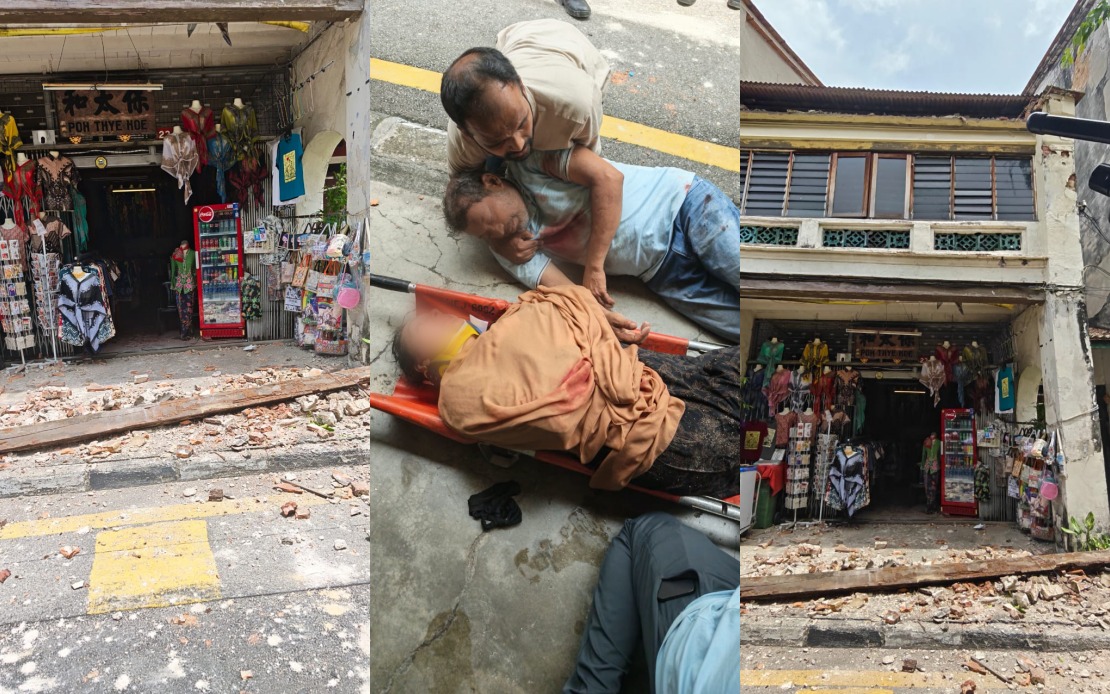
An incident on Armenian Street in George Town has cast a spotlight on the vulnerability of heritage structures in Penang's UNESCO-listed historic district. Two Sri Lankan nationals, identified as Mohamad Ammtar and Fatimah, sustained injuries when debris—comprising stones and a timber beam from the first floor—fell upon them on August 4. The emergency response was swift, with firefighters from the Lebuh Pantai station arriving within minutes of the 1.11 pm distress call. Both victims received immediate medical attention at the scene before transport to Penang Hospital for ongoing care.
The affected building, situated along one of George Town's most visited tourist corridors, operates a grocery shop on its ground floor with the upper storey appearing vacant at the time of the incident. The timing added particular misfortune for the injured pair, who had been scheduled to return to Sri Lanka the following day. Their status as international visitors has amplified attention to what might otherwise have been treated as a localized structural failure, raising questions about whether the tourism infrastructure in heritage zones receives adequate maintenance oversight.
Penang Fire and Rescue Department assistant director of operations John Sagun Francis provided the initial technical assessment, describing how the deteriorated beam gave way without apparent warning. The specificity of his account—identifying the exact composition of the fallen debris—underscores the kind of granular information that building inspectors will now be scrutinizing across the state. The incident occurred in broad daylight when Armenian Street was likely crowded with visitors and shoppers, meaning the potential for multiple casualties existed had circumstances aligned differently.
State Tourism and Creative Economy Committee chairman Wong Hon Wai responded to the incident by visiting the scene personally and immediately convening advisory measures. He directed George Town World Heritage Incorporated (GTWHI) and the Majlis Bandaraya Pulau Pinang (MBPP) to circulate safety inspection guidelines to all heritage building proprietors throughout the state. His public statements emphasized that this single incident represented a systemic vulnerability rather than an isolated accident, acknowledging that dozens of comparable structures scattered throughout the heritage zone might harbour similar structural deficiencies.
Wong's characterization of the incident as serious reflected multilayered concerns beyond the immediate injuries sustained. He stressed that safety inspections must extend comprehensively across all heritage and older buildings, not merely those showing obvious signs of distress. This preventive approach recognizes that structural deterioration often proceeds invisibly until catastrophic failure occurs. The chairman's acknowledgement that such buildings pose risks to both residents and the substantial daily flow of heritage tourists represents an explicit acceptance of responsibility from the state administration.
The structural integrity of George Town's heritage buildings has long presented a management challenge for authorities. These properties, many dating from the colonial and early post-colonial periods, require specialized knowledge to assess properly. Standard inspection protocols may prove inadequate for timber-frame and masonry construction techniques that differ markedly from contemporary building practices. The state government's decision to mobilize both GTWHI—an organization specifically created to steward the heritage zone—and the municipal authority suggests recognition that expertise from multiple agencies will be necessary to conduct credible assessments.
Coordination with the Sri Lankan High Commission in Kuala Lumpur signals another dimension of this incident's implications. Tourist injuries in heritage zones carry diplomatic weight, particularly when the injured parties originate from neighbouring countries with whom Malaysia maintains active tourism and cultural partnerships. The state's commitment to extend immediate assistance to the affected visitors and to liaise with Sri Lankan authorities demonstrates awareness that international relationships hinge partly on how visiting nationals are treated during emergencies and subsequent recovery periods.
The incident illuminates a persistent tension in heritage preservation efforts across Southeast Asia. Conserving historical architecture demands heavy financial investment and technical expertise, yet many property owners lack resources or knowledge to maintain aging structures to contemporary safety standards. In George Town, where many heritage buildings serve commercial functions on ground floors while upper storeys remain underutilized or vacant, the economic incentive to invest in comprehensive structural repairs often appears weak. Owners may defer expensive remedial work until catastrophe forces intervention, creating the precise scenario that unfolded on Armenian Street.
Wong's pending investigation into the underlying causes will likely reveal whether the collapse resulted from deferred maintenance, water ingress, pest damage, or accelerated deterioration from environmental factors particular to Penang's tropical climate. Timber beams in high-humidity environments face particular vulnerability to fungal decay and insect damage, processes that may advance rapidly but remain concealed within wall cavities until structural failure becomes imminent. Any comprehensive inspection regime must account for these invisible degradation pathways rather than relying solely on visual assessment.
The international dimension of this incident extends beyond diplomatic courtesy. George Town's status as a World Heritage Site depends partly on demonstrating that heritage conservation proceeds responsibly and that public safety receives priority attention. Major incidents involving tourists can influence travel advisories and insurance ratings, potentially affecting the broader heritage tourism economy that sustains many George Town businesses. This economic interdependence means that Wong's response—treating the incident with appropriate gravity and committing to systematic remediation—serves not only immediate safety objectives but also the long-term viability of heritage-based tourism in Penang.
Moving forward, the challenge for state authorities involves translating Wong's stated commitment to comprehensive building inspections into sustained operational reality. This requires securing sufficient funding, assembling teams with appropriate technical qualifications, establishing clear standards for acceptable structural conditions, and developing protocols for compelling owners to execute necessary repairs. For a heritage zone encompassing hundreds of buildings, this represents substantial undertaking. The incident on Armenian Street has created political momentum for action, but sustaining that momentum through the lengthy process of systematic inspection and remediation will test the state government's resolve and capacity.

