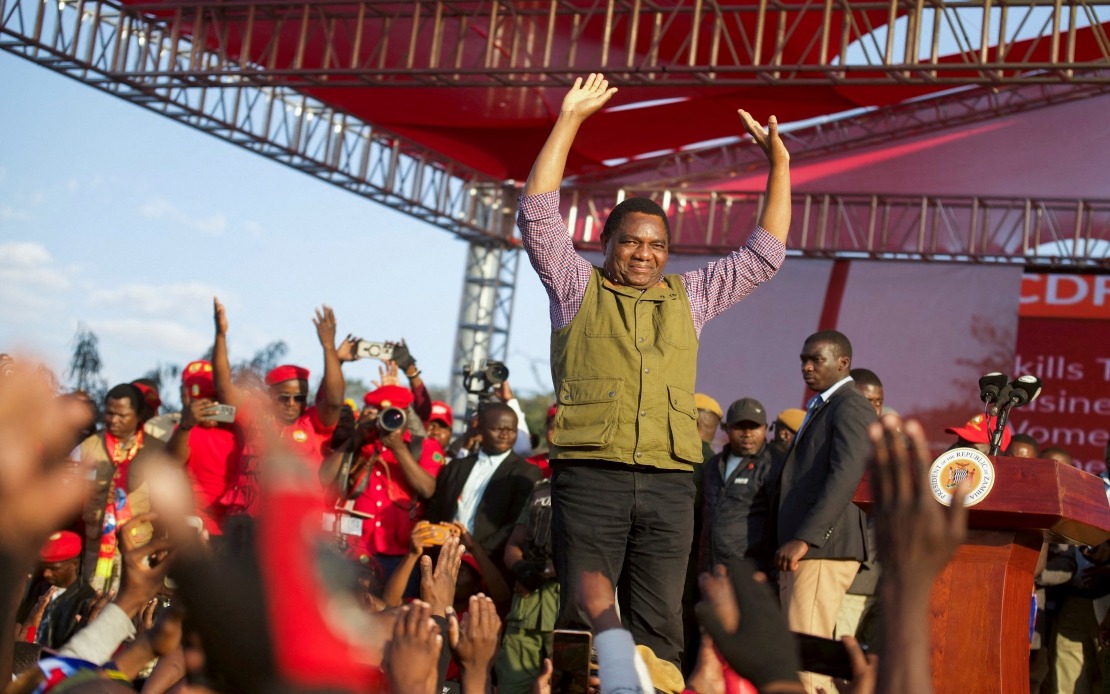
Zambian President Hakainde Hichilema appeared headed for a decisive re-election victory on Sunday as results rolled in from the country's presidential race, with the 64-year-old economist and rancher commanding a substantial advantage over his nearest competitor. With ballots counted from 135 of 226 constituencies, Hichilema had accumulated 1,544,140 votes, according to tallies released by the Electoral Commission of Zambia at its results centre in Lusaka. His strongest challenger, Brian Mundubile of the opposition National Reconciliation Party for Unity and Prosperity, trailed significantly with 1,030,662 votes—a gap of over 500,000 votes that would prove difficult to overcome even with remaining constituencies to be processed.
The race featured a crowded field of 13 candidates competing for the presidency, though only Hichilema and Mundubile appeared genuinely competitive based on early returns. Electoral Commission Chairperson Mwangala Zaloumis announced the consolidated results at approximately 2130 GMT, providing the first substantial snapshot of voter preferences across multiple regions. While nearly 40 per cent of constituencies had yet to report, Hichilema's commanding position suggested the outcome was largely determined, barring extraordinary swings in the outstanding results.
Hichilema's apparent return to office would represent a significant endorsement of his first term, which began in 2021 after he defeated then-president Edgar Lungu with a landslide margin exceeding one million votes. The incumbent has campaigned heavily on his record of economic restructuring, particularly his efforts to address Zambia's substantial debt burden that had accumulated under his predecessor. These financial challenges had constrained the government's ability to deliver public services and invest in development, making debt resolution a central policy priority for his administration.
Beyond debt restructuring, Hichilema has highlighted improvements in Zambia's mining sector as a cornerstone achievement, seeking to revitalise an industry critical to the country's economy and export revenues. His administration introduced free education policies across public primary and secondary schools, representing a substantial expansion of social support that directly affects millions of Zambian families. These flagship programmes have featured prominently in his campaign messaging, appealing particularly to working-class and lower-income voters concerned with access to education and economic opportunity.
Mundubile, a 55-year-old lawyer, has positioned himself as an alternative voice, and his National Reconciliation Party for Unity and Prosperity has secured parliamentary representation in several constituencies, particularly across Zambia's urbanised corridor linking Lusaka and the Copperbelt region. This mining heartland has historically been contested political terrain, and the opposition's success in capturing some seats suggests Hichilema's UPND has not achieved monolithic dominance even in areas of traditional support. The parliamentary dimension of the election adds layers of complexity to governance that will extend beyond the presidential contest.
Under Zambian constitutional rules, a presidential victor must secure more than 50 per cent of all valid votes cast to claim the presidency outright. The threshold is deliberately high to ensure broad-based support and prevent a fractured electorate from producing a president lacking majority legitimacy. If no candidate reaches this benchmark following the initial counting of votes, a second round ballot would pit the top two contenders against one another, potentially consolidating support among voters who initially backed other candidates.
Hichilema's apparent trajectory toward victory holds implications across southern Africa and the region more broadly. Zambia, as a major copper producer and established democratic actor, serves as a stabilising influence in a region experiencing political turbulence in several neighbouring states. A successful re-election would provide continuity in an administration committed to orthodox economic management and debt resolution—policies that international creditors and multilateral institutions have encouraged, though they sometimes generate domestic tension around public spending levels.
The incumbent president's background as an economist and commercial farmer distinguishes him from many political leaders in the region, bringing a particular perspective shaped by private sector experience and understanding of agricultural and resource-based industries. This technocratic orientation has influenced policy choices regarding mining sector engagement and fiscal discipline, though critics argue it has sometimes privileged financial orthodoxy over immediate poverty alleviation. The election results suggest voters have, on balance, endorsed this approach or at least preferred it to available alternatives.
For Malaysian observers, the Zambian election illustrates how commodity-dependent economies navigate political transitions and how debt crises can reshape electoral calculations. Like several Southeast Asian nations, Zambia confronts challenges of balancing growth with fiscal sustainability, and its experience with debt restructuring offers lessons—both positive and cautionary—for policymakers managing similar pressures. The conduct of elections in frontier democracies remains significant to Malaysia's broader engagement with African nations and comparative governance challenges.
With most constituencies having reported, attention would likely shift from whether Hichilema would win toward questions of margin and mandate strength, the opposition's parliamentary performance, and how quickly the Electoral Commission would complete official certification. The consolidation of power in an incoming second term would set the tone for Zambia's political economy over the next five years, with implications for foreign investment, regional stability, and the trajectory of democratisation in southern Africa.

