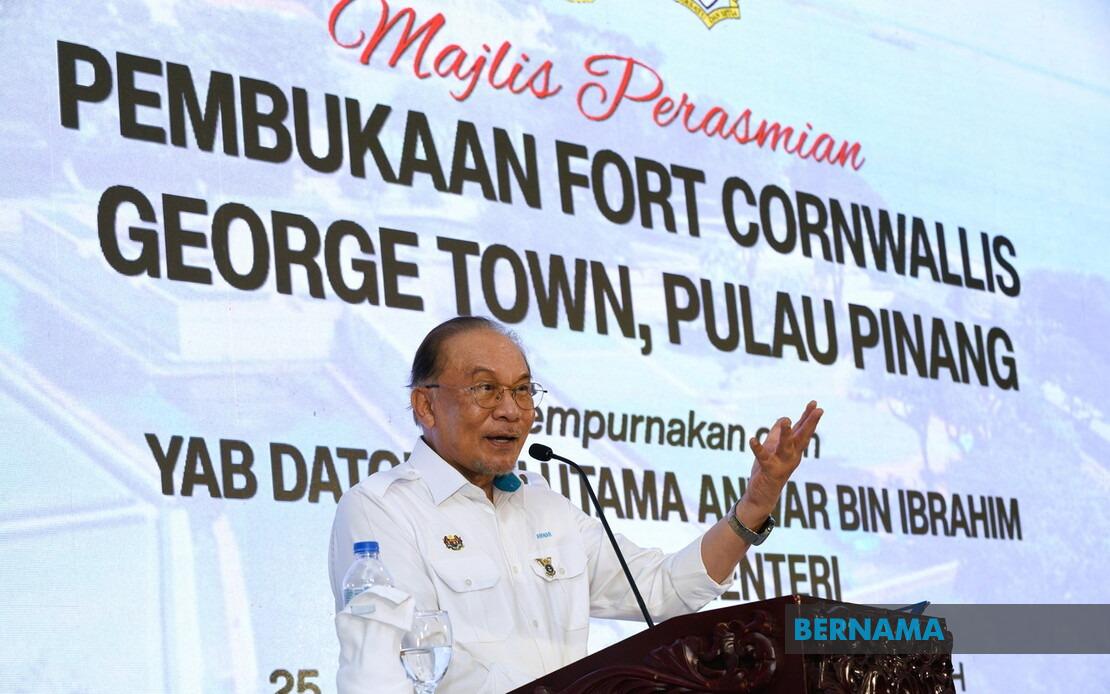
Prime Minister Datuk Seri Anwar Ibrahim has called for a fundamental shift in how Malaysia approaches its historical sites, advocating that these locations should function as meaningful educational spaces rather than serving primarily as commercial tourist attractions. Speaking at the opening ceremony of Fort Cornwallis in George Town on July 25, the Prime Minister outlined a vision where visits to heritage sites become opportunities for deeper learning about the nation's past, particularly the sacrifices made during the struggle for independence and the experiences of Malaysians under colonial rule.
Anwar stressed that the preservation and presentation of historical sites must go beyond displaying their architectural or aesthetic qualities. Instead, these spaces should be deliberately designed to foster understanding among younger generations about fundamental national values. The Prime Minister emphasized that exposure to history should encompass lessons on the profound importance of unity, the true cost of achieving independence, and the collective hardship endured by ordinary Malaysians during periods of foreign occupation. This approach seeks to transform passive sightseeing into active civic education.
The Prime Minister's intervention reflects broader concerns within Malaysian leadership about potential disconnects between younger citizens and the historical foundations of the nation. By recommending that educational components accompany all youth visits to heritage sites, Anwar is proposing a structured methodology for embedding historical consciousness into formal and informal learning experiences. This strategy recognizes that physical spaces themselves carry pedagogical value when properly contextualized and explained to visitors.
Crucially, Anwar articulated a perspective on historical interpretation that prioritizes Malaysian agency and experience over colonial narratives. He argued that the nation's history should be recounted through the lens of ordinary people's lived experiences, their struggles, and their sacrifices, rather than through frameworks established by former colonizing powers. This reflects an ongoing effort across Southeast Asia to decolonize historical narratives and center indigenous perspectives in understanding the past.
Regarding Fort Cornwallis specifically, the Prime Minister clarified that conservation efforts are not intended to romanticize or glorify the colonial period itself. Rather, the preservation serves a dual purpose: it allows the community to confront difficult historical truths and extract meaningful lessons from them. This distinction is important for understanding how heritage conservation can occur without implying approval of the colonial enterprise. The site becomes a teaching tool for understanding how external domination operated and how it was ultimately overcome.
Anwar elaborated on a central historical lesson that colonialism imparted to Malaysians: the vulnerability of nations lacking internal unity and strength. He argued that the colonial experience demonstrated how external powers could impose their will on a divided or weakened society, pursuing their own strategic interests regardless of local consequences. This interpretation positions historical education not merely as remembrance but as practical preparation for contemporary challenges.
The Prime Minister assigned significant responsibility to the current generation, framing it as an obligation to safeguard national peace and strengthen racial unity as a direct response to historical lessons. By emphasizing appreciation for the sacrifices of preceding generations, Anwar connected historical education to present-day nation-building efforts. This approach seeks to make history relevant to contemporary governance and social cohesion rather than relegating it to academic interest.
For Malaysia's education system, this intervention signals potential shifts in how heritage sites might be integrated into curricula and school programs. The emphasis on educational programming at historical locations could lead to expanded partnerships between the tourism and education sectors, creating frameworks where student visits yield structured learning outcomes aligned with civics and history curricula.
From a regional perspective, Malaysia's approach to historical interpretation reflects broader Southeast Asian efforts to assert independent historical narratives following decolonization. Other nations in the region similarly grapple with how to present colonial heritage sites in ways that neither glorify foreign rule nor deny its historical reality. Malaysia's framework—using such sites as platforms for understanding resistance, sacrifice, and national resilience—offers a model for this balance.
The initiative also carries implications for cultural tourism development in Malaysia. By emphasizing educational value alongside visitor experience, heritage sites can attract international tourists seeking deeper engagement with history while simultaneously serving domestic educational objectives. This positions Malaysia's historical sites as sophisticated cultural institutions rather than simple entertainment venues, potentially elevating their significance within global heritage tourism frameworks.
Implementing this vision will require coordination between heritage authorities, educational institutions, and tourism operators. Training guides, developing interpretive materials, and structuring educational programs demand resources and expertise. The success of Anwar's proposal depends on whether these practical mechanisms receive adequate support and funding.

