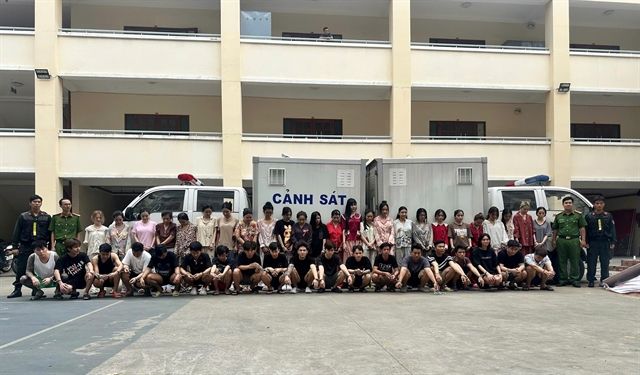
Vietnamese authorities in Ho Chi Minh City have dismantled a significant drug trafficking network built on deceptively packaged electronic cigarettes, netting 49 arrests including nationals from South Korea, China and Cambodia. The investigation revealed a coordinated operation distributing etomidate, a potent sedative normally reserved for surgical use, concealed within vape pods marketed under innocuous wellness-focused branding. Police confiscated 1,670 pods alongside substantial quantities of ketamine and methamphetamine, signalling the scope of this clandestine enterprise.
Etomidate represents a relatively novel challenge for Southeast Asian law enforcement. The substance, a short-acting anaesthetic approved only for hospital use under specialist supervision, was added to Vietnam's controlled substances list in January—a regulatory response suggesting authorities had begun tracking its misuse. The substance's inclusion in sweetened e-cigarette solutions represents a sophisticated obfuscation strategy, transforming dangerous pharmaceuticals into products that appear to offer benign benefits to consumers unfamiliar with their true composition.
The marketing approach proved deceptively effective. Street-level distributors promoted the vape pods under appealing monikers—"chill pod," "relaxation pod," "sleep-well pod," and "fly pod"—language designed to attract young people seeking stress relief or recreational experiences. This rebranding strategy exploited the cultural cachet of vaping while disguising the genuinely hazardous nature of the products. Police intelligence suggests these items circulated through venues frequented by youth demographics, including bars, karaoke establishments, and rental apartments.
The investigation originated from intelligence operations targeting a street-level dealer operating on An Duong Vuong Street in An Lac Ward. Police identified the individual as Nguyen Huu Huan, 28, from Dong Thap province, who operated under the street nickname "Ba Giá." His June 25 arrest for selling etomidate-laced vapes to a local customer became the entry point for a broader enforcement action that eventually exposed multiple supply chains extending across borders and international networks.
Investigative work uncovered a layered distribution architecture. The primary network involved Huynh Ngoc Thuy Nhu, 26, and her assistant Hua Tuong Vy, 20, both Ho Chi Minh City residents, operating what amounted to a mid-level wholesale operation. More significantly, authorities identified Le Quoc Duy, 40, from An Giang province, who functioned as an international smuggler. Duy orchestrated transnational operations, acquiring vape pods from Cambodia and transporting them through porous border crossing points in his home province before consolidating shipments for delivery to Ho Chi Minh City distribution points. Police recovered 37 pods from Duy's location alongside 200 grams each of ketamine and methamphetamine.
A parallel supply chain operated by Han Kiat, a Cambodian national, and three additional foreign accomplices specifically targeted the expatriate community residing in Ho Chi Minh City. This separate network structure suggests organised criminals had segmented their market operations, with domestic and foreign distribution channels maintaining distinct supply chains and customer bases. Such compartmentalisation reflects evolving sophistication in transnational drug trafficking, where operators minimise cross-contamination and reduce exposure during enforcement actions.
The pharmacological reality underlying etomidate's threat profile distinguishes it from conventional recreational drugs circulating across Southeast Asia. Upon inhalation, etomidate bypasses normal metabolic processes, crossing directly through lung tissue into systemic circulation and reaching the brain within seconds. Initial effects—light-headedness and mild hallucinations—may seem manageable to inexperienced users, but acute consequences escalate rapidly to encompass severe neurotoxicity, profound drowsiness, involuntary muscle contractions, and complete loss of consciousness. Critically, combining etomidate with alcohol or other sedatives risks sudden respiratory failure and death, a particularly acute danger in party environments where polydrug use remains common.
The detection challenge compounds enforcement difficulties. Standard rapid-screening kits available commercially target conventional drugs—heroin, cannabis, methamphetamine—and cannot identify etomidate due to its distinct chemical architecture. Only specialised forensic analysis systems operated by law enforcement and governmental laboratories possess the capability for accurate identification. This technical asymmetry means criminals can credibly market etomidate-containing products as "undetectable" or "100 percent negative," exploiting consumers' justified distrust of ordinary testing methodologies and their desire for products offering plausible deniability.
For Malaysian readers, this development carries direct relevance. Ho Chi Minh City and other regional hubs function as distribution arteries for Southeast Asian drug networks, with contraband frequently reaching Malaysia through established trafficking routes. The emergence of pharmaceutical-grade substances repackaged as lifestyle products signals an evolution in trafficking methodologies that transcends individual national jurisdictions. Vietnamese authorities' discovery of foreign nationals operating supply chains suggests these networks maintain sophisticated international reach, potentially extending into Malaysian markets alongside conventional narcotics.
The sophistication demonstrated by this operation reflects broader trends in Southeast Asian organised crime. Traffickers increasingly adapt to regulatory constraints by introducing substances falling outside traditional enforcement frameworks, exploiting the lag between emerging threats and legislative response. Etomidate's January listing in Vietnam suggests authorities had already begun monitoring its diversion, yet criminal entrepreneurs had already established distribution infrastructure. This pattern—where regulatory action arrives after criminal networks achieve operational momentum—shapes enforcement priorities across the region.
Public health implications extend beyond individual consumption patterns. The strategic targeting of young people through venues and social environments suggests deliberate market segmentation, with traffickers identifying and cultivating youth demographics as primary revenue sources. Police warnings about the trendy appearance of vape products acknowledge that their design and marketing leverage aspirational consumer psychology, particularly among adolescents and young adults susceptible to perceived social currency attached to innovative consumption methods.
Ho Chi Minh City police have called upon citizens to exercise heightened vigilance regarding e-cigarettes of uncertain provenance, explicitly warning against the purchase, possession, sale, or transportation of unverified products. This messaging reflects an acknowledgment that enforcement alone cannot address demand-side factors, requiring public cooperation and informed consumer choice. For Malaysia's regulatory agencies and law enforcement bodies, this Vietnamese operation provides operationally valuable intelligence regarding transnational trafficking patterns and emerging drug formulations requiring preventative monitoring and potential legislative response.

