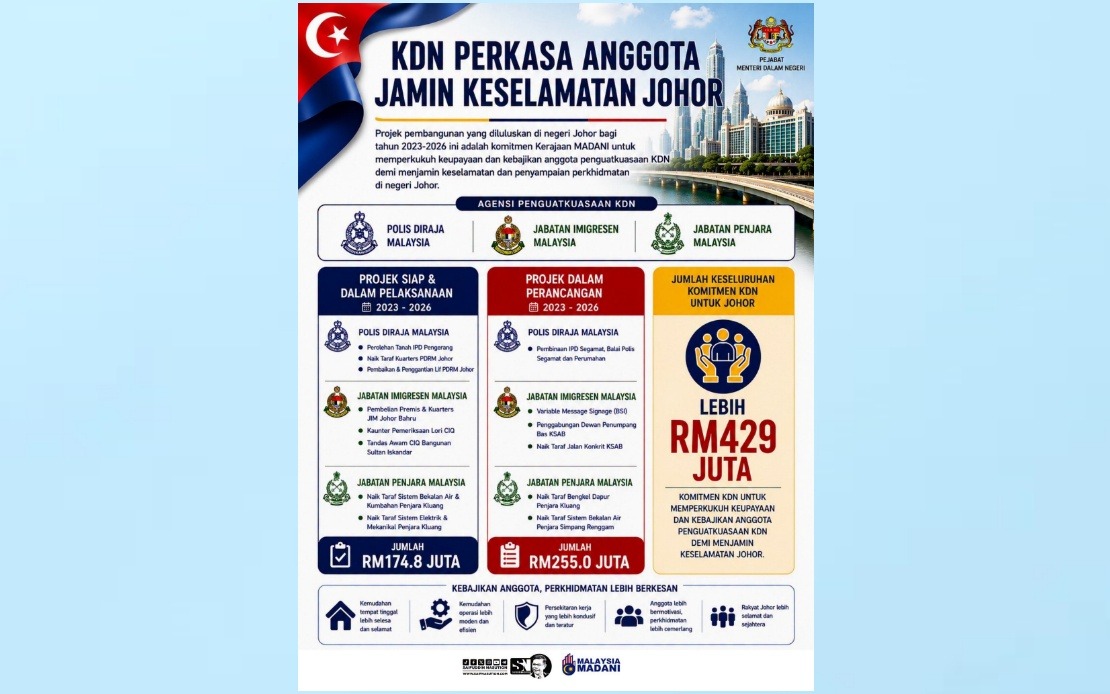
The Home Ministry has committed more than RM429 million in funding since 2023 to bolster both personnel welfare and the operational capacity of enforcement agencies operating throughout Johor. Minister Datuk Seri Saifuddin Nasution Ismail outlined this substantial investment programme, which targets three critical government agencies: the Royal Malaysia Police, the Malaysian Immigration Department, and the Malaysian Prisons Department. The financial commitment underscores a broader strategic approach to strengthening the state's security infrastructure while prioritising the well-being of those working on the front lines of law enforcement.
Saifuddin Nasution framed investment in personnel welfare as far more than a benevolent gesture, positioning it instead as a calculated strategy to enhance operational efficiency and effectiveness across all three agencies. The underlying logic is straightforward yet compelling: when enforcement officers work in improved conditions with adequate facilities and modern tools, their capacity to fulfil their duties safely and comprehensively expands proportionally. This creates a direct correlation between staff welfare and public security outcomes, a principle that government policymakers increasingly recognise as essential for sustainable law enforcement performance.
The practical benefits of this approach extend beyond the barracks and offices. When police officers, immigration officials, and prison staff operate from properly equipped facilities with dignified working conditions, the Malaysian public experiences tangible improvements in service delivery. Border security becomes more robust, crime investigation gains momentum, and correctional facilities operate more effectively. Saifuddin Nasution articulated this point clearly, noting that a more secure and safer Johor emerges not merely from funding enforcement agencies, but from ensuring those agencies are staffed by personnel who feel valued, supported, and equipped to perform their roles.
Breaking down the RM429 million allocation reveals a structured approach to implementation. Of this total, RM174.8 million has been committed to projects already completed or currently under active development. The remaining RM255 million comprises initiatives still in the planning stages, allowing the ministry to build a comprehensive pipeline of improvements spanning several years. This bifurcated approach enables immediate gains while ensuring sustained investment momentum across the medium and long term.
Projects currently advancing include the acquisition of land for the Pengerang District Police Headquarters, a critical infrastructure project designed to strengthen police presence in that district. Simultaneously, the Immigration Department is acquiring office premises and residential quarters in Johor Bahru, addressing space constraints that have long hampered operational efficiency. Kluang Prison is undergoing upgrades to its basic facilities, improvements that directly impact the dignity and safety of both inmates and prison staff. These initiatives represent the tangible face of the ministry's investment strategy, delivering concrete enhancements to facilities and infrastructure across the state.
The pipeline of planned projects reveals an equally ambitious vision for Johor's enforcement landscape over the coming years. The construction of the Segamat District Police Headquarters will introduce a purpose-built facility incorporating both a police station and residential quarters, a comprehensive approach that has become increasingly recognised as essential for rural and semi-rural policing. The consolidation of bus passenger terminals at the Sultan Abu Bakar Complex speaks to ancillary improvements that support overall public order management. Further enhancements to Kluang Prison's kitchen workshop and upgrades to the water supply system at Simpang Renggam Prison address fundamental infrastructure deficiencies that affect daily operations and staff morale.
Saifuddin Nasution positioned this Johor-focused allocation within the broader framework of the MADANI Government's development philosophy, emphasising that the distribution of resources reflects tailored responses to each state's specific needs and priorities. Rather than applying a one-size-fits-all funding formula, the government has endeavoured to assess Johor's particular requirements and allocate resources accordingly. This differentiated approach implicitly acknowledges that enforcement challenges vary across Malaysia's states, requiring customised solutions grounded in local understanding and analysis.
The minister referenced recent clarifications provided by Prime Minister Datuk Seri Anwar Ibrahim in the Dewan Rakyat regarding Johor's overall development allocation, which has expanded to approximately RM14.6 billion from the previous RM10.2 billion. This significant increase represents roughly a 43 percent boost in funding, a substantial shift that positions Johor prominently within national development priorities. Within this larger context, the RM429 million earmarked for enforcement agencies and personnel welfare represents a meaningful component of the state's enlarged development envelope.
For Malaysian readers, particularly those in Johor, this investment programme carries several implications. The construction of new police headquarters in Segamat and Pengerang, combined with improved facilities in existing stations and prisons, should translate into more responsive law enforcement and correctional services. Enhanced border security through better immigration facilities holds particular significance for a state that serves as a major entry point for foreign visitors and workers. The emphasis on personnel welfare also signals governmental recognition that enforcement work demands toll on those who undertake it, and that supporting staff well-being represents an investment in effective public services.
Regionally, Malaysia's approach to enforcement agency investment may offer insights for other Southeast Asian nations grappling with similar challenges around resource allocation, staff retention, and security infrastructure development. The strategic emphasis on linking personnel welfare to operational outcomes represents a philosophy increasingly adopted across the region, as governments recognise that sustainable security gains require investing in the people who deliver them.
The RM429 million commitment also reflects evolving attitudes toward public sector employment within Malaysia's government service framework. By prioritising quarters, modern facilities, and workplace improvements, the Home Ministry signals that enforcement careers offer not merely employment but professional environments worthy of public service commitment. This matters for recruitment and retention, particularly as Malaysia competes globally for talent and seeks to ensure that its most capable citizens remain engaged in public security work.
Looking forward, the ministry indicated its determination to ensure optimal utilisation of allocated funds while maintaining focus on personnel welfare and public security. The statement that every fund would be deployed efficiently and that the ministry would continue supporting both enforcement staff and Johor's residents suggests sustained attention to implementation quality and outcomes measurement. In a Malaysian context where infrastructure projects sometimes encounter delays or cost overruns, such affirmations carry importance for stakeholders monitoring progress.

